REVIEW · 2023-08-09
BOKURA
Two players, two views of one road
First Impressions
The label Steam shows for this game depends on which language you read it in. As of 2026-09-21, the all-language, all-purchase-type count is 12,896 reviews, 11,804 of them positive — 91%, labelled Very Positive.
Narrow it to English and it is 5,640 of 5,933, or 95%: Overwhelmingly Positive. The Japanese pool is 432 of 491, 88%, Very Positive. The Simplified Chinese pool is 1,633 of 2,098 — 78%, and the label drops to Mostly Positive.
Same game, same build, same puzzles. Yet English and Simplified Chinese sit seventeen points apart, three label steps away from each other. Where that gap comes from is what I went looking for.
The short version first. What all three pools are angry about is not the design. It is how the game was sold. What they disagree on is the condition the game imposes: it cannot be played alone.
 Key art for BOKURA — Steam store key art
Putting the Mechanics into Words
The game takes exactly two players. Alone, it starts and goes nowhere. The two stand on the same path, but what fills their screens differs: one sees a forest, the other a machine city.
Across the helpful positive reviews the recurring line is that you are not looking at the same place, and that you have no choice but to trust the other screen. Communication, trust and perspective are the words that keep coming up. One reviewer turns it into a joke: one player gets the pretty forest, the other gets the ugly half.
In Puzzlebyrinth terms this is a split of the verbs. Run, jump, carry — the verbs themselves are ordinary, well inside the puzzle platformer norm. What is new is the board. The designer deliberately halves the observation resolution any one player can hold.
So the solution is a conversation, not a procedure. It is the idea behind Keep Talking and Nobody Explodes: the manual goes to one person, the bomb to the other. But where We Were Here Forever locks its two players in separate rooms, this one keeps them side by side on one road and separates what they see.
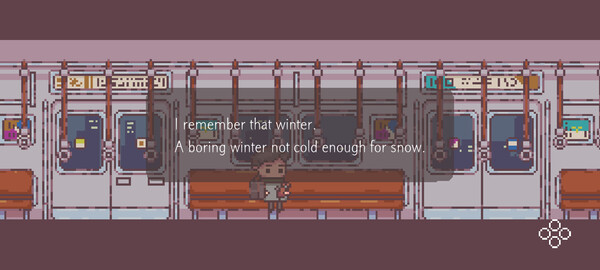 BOKURA in play — image 1 as listed on the Steam store page (Steam store screenshot)
The Feel of the Story
Positive and negative reviews both drift onto the story. The premise is two boys who have run away from home; the further you go, the grimmer the material gets.
The positive version of this runs: we laughed, we cried, we sat in silence afterwards. Japanese reviews in particular keep returning to friendship. There is more than one ending, and the game is built on the assumption that you swap roles and go round again.
The negative side is just as consistent. The dialogue is long, it cannot be skipped, the plot lurches, and — this one recurs — a game marketed as cute ships no content warning. Grotesque is the word the English pool reaches for. The Chinese pool goes further and says the Japanese storytelling register simply does not land.
Both are describing the same object. The author made the story heavy in order to test the relationship between the two players. Whether that weight reads as earned or imposed depends on who is sitting next to you. That is not a question of quality; it is the reach of the design.
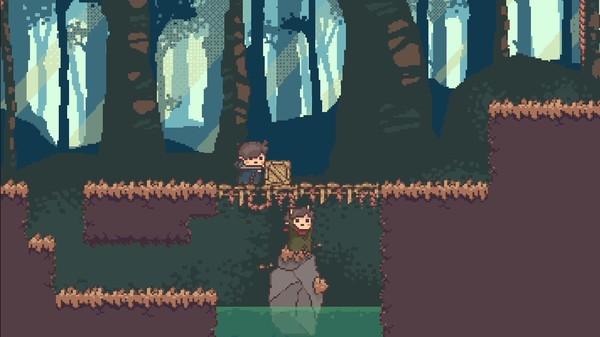 BOKURA in play — image 2 as listed on the Steam store page (Steam store screenshot)
The Texture of Difficulty
On the difficulty of the puzzles themselves, the reviews barely disagree. The contraptions are legible. Where people get stuck is not the procedure but the handover.
What recurs is getting directions wrong. Your right is not the right of the person facing you. One positive review gives the game full marks on the grounds that their partner had no sense of direction at all. It is framed as a joke, but it locates the difficulty exactly.
The Chinese pool's negatives add something the English pool mostly does not: the workload is not even. While one player thinks, the other can become a tool, moving where told. Complaints about strict jump and carry hitboxes stack up in the same place.
That imbalance is the far side of splitting the information. Halve what each player can see and you invite a thinker and a mover. It is close to an unavoidable side effect, and which role you draw changes the game you played. Difficulty here wears a different face per person.
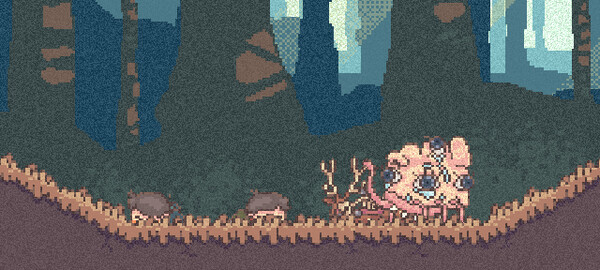 BOKURA in play — image 3 as listed on the Steam store page (Steam store screenshot)
Reviews Consulted
This piece was written from the Steam review pool as it stood on 2026-09-21. No review text is quoted directly; recurring claims are reconstructed.
・Steam: BOKURA (11,804 of 12,896 reviews positive across all languages and purchase types = 91%, labelled Very Positive. English pool: 5,640 of 5,933 = 95%, Overwhelmingly Positive. Japanese pool: 432 of 491 = 88%, Very Positive. Simplified Chinese pool: 1,633 of 2,098 = 78%, Mostly Positive.)
・Read via WebFetch: the top 10 helpful positive and top 10 helpful negative English reviews, the top 10 helpful negative and top 8 helpful positive Japanese reviews, the top 10 helpful negative Simplified Chinese reviews, and 8 recent reviews across all languages — 56 in total.
・Developer, publisher, release date, supported languages and store blurb come from Steam's appdetails. The Friend's Pass is confirmed by an official Early Access announcement; I could not confirm an official statement on when or why it was withdrawn, so the account here rests on what reviewers report.
・The images are URLs returned by Steam's appdetails API, used verbatim. Their existence was checked, but this environment cannot reach Steam's image hosts, so I could not look at them. The captions therefore describe nothing specific.
Closing
Back to the label gap. Reading the three negative pools side by side, the first surprise is how similar the complaints are. In every pool the top of the list is the Friend's Pass: during Early Access one copy let two people play, and reviewers across languages report that it went away at 1.0 while the price was cut at the same time.
The largest grievance, in other words, sits outside the game. Buying early and supporting the project left you worse off. English, Japanese and Chinese pools all put that near the top.
The divergence starts after it. The English negatives mostly stop there. The Chinese ones keep going: rooms fail to open, connections drop, the workload between the two roles is lopsided, the storytelling register does not land. When a game requires two people at the table at once, the network and the partner go straight onto the scorecard.
On design, I give it 8.0. One move — halving the observation resolution and handing each half to a different person — turns an ordinary set of verbs into a conversation. It puts perspective between two heads instead of inside one. The marks come off for how little the game does about the role imbalance that split creates, and for how much of the burden of finding a second player it leaves to you.
Steam's 91% looks right to me. But it is a number posted by the people who found a partner. Reviewers put a single run at roughly four to five hours, and about seven to see the endings. That is short. Short enough that if you have one person you can sit down next to, it is a cheap evening.
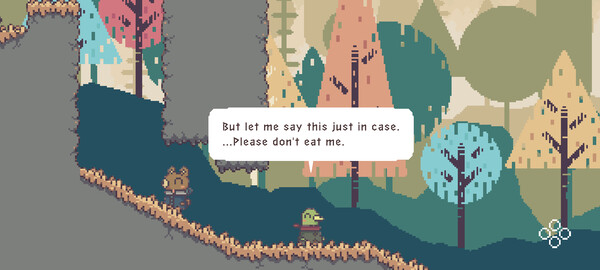 BOKURA in play — image 4 as listed on the Steam store page (Steam store screenshot)
Where are you with this game?
Press one and the game goes on your shelf. You can see it on your account page.
Reactions (no login)
Anonymous • one of each per visitor per day
Read next
Related reviews
We Were Here Forever
A co-op-only first-person puzzle adventure in which two prisoners, held in separate parts of Castle Rock, escape by describing to each other what only one of them can see or hear. Explaining yourself over a walkie-talkie - and being misunderstood - is the mechanic. The fourth entry in Total Mayhem Games' We Were Here series.
Teslagrad 2
A 2D puzzle-platformer that climbs an abandoned tower above a northern fjord by flipping magnetic poles and carrying momentum. Rain Games keeps the wordless storytelling and painted backdrops of the original, but steers from stop-and-think puzzles toward sliding and flow.
HUMANITY
A puzzle-action game where you play a glowing Shiba Inu placing command tiles — turn, jump, float — beneath an endlessly marching crowd to guide it to the goal. tha ltd. and Enhance's modern redrawing of the Lemmings lineage.


