REVIEW · 2022-05-10
We Were Here Forever
Only what you share becomes a bridge
First Impressions
What I read is the pile of Steam user reviews for We Were Here Forever as of 2026-08-01: 18,631 reviews across all languages, 16,886 of them positive — about 91%, labelled Very Positive. Developed and published by the Dutch studio Total Mayhem Games, released 10 May 2022. Two players only, microphone required, escape a castle while talking over walkie-talkies. That premise alone changes how the reviews are written.
Line up the helpful positives and they are barely about the game. "Found out my friend is an actual idiot." "I had 40 people on my friends list when I started; now I have 39." The top slots are reports about the partner, not the puzzle. The long, serious reviews land in the same place: no single player can bulldoze a puzzle alone. What is being rated is less a game than an event between two people.
The helpful negatives keep returning to three words: padding, imbalance, bugs. "We carried the same object to the same place three times." "One person did 90% of the thinking while the other waited." The store copy promises tension — can you explain things clearly before time runs out — while the top reviews describe a lot of walking. I want to read that gap as a question of design range, not as a fight.
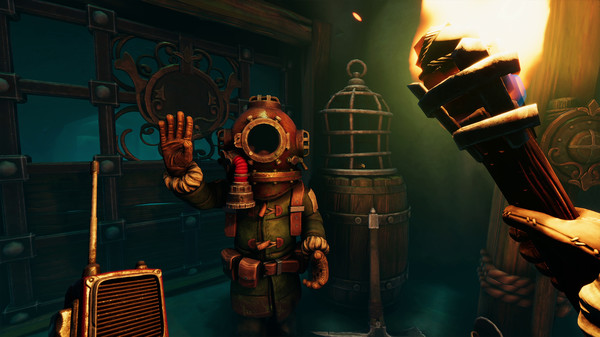 Official art for We Were Here Forever — Steam store key art (store header art)
Putting the Mechanics into Words
The verb here is not push or carry but describe. What the positive reviews praise, over and over, is the act of turning a symbol only you can see, or a sound only you can hear, into words. In Puzzlebyrinth's vocabulary, the verb that drives state change sits inside the player's mouth. The lever does not change the board; the sentence that correctly names the lever does.
That makes the negatives' complaint about "imbalance of information" a precise design note rather than a grumble. Skew the split too far and the verb only fires on one side — hence "the other player was just there to enter their half of the answer." Share everything and the reason for a second player evaporates. Several negatives argue that too many of this game's puzzles drift toward the second failure.
The correct answer lives in a narrow band between symmetry and asymmetry — a problem specific to co-op puzzles, which I wrote about in The Grammar of Solving Together. What is striking here is that the criticism names individual chapters rather than the whole game. Only the chapters that fall outside the band get hit.
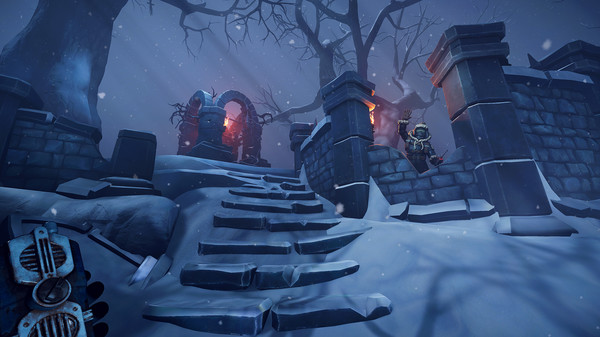 Official art for We Were Here Forever — Steam store key art (store main capsule art)
The Feel of the Controls
The most interesting thing in the review pool concerns the walkie-talkie. The store page leads with it — communicate by radio, be each other's eyes and ears — and the system requirements insist on a microphone. Yet the same sentence recurs across positive and negative reviews alike: we switched to Discord.
Even the reasoning matches. Push-to-talk only, one speaker at a time, no indication that the other person heard you. One positive review talks itself into it: "sure, it's meant to work that way, but convenience beats realism." The friction the designer refused to remove was removed by the players instead. Subtraction, handed over to the audience.
The friction did not vanish, though. One of the top funny reviews is simply a transcript of two people trading nonsense syllables through the underwater chapter. Drop the radio and the real constraint — say aloud what only you can see — is still there. What survives as feel is not the device but the grammar the device was protecting.
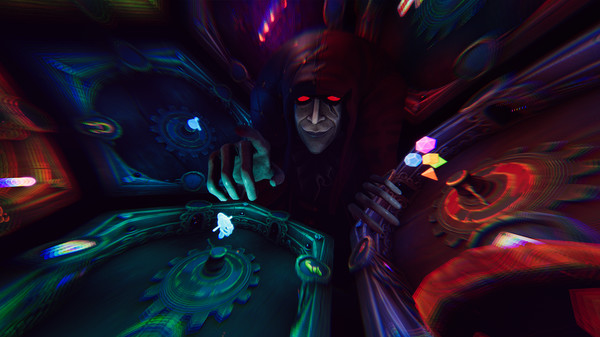 Official art for We Were Here Forever — Steam store key art (store hero capsule art)
Design Craft
The sharpest negative calls the game "too tame" and "overly-curated": the tension of earlier entries, where radio chatter turned increasingly panicked under an encroaching hazard, is gone, replaced by "here is the next puzzle, solve it with these parts."
What is interesting is that the positives cite the same property as a virtue. One long recommendation puts it at the centre: the game does not hide the components; everything you need is presented. Removing noise — subtraction in service of observation resolution — reads as considerate to one camp and as boredom to the other. Same operation, two names.
That is range, not quality. In a co-op puzzle, felt difficulty is rate-limited by whichever player is less practised. A design that hands things over pre-chewed lets you bring a partner who has never played a puzzle game. A design that keeps the tension only reaches two people who already share the habit. This game chose the first, and lost part of its own returning audience as the price.
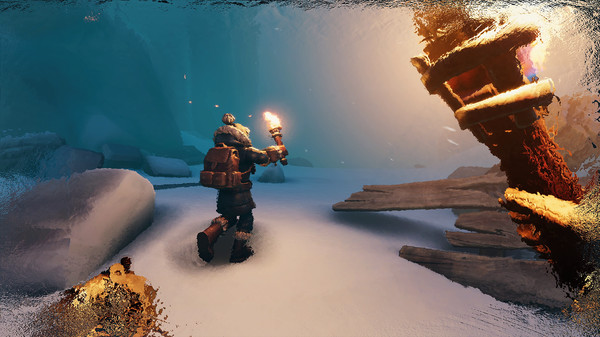 Official art for We Were Here Forever — Steam store key art (library hero art)
Place in the Lineage
Critics and users spotted the same shift and split only on how to score it. The Gamer gave it 80, praising "a focus on execution over abstraction." GamingTrend gave it 65 for making you complete the same puzzle three or four times. The diagnosis — weight moving from abstraction (working out what to solve) to execution (entering what you already know) — is shared.
The series began with one image: answers in one room, questions in the other. The fourth entry adds chapters, a story, and a whole castle. When reviews say the earlier games were better, what they miss is usually not volume but the purity of that single image. The expansion did not add verbs.
Among co-op escape puzzles I have covered Escape Academy and The Past Within, where two players move through different eras of the same house. This one leans hardest on sheer talking. Whether you can pick your partner is, more or less, the quality of the experience.
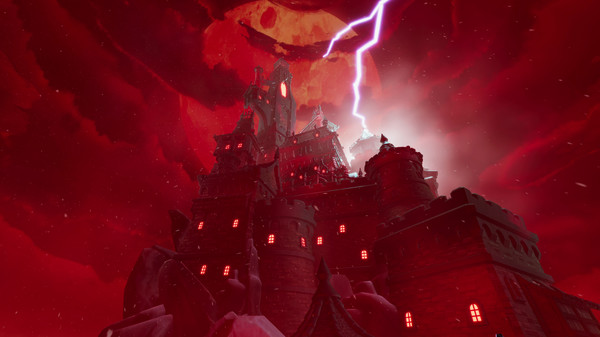 Official art for We Were Here Forever — Steam store key art (library header art)
Reviews I Read
This piece was written by reading the Steam store and community review listings as of 2026-08-01. No review text is quoted verbatim; recurring claims are reconstructed.
・Steam: We Were Here Forever (16,886 positive of 18,631 all-language reviews, about 91%, Very Positive; last 30 days 164 reviews at 79%, Mostly Positive)
・Top-rated reviews (11 read), top-rated negative reviews (10 read), plus 3 individual reviews posted in 2025-2026
・GamingTrend, "Quantity over quality" (65), plus the IGN / The Gamer / PC Gamer pull quotes carried on the Steam store page
Closing
Steam's overall sits near 91% (16,886 of 18,631, as of 2026-08-01), but the last 30 days read 79% across 164 reviews — Mostly Positive. The game has also been running at 60% off in the same window; discount-wave buyers may be part of that, though the review pool alone cannot establish it. I note the numbers and leave it there.
From a design standpoint I give it 7.5. Putting conversation in the verb slot is a real invention, and holding the condition — neither player advances alone — across six chapters is genuinely hard work. Against that, the chapters that repeat one structure three times, and the walking and unskippable cutscenes, are time in which the verb is not firing. That is where my number and Steam's 91% part ways.
Reviews cluster completion around 10-13 hours. Difficulty swings hard depending on your partner, so I placed the number in the middle. This is a game to recommend to people who already have someone they can be stuck with, out loud, for an evening. Without that, nothing is left — and the game itself can never make that call for you.
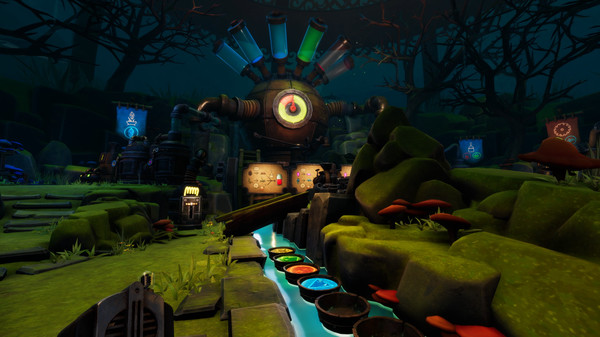 Official art for We Were Here Forever — Steam store key art (store page background art)
Where are you with this game?
Press one and the game goes on your shelf. You can see it on your account page.
Reactions (no login)
Anonymous • one of each per visitor per day
Read next
Related reviews
The Past Within
A point-and-click adventure playable only by two people at once: one stands in the Past, the other in the Future, and every puzzle is solved by describing aloud what only your own screen shows. The past is drawn in 2D, the future in 3D. Rusty Lake's first co-op-only game.
Return to Monkey Island
A point-and-click adventure in which series creator Ron Gilbert returns, three decades on, to the pirate comedy he left unfinished. It replaces the old verb menu with a single context-sensitive interaction, adds an in-world hint book that opens solutions in stages, and sends Guybrush Threepwood after the Secret of Monkey Island once more.
Hyperbolica
A first-person non-Euclidean adventure set in towns built from hyperbolic space, where parallel lines refuse to stay parallel, and spherical space, where distant objects look larger; you talk to residents and play races, skiing and snowball fights to build an intuition for the place. Made by CodeParade, who wrote the rendering pipeline from scratch.


