REVIEW · 2015-10-08
Keep Talking and Nobody Explodes
'It breaks friendships' is written on both sides
First Impressions
The people who praise this game and the people who dismiss it write down the same thing: it breaks friendships. One side records that as a souvenir, the other as a price. By the numbers it does not look like a contested game at all.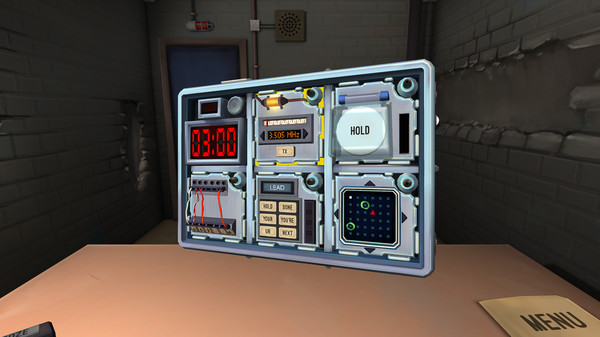 Official asset for Keep Talking and Nobody Explodes — Steam store key art
Steam reads 98% positive across 8,098 reviews, labelled Overwhelmingly Positive (snapshot 21 August 2026). SteamDB is a little harsher: about 17,000 reviews at 94.75%. Change the vessel and the number moves hard. Metacritic has the PC version at 71 from critics, labelled mixed or average, while the PS4 version sits at 88.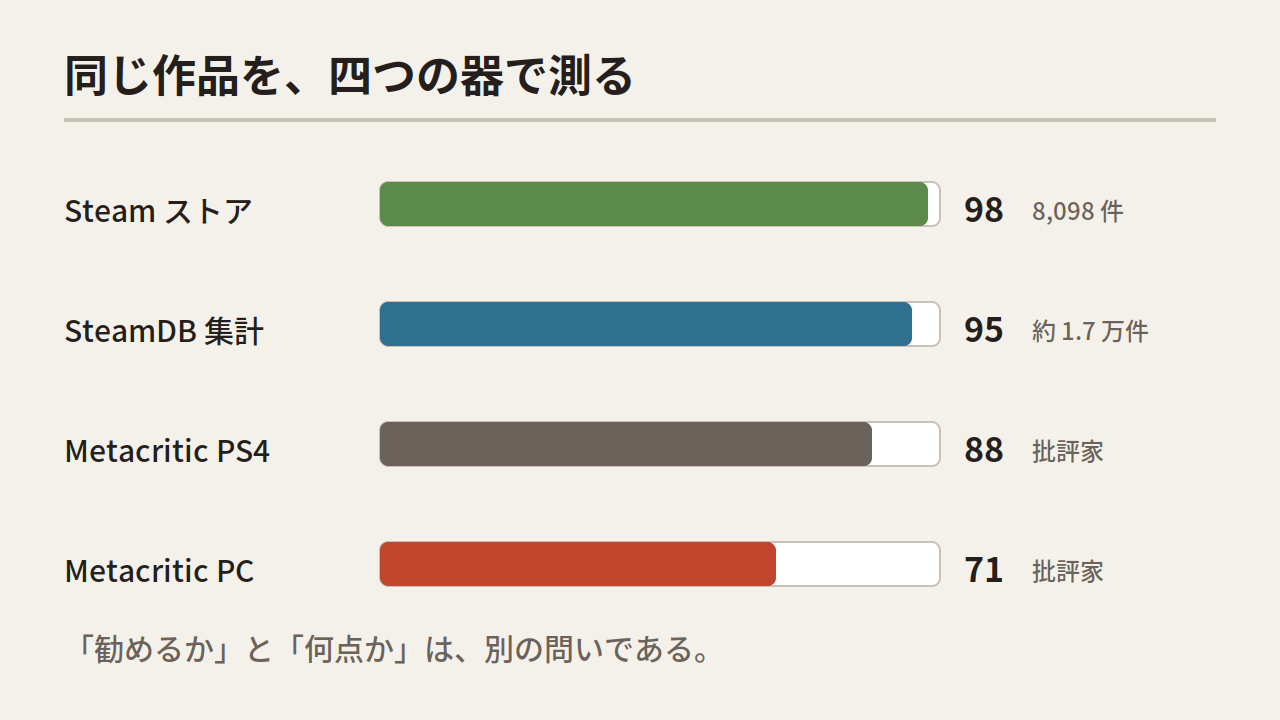 Four vessels, one game: 98 sits next to 71 (diagram, drawn for this piece)
Reading the ten most helpful positive reviews against the ten most helpful negative ones, what surprised me was that both sides name one and the same phenomenon. Praise says 'my friend and I are married now' and 'we broke up after two rounds', laughing. Dissent says it destroys friendship and breeds toxicity. Same event; only the sign differs.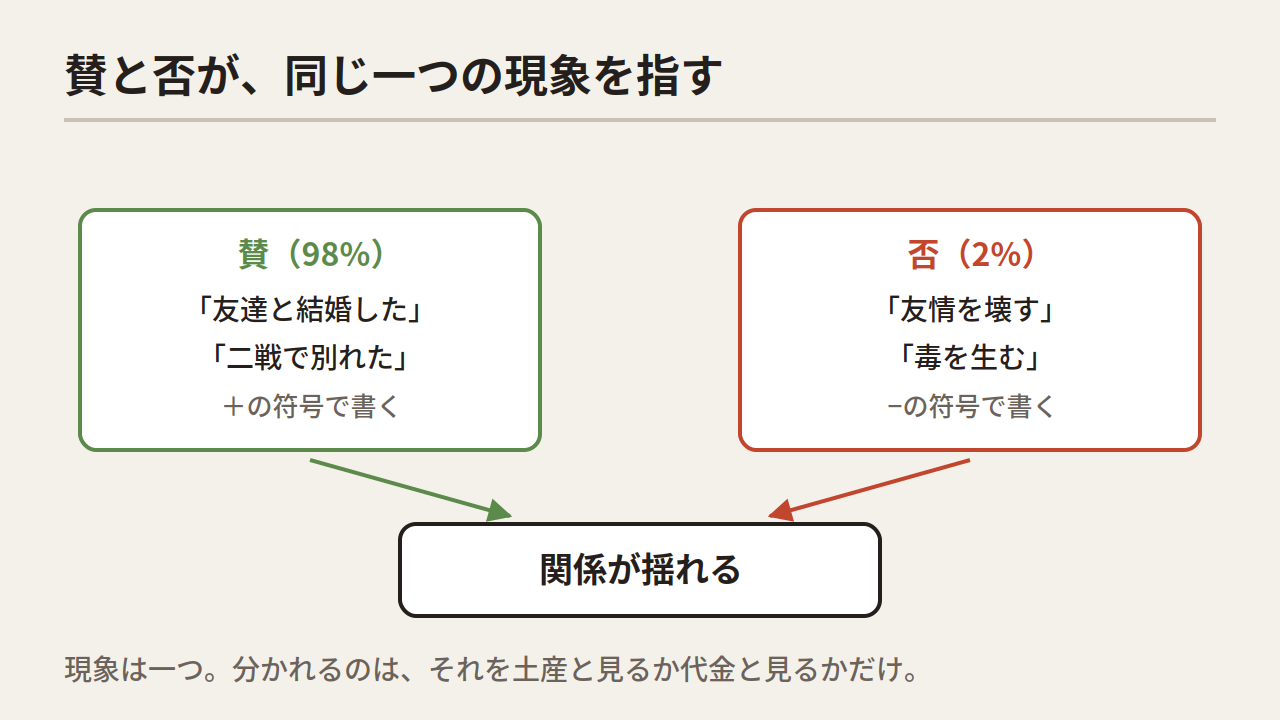 Both sides point at one phenomenon; only the sign differs (diagram, drawn for this piece)
Putting the Mechanics into Words
What is actually here. One person sits in front of a bomb and a clock starts. The others hold the defusal manual. The reader cannot see the bomb, and the person looking at the bomb has no manual. So the only bridge is the voice.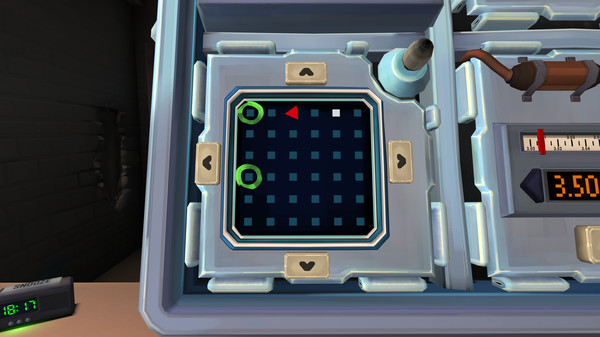 Official asset for Keep Talking and Nobody Explodes — Steam store key art
The layout turns information asymmetry directly into a board. The defuser can see but not know; the reader can know but not see. Reviewers keep describing it as an exam in their own powers of description, and the recurring positive line — you need to be good at talking and to have a smart friend — states the entry condition exactly.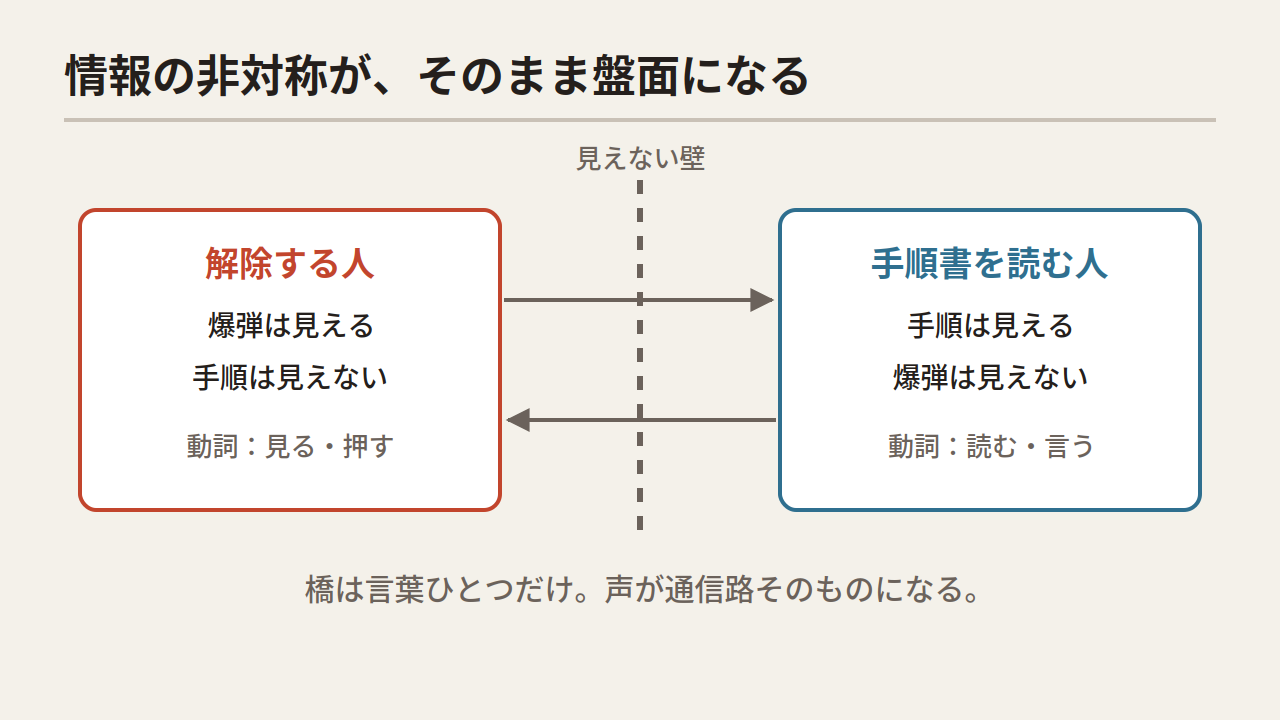 What each side can see is swapped, and the only bridge is the voice (diagram, drawn for this piece)
Take inventory of the verbs and there are four: look, speak, listen, press. This is an extreme case of what we call subtracting verbs. Instead of adding places to press, the game pushes the load onto language. The combinatorial explosion happens in the reading-aloud, not on the board. Four verbs. What multiplies is the reading-aloud, not the verb set (diagram, drawn for this piece)
The Texture of Difficulty
The manual is written in the grammar of conditionals. If there are two or more red wires. If the number of batteries is odd. If the serial number contains a vowel. Two boards can look identical and one condition changes which wire you cut. What you memorise is not answers but how to read conditions.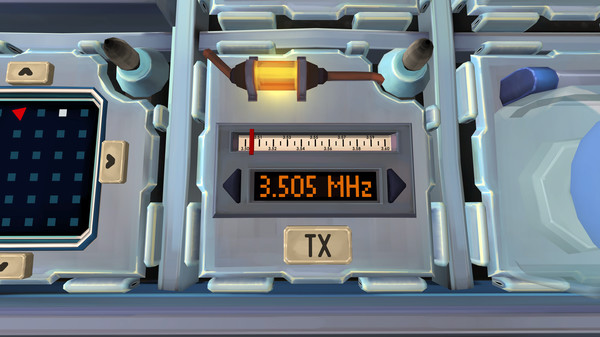 The manual is written in the grammar of conditionals (diagram, drawn for this piece)
So the difficulty splits three ways: reading the conditions correctly, putting what you see into words, and waiting for a machine's cycle to come round. The manual is said to mix in confusable glyphs and words that sound alike on purpose. The first two are designed cruelty, and almost nobody in the pool complains about them.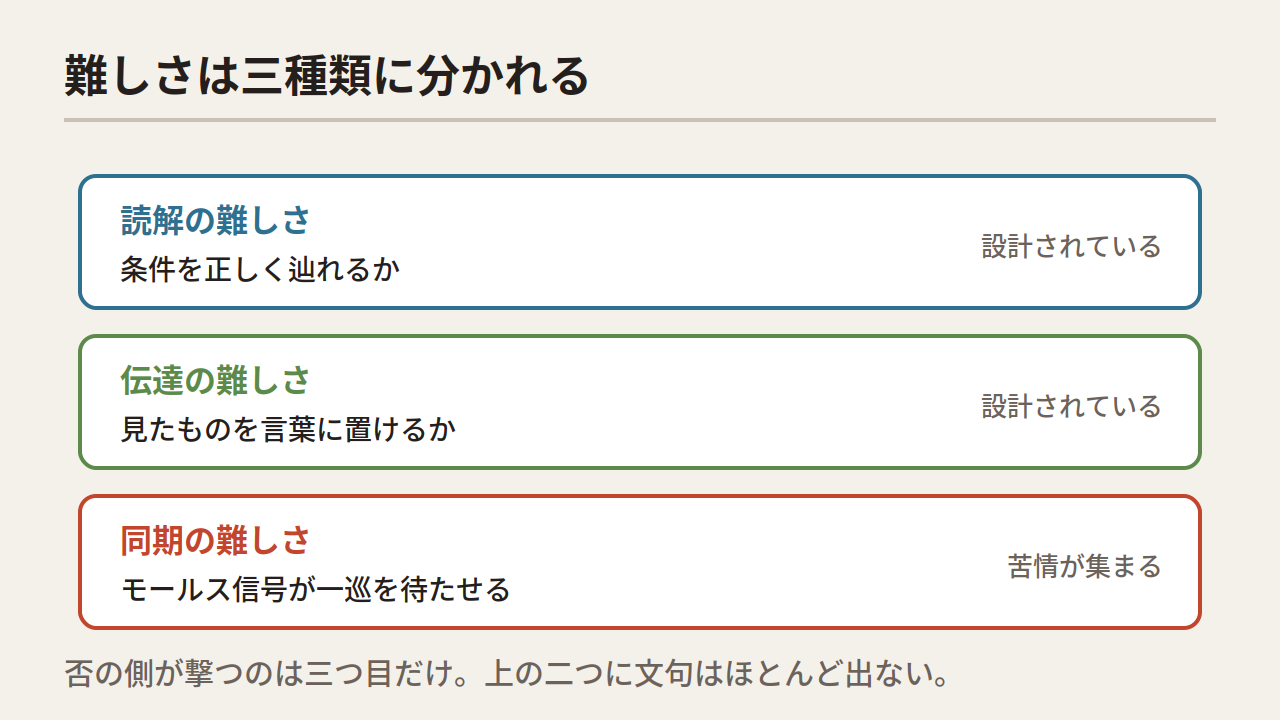 Split difficulty three ways and only the third one draws complaints (diagram, drawn for this piece)
The negative side fires at the third only. Several reviews go after the Morse code module: the loop comes round again before one letter is through, and no attempt lands. A five-hour player and a one-hour player both report stopping there. It is not difficulty you cannot solve but difficulty that makes you wait, and it crosses the line I drew in how far difficulty stays fair.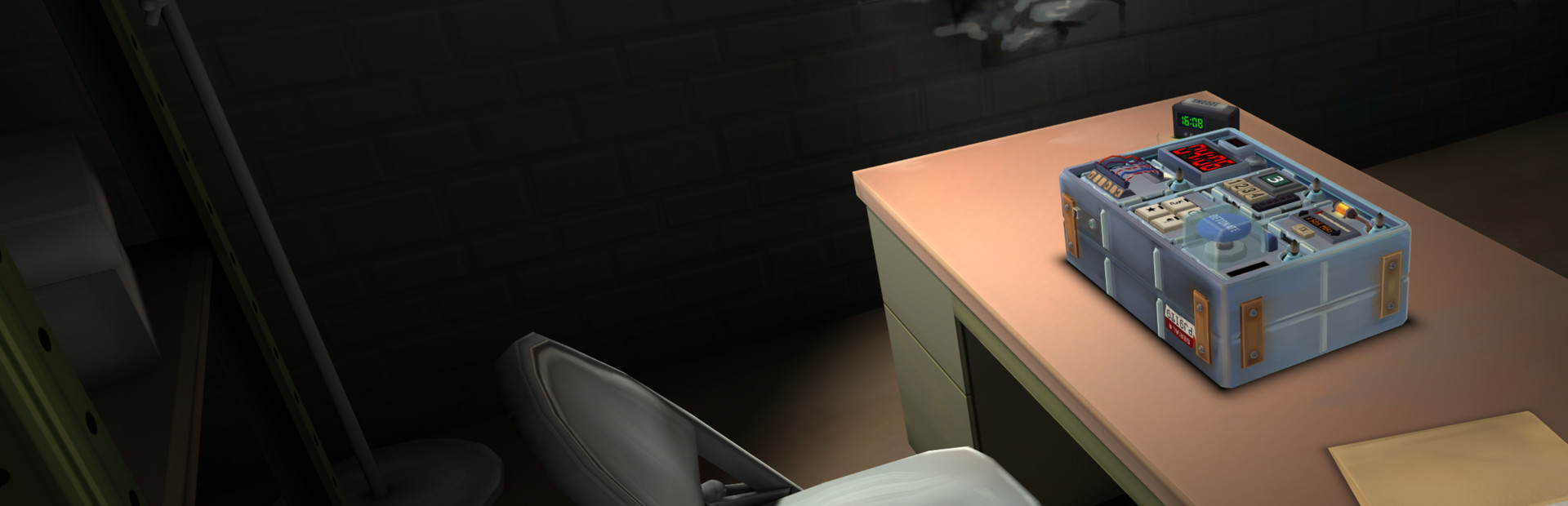 Official asset for Keep Talking and Nobody Explodes — Steam store key art
Design Craft
The shape is reported to be deliberate. At a 2014 game jam the three authors first built a VR roller coaster: fun for whoever wore the headset, dull for everyone watching. By their own account they steered towards giving the spectators a job. That is where the idea of making the sighted player talk about what the other cannot see comes from.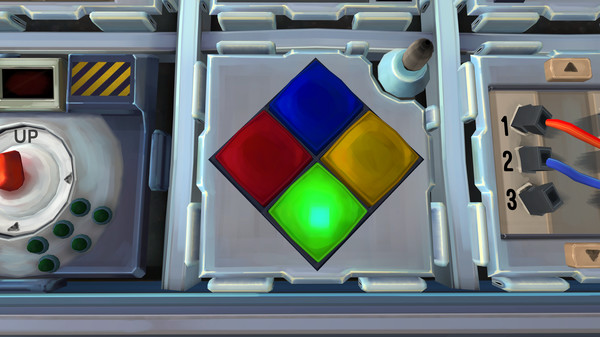 Official asset for Keep Talking and Nobody Explodes — Steam store key art
What is striking is how nearly absent price is from the pool. The manual is said to be published free on the official site, so the reader never has to buy in, and one copy seats a table — which leaves little room for 'too expensive' to appear. What remains instead is a condition: you cannot play alone. One review bought it expecting online co-op and was refused a refund.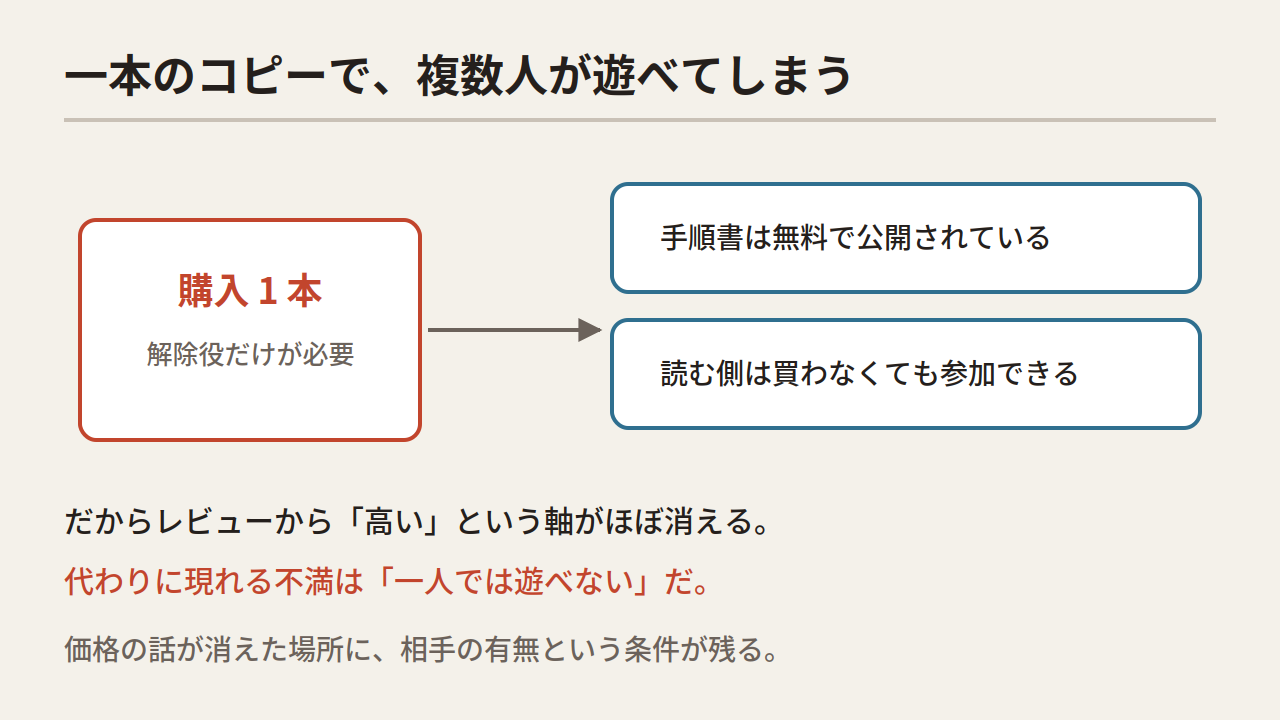 One copy seating several players is what removes price from the conversation (diagram, drawn for this piece)
Sources
This piece was written by reading the user reviews on the Steam store page and the official discussion board as of 21 August 2026. No review text is quoted directly; typical claims are reconstructed.
- Steam: Keep Talking and Nobody Explodes (98% of 8,098 reviews positive, Overwhelmingly Positive; 95% of 71 in the last thirty days)
- Read the top ten positive and top ten negative reviews by helpfulness in full, twenty in all. In this environment the positive listing returned the same set under every locale and sort order, so the shortfall was covered by the official forum threads 'Do I need two copies?' and the thread on split screen, plus the store's About This Game text
- Aggregates and critic scores come from SteamDB (about 17,000 reviews, 94.75%) and the Metacritic scores and awards recorded on Wikipedia (PC 71 / PS4 88), which is also the source for the three authors, the game-jam origin and the award history
- Several of the most recent negative reviews make claims about how the developer handled payment for contributors. I could not find primary confirmation, so I have not treated it as fact and have kept the body of this piece to design
- On images. Six are official Steam assets whose existence was confirmed on the store page and in SteamDB's asset listing; the image CDN was unreachable from this environment, so their contents could not be checked by eye and the captions are kept to the title and the asset type. No in-game capture URL was obtainable from this store page, so all six are key art. The remaining eight are diagrams I drew for this piece, and those I did check one by one.
Closing
The split between press and players is easy to read. Destructoid gave it 9 and recommended it conditionally — the fix you were looking for, if you have friends willing to commit. Metacritic's PC page still stops at 71. Critics score the fact that it cannot stand alone; users vote with a partner already assumed. Official asset for Keep Talking and Nobody Explodes — Steam store key art
I have it at difficulty 3, labelled standard. Hours in the pool scatter widely, from 0.1 to 167, with a median around four. This is not a game you read through once; it is a game you learn across an evening of repeated explosions. Set beside the co-op of We Were Here Forever, it takes both the brevity of a single round and the payoff of knowledge carrying to the next table.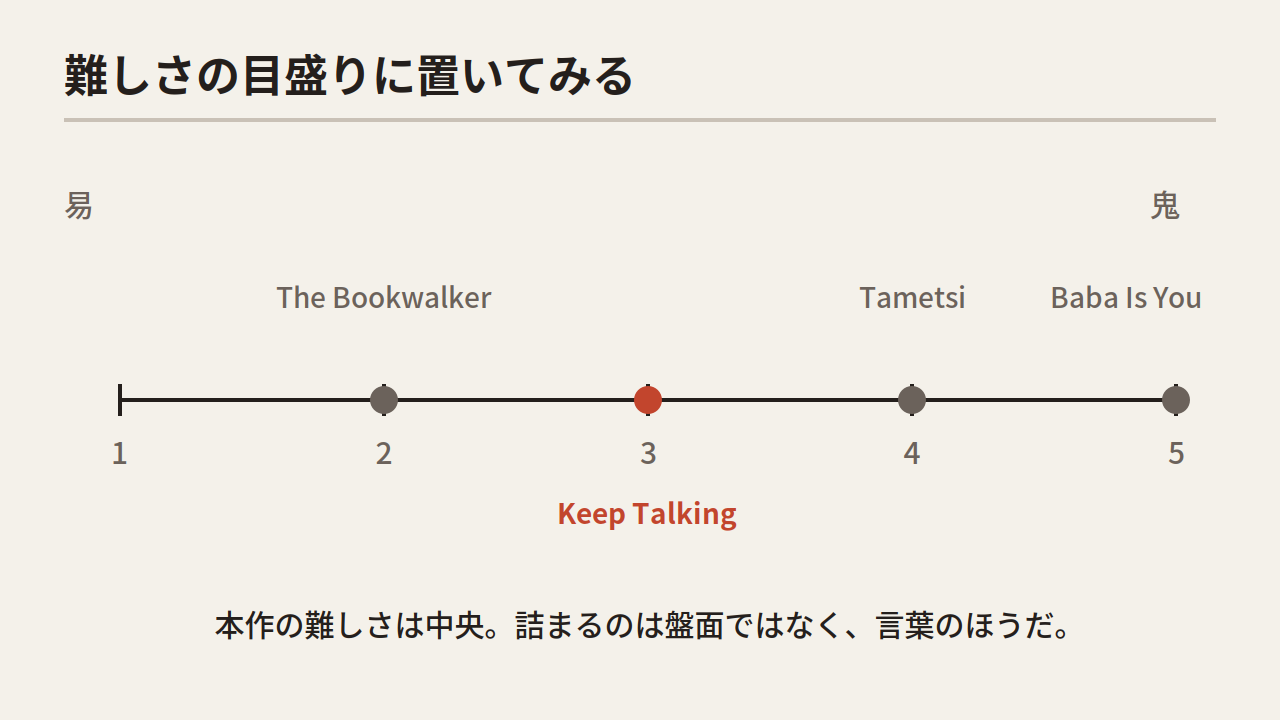 Difficulty sits in the middle; what stops you is the language, not the board (diagram, drawn for this piece)
I give it 8.6. The distance from Steam's 98% is a distance in what my ruler points at. Cutting the verbs to four and turning conversation into the board still has few equivalents ten years on. Two things come off: the Morse synchronisation is a wall of a different kind from everything around it, and the condition for play sits in your social life rather than in the game. With someone to talk to it returns many times its price. Alone, it was never for you.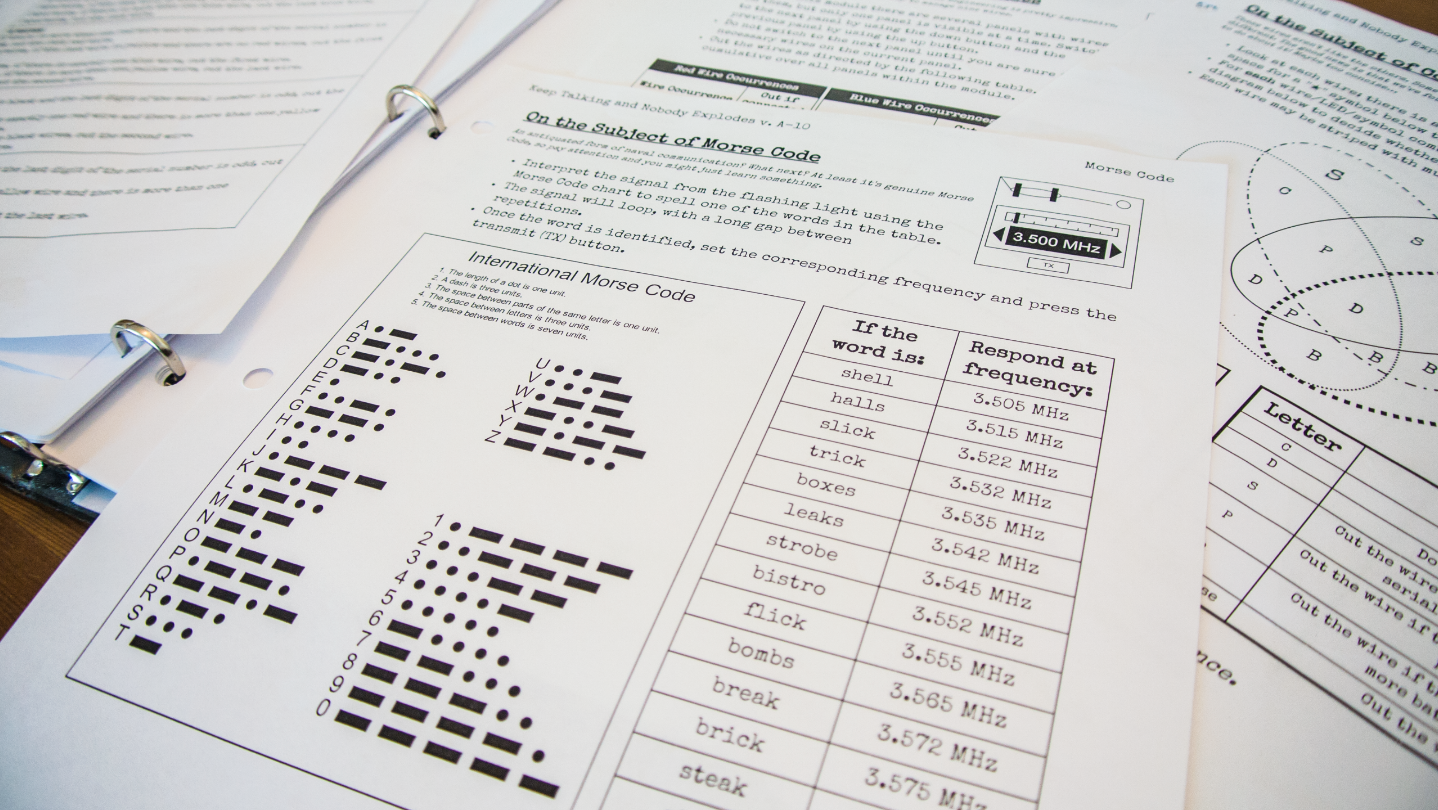 Official asset for Keep Talking and Nobody Explodes — Steam store key art
Where are you with this game?
Press one and the game goes on your shelf. You can see it on your account page.
Reactions (no login)
Anonymous • one of each per visitor per day
Read next
Related reviews
Mini Metro
A 2D minimalist puzzler in which you draw subway lines between circle, triangle and square stations in a growing city, allocating the carriages and tunnels handed to you each week, and keep the city moving until the platforms overflow. From New Zealand's Dinosaur Polo Club, grown out of a game-jam prototype.
SquareCells
A tiny logic puzzle that crosses Picross with Minesweeper: fill or break each square in a hidden grid using only the surrounding clues, where a number in a cell tells you how many cells it connects to. No guessing — every solution is reachable by pure deduction. By Matthew Brown, creator of Hexcells.
Else Heart.Break()
A Swedish adventure set in the electric town of Dorisburg, where you carry a device that opens up the insides of almost anything. Coffee makers, doors and buses all run on source code written in the game's own language, and you edit it directly. Led by Erik Svedäng and released in 2015.


