REVIEW · 2019-03-12
Hypnospace Outlaw
Reading a dream-time 1999 internet from the moderator's chair
First Impressions
Hypnospace Outlaw is an observation adventure released on March 12, 2019, credited to Tendershoot, Michael Lasch and ThatWhichIs Media, published by No More Robots. Jay Tholen is recorded as designer, artist and composer. The year is 1999, and people log into a virtual internet while they sleep. You patrol it as a volunteer Enforcer.
As of my 2026-09-10 snapshot the Steam aggregate is 96.7% positive — 5,353 up against 185 down out of 5,538 reviews across all languages — labelled Overwhelmingly Positive, with an 83 on Metacritic for PC. Numbers that look settled. Read the bodies and both sides are splitting over one question.
The question is whether this is a game at all. The helpful positives keep reaching for explore, rabbit hole, worldbuilding and a capitalised Experience. The loudest negative writes "it's hardly a game". What is striking is that both camps cite almost the same moments.
So the disagreement is not about quality. It is about what counts as play. From here I follow where each side draws that line.
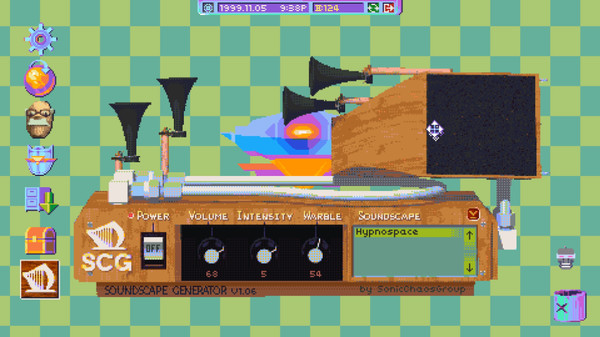 Hypnospace Outlaw in-game view — Steam store screenshot
Putting the Mechanics into Words
The verb list is startlingly short. Look at a page. Click a link. Type a word into the search box. Drag an offending item into the report tray. One positive review boils it down to find thing, catalog it, move on — and that is very nearly the whole vocabulary.
In Puzzlebyrinth terms this is subtraction of verbs, carried a long way. What is left after the subtraction is observation resolution: who posted what, when, and where a page's assets came from. Fewer hands, finer eyes.
The weak search box is the hinge. Period search does not carry you to your destination, and several positives praise exactly that — "search engines that don't take you far." What you remember becomes the key instead. Knowledge is the inventory.
The grammar of this game therefore sits in memory rather than on a board. It is the stance Her Story took when it made a search term the only verb. The difference is that Hypnospace has links. Hit a dead end and you can still walk sideways.
 Hypnospace Outlaw in-game view — Steam store screenshot
The World
What the review pool most wants to talk about is neither the cases nor the mystery. It is the residents. The positives converge on personality, humanization, archive. One says you start recognising names; another compares it to reading the logs of a long-dead BBS.
Even the anecdotes rhyme. More than one review follows a self-styled celtic wizard — a furniture salesman offline — across months of page updates. You are not reading someone's diary. You are reading their revision history.
The negatives do not dispute this. One simply writes that he could not bring himself to care about a fictional person's amateur comics about a fictional character. That is not a rebuttal; it is a statement of range. Almost everything here rests on whether fictional strangers can hold you.
Worth noting how often the music comes up. Positives point to a unique track per page and fictional artists with whole albums attached. A negative points at the same feature and reports having to mute autoplay by hand on every new page. One design decision, two faces.
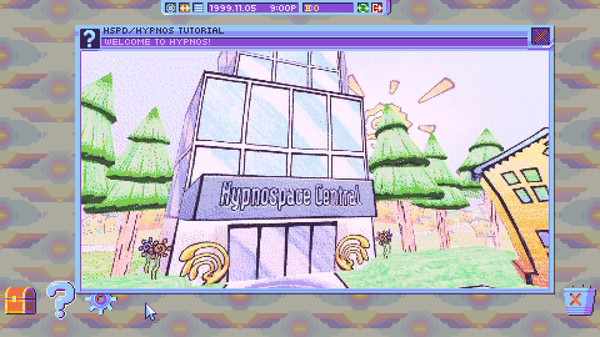 Hypnospace Outlaw in-game view — Steam store screenshot
The Texture of Difficulty
Difficulty is where the pool splits most concretely. In everything I read, the reports of getting stuck cluster in the back half.
The first half is well liked by both camps. Early cases, they say, tend to solve themselves while you are busy exploring. The route and the exploration are the same thing. As a learning curve, that is honest work.
The back half is where it breaks. The negative accounts agree almost word for word: you must reach one specific page and type one specific string. One reports combing every user on Hypnospace by hand for the final case. Plenty of positives admit to opening a guide.
I read this as the quality of the difficulty changing, not its amount. The first half rewards raising your observation resolution. The second asks you to guess a string, and the candidate space is effectively unbounded — combinatorial explosion. Teaching stops while demands keep climbing. That is the design fault.
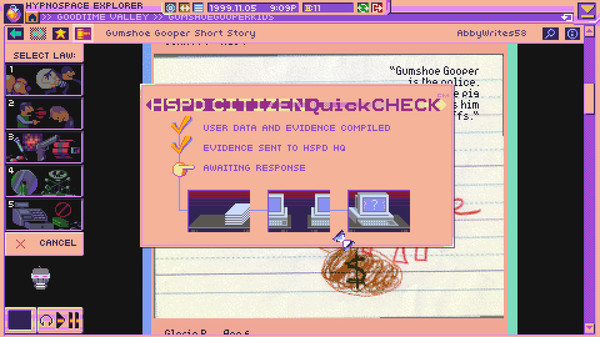 Hypnospace Outlaw in-game view — Steam store screenshot
Place in the Lineage
The comparisons in the pool are lopsided: Papers, Please, Orwell: Keeping an Eye On You, and the real Geocities archives. The first two are the make-a-job-into-play lineage. The last is not a competitor but a control group.
The sharpest line in the negatives comes from there. If atmosphere is all you want, one reviewer says, go read the actual archives — real people, real stories, already online. That is a strong question.
My answer is editing. The real archives have none. This game has an order you can walk and a designed way of hiding things. Searching the archive only works as a mechanic because someone hid the records on purpose.
The same line explains the gap between the press and the store. Metacritic 83, Steam 96.7%. Score it as a game and the back half costs it points. Look at it as an exhibit and the density pays. One work, two instruments.
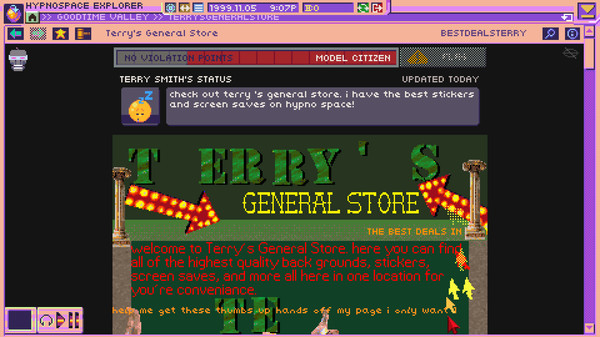 Hypnospace Outlaw in-game view — Steam store screenshot
Sources
This piece was written from the user reviews on the Steam store page as of 2026-09-10. No review text is quoted verbatim; typical claims are reconstructed.
・Steam: Hypnospace Outlaw (Overwhelmingly Positive, 96.7% of 5,538 reviews across all languages — 5,353 up, 185 down)
・Read via WebFetch: the top 10 helpful positive, top 10 helpful negative, and 8 most recent English reviews
・Wikipedia: Hypnospace Outlaw (source for release date, credits, and the Metacritic 83)
Closing
Against Steam's 96.7% I land at 8.0. The gap is simple: the two halves score differently.
The first half is good. It cuts the verb list to four and spends the savings on observation resolution, treating a weak search box as grammar rather than a defect. On its own, that is a 9.
The second half drops. Teaching stops and the game asks only for the right string. That is why guide-opening confessions turn up on the positive side too. The design loses its through-line.
The recent page shows people still returning — every couple of years, wishing they could forget it and start over. And note that "the story just stops" and "it left me wanting more" are two reactions to the same ending. If reading a fictional stranger's revision history appeals, this is a strong recommendation. If you want clear objectives and resistance, it is not.
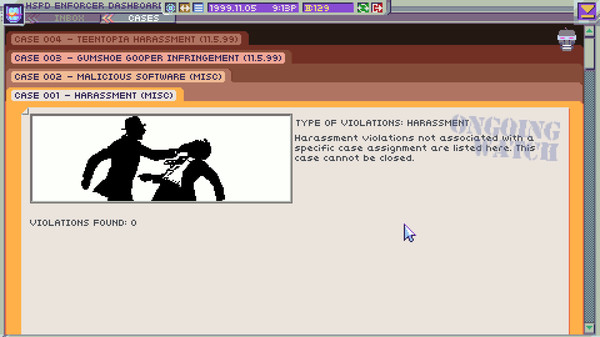 Hypnospace Outlaw in-game view — Steam store screenshot
Where are you with this game?
Press one and the game goes on your shelf. You can see it on your account page.
Reactions (no login)
Anonymous • one of each per visitor per day
Read next

Related reviews
Phoenix Wright: Ace Attorney Trilogy
A courtroom adventure in which you play defense attorney Phoenix Wright, matching one line of testimony against one piece of evidence to break a lie. Capcom's collection gathers all fourteen episodes of the three games first released between 2001 and 2004, with the art redrawn frame by frame.
AI: The Somnium Files
A detective adventure set in near-future Tokyo, in which a one-eyed police detective works a serial murder case alongside the artificial intelligence housed in his prosthetic eye. First-person investigation scenes alternate with third-person 'Somnium' dives into a suspect's dream, where a six-minute budget must be spent to open Mental Locks, and an in-game flowchart lets you walk the branches toward several endings. Written and directed by Kotaro Uchikoshi of the Zero Escape series, from Spike Chunsoft.
Unheard - Voices of Crime
A deduction adventure played over a top-down floor plan: you move between rooms and scrub a recording of the day back and forth, listening. There are no subtitles — you name the figures and answer the case questions using only what you heard. From NExT Studios.


