REVIEW · 2019-03-28
Unheard - Voices of Crime
How 33,811 reviews judged one subtraction: no subtitles
First Impressions
Unheard launched on 28 March 2019: an audio deduction adventure developed by NExT Studios and published by NExT Studios with 505 Games. You are the test subject for a device that replays the recording of a crime, moving room to room across a building's floor plan and hearing only what reaches the room you are standing in. Five cases in the base game, with free and paid extra cases alongside.
As of the 2026-08-12 snapshot the tally is 32,456 recommended against 1,355 not recommended out of 33,811 in all languages — 96%, labelled Overwhelmingly Positive. Open the language breakdown and the picture shifts. Simplified Chinese, 26,783 reviews, carries that label; English, 2,798 reviews, sits at 91% and Very Positive. The last 30 days are 91% of 326. Metacritic is listed at 72.
So roughly eight in ten reviews here are Chinese-language — an unusually lopsided pool. And sorting the English negatives by helpfulness, the top of that column is taken up by a single topic: there are no subtitles. Voice acting comes second. The 96% is quiet; what sits underneath it is not. I want to read the lopsidedness along with the game.
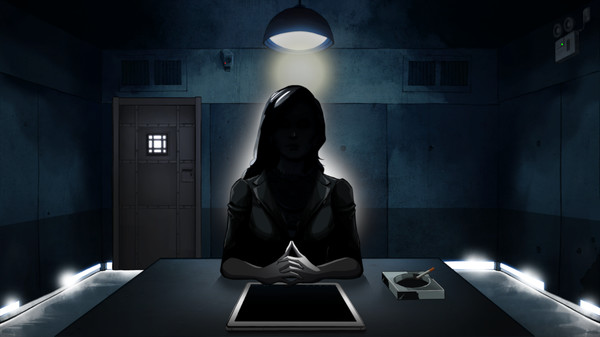 Under a hanging lamp, a backlit woman sits with her hands folded, her face never visible; a tablet lies on the table in the foreground, an ashtray to the right, a steel door with a barred window behind her — Steam store screenshot
Putting the Mechanics into Words
What the helpful positive reviews raise in common is how little apparatus there is. One calls it possibly the purest detective simulator they have played — no hints, no markers, no deductions made for you, just you and the raw evidence. Another calls it an eavesdropper's dream. Strikingly, the number of lines any review spends explaining the controls is tiny.
In this site's vocabulary the game has two verbs: move to a room, move time. No inventory, no examine, no dialogue choice. The load-bearing decision is that the unit of observation resolution is fixed at one room. Run the same recording again from a different position and only the audible range changes. Turning time into a verb is the same instinct as Tacoma, but where that game lets you walk freely inside a scene, this one cuts information on a coarse grid of rooms.
The negative side names the same structure differently: not much of a detective, more of a rewind simulator. One long review argues the search space — rooms multiplied by timeline — is large while its information density is low, so you play out very long scenes to learn very little. Cut the verbs down to two and a thin board leaves nothing but legwork. The side effect of subtraction is being described directly as the complaint.
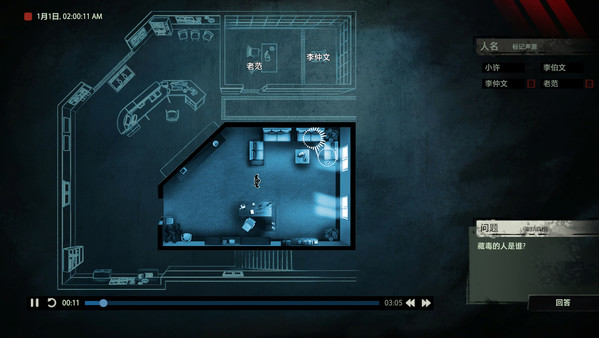 A blueprint-style floor plan with a single room lit up and a sound-wave marker inside it; a playback bar with rewind and fast-forward reads 00:11 / 03:05, a name list sits top right and a question panel bottom right — Steam store screenshot
Subtraction
The most-upvoted English negative review — 237 helpful votes — is about subtitles. The writer is not deaf but has significant difficulty making out words, and cannot follow filmed dialogue without captions. In the second case they lost a key detail under the background noise; in the third the explosion left their ears ringing. Their closing line is that it was the most exhausting game they had ever played. Several other reviews near the top reach the same verdict from auditory processing difficulties.
A high-ranking positive review takes up the same topic and lands the opposite way. A non-native English speaker writes that subtitles would defeat the purpose of the game — you are meant to listen, not read — and later appends an apology to anyone with hearing difficulties they may have offended. In design terms this is the subtraction of a single element, and the effect the subtraction produces and the audience it locks out are sitting on exactly the same point.
What makes it interesting is that another negative review audits the subtraction itself: no case in the game asks you to make out ambiguous speech, and each speaker shows an equaliser as they talk, so there is never confusion about who is talking. In other words nothing here is information that only sound can carry — it is text-deliverable information delivered by sound alone. Whether the subtraction protects the core of the work or merely narrows its door is not settled inside the pool either.
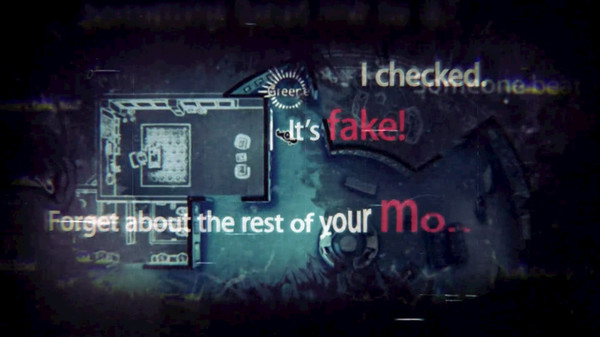 English dialogue laid over a darkened, blurred floor plan in large stylised type — “I checked.”, “it's fake!” with fake in red, and “Forget about the rest of your mo…” running across the lower half — Steam store screenshot
The Texture of Difficulty
On difficulty the two camps arrive at nearly the same diagnosis. One positive review says they did not find it a hard game and that this took nothing away — be thorough and you can solve every case without a mistake. A long Simplified Chinese review says the same thing from the other direction: as many have noted, it is not brain-burning enough. Praise and complaint share the observation; only the verdict differs.
The negative side wires that observation into a design argument. One long review splits deduction-game questions into keys and deductions and says Unheard is mostly keys: somebody says a name and the tag is filled, and the last unnamed woman is filled by elimination. Another points out there is no penalty for a wrong answer, so repeated guessing gets you through. Keeping the question count low enough to avoid combinatorial explosion also leaves room to brute-force it.
Plenty of reviews locate the real difficulty somewhere else, though: when to break off one running conversation and which room to go back to. A recent positive review describes the group they were following merging with another group in the same room and says that is the challenge, and it also drives them slightly insane. The load sits on attention and short-term memory rather than on inference — which is how too easy and exhausting end up describing the same game.
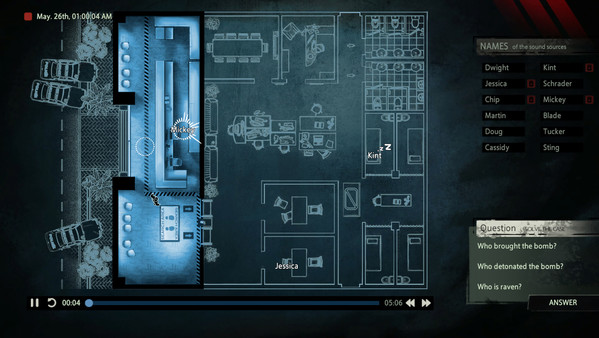 A wide floor plan with cars drawn outside on the left and a run of small rooms to the right; two long rooms are lit blue. The NAMES panel top right lists twelve people including Dwight, Kint and Jessica, and the question panel below reads “Who brought the bomb?” — Steam store screenshot
Place in the Lineage
English-language reviews always place this game next to something. Return of the Obra Dinn, The Case of the Golden Idol, The Roottrees are Dead. One positive review sums it up as a combination of Golden Idol and Telling Lies; a negative one says that if you are fresh off Obra Dinn, this is not it. The comparisons cluster tightly on deduction games.
Read the Simplified Chinese pool by helpfulness and the neighbours change. The single most-upvoted request is Steam Workshop support so players could write their own scripts and record their own voices — several of the highest-ranked reviews are exactly that. Another proposes a co-op mode where each player occupies one room, imagining something close to a murder-mystery party table. The same game is being read as a deduction lineage on one side and as a staging tool on the other.
The audio itself divides too. A long Chinese review that played through in both languages says the Chinese voice cast gives each character a distinct colour, that the English version does not reproduce this well, and that the experience is dragged down overall for anyone playing in English. The English-side complaints — over-acted, community-theatre energy, 1940s vernacular that lands like a Looney Tunes gangster — line up exactly with that reading. Chinese came first here; English is a layer added on top.
 The same treatment in Chinese: “喂”, “我核实过了” and “你那个是假的” laid in large type over a rounded floor plan, with the character 假 alone in red; room labels read 刘总 and 秘书 — Steam store screenshot
Sources
This piece was written from the Steam user reviews as they stood on 2026-08-12.
· Steam: Unheard - Voices of Crime (32,456 recommended / 1,355 not recommended out of 33,811 in all languages — 96%, labelled Overwhelmingly Positive; English 2,798 at 91% Very Positive, Simplified Chinese 26,783, last 30 days 91% of 326)
· Read: 10 positive and 10 negative English reviews by all-time helpfulness, the 10 most recent English reviews, and the 10 most helpful Simplified Chinese reviews — 40 in total.
· Tallies and price history taken from SteamDB and Steambase. The Metacritic score of 72 is as displayed on the Steam store page.
· Completion-time figures are from HowLongToBeat (main story about 4 hours, main plus extras about 5.5, completionist about 7.5).
Closing
The intended reach is clear enough. It works for anyone who enjoys the act of running a recording again and again and watching the audible range change with where they stand. It does not work for anyone who wants to submit their observations as their own inference — that is Her Story's job, and Obra Dinn's. And for anyone who needs subtitles the door is still shut.
The sharpest line in the whole pool comes from the negative column: if you build an audio puzzle with no text cue, the puzzle needs to be about the audio, not audio used to deliver information that could easily be textual. By that standard Unheard is right as an instrument and short as a set of questions. The invention — cutting information on a coarse grid of rooms — survives; the work of reconciling what you cut was never built.
Steam's overall is 96%; my score is 7.4. The gap is not only the lopsided pool. Reducing the verb set to two and pinning observation resolution to a spatial grid was genuinely distinctive in 2019 and still has few close relatives. The deduction is on the question side. Self-reported completion times in the reviews scatter across roughly three to eight hours and HowLongToBeat puts the main story near four; at this design that shortness is neither virtue nor flaw, just the point at which the questions ran out first.
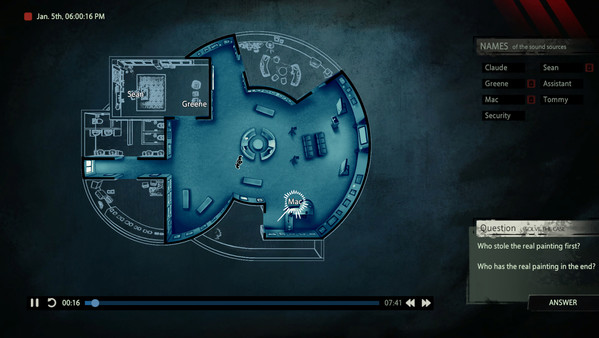 A curved, gallery-like floor plan with the central hall lit and two figures tagged Greene and Mac. The NAMES panel top right lists seven people; below it the questions read “Who stole the real painting first?” and “Who has the real painting in the end?” with an ANSWER button, and the playback bar reads 00:16 / 07:41 — Steam store screenshot
Where are you with this game?
Press one and the game goes on your shelf. You can see it on your account page.
Reactions (no login)
Anonymous • one of each per visitor per day
Read next
Related reviews
The Occupation
A first-person thriller set in North West England on 24 October 1987, in which you play a journalist slipping into restricted areas and interviewing people to gather evidence. The in-game clock runs at real-world speed and the cast moves on a timetable, in this game from White Paper Games.
Telling Lies
An FMV mystery where you search a database of secretly recorded video by the words spoken in it, reassembling four lives and one big lie from fragments. From Sam Barlow of Her Story, built on a single verb — search — that takes stories apart and rebuilds them.
inbento
A pattern-matching puzzle played inside a 3×3 lunchbox. You don't place the food directly: you play a small hand of operation cards that move, swap, copy or lift tiles, and you must spend every card exactly. 127 levels, wordless, with a short story about a cat mother and her kitten. By Afterburn, who also made Golf Peaks.


