REVIEW · 2017-08-01
Tacoma
What 4,782 reviews meant by the word “short”
First Impressions
Tacoma launched in August 2017: a first-person exploration adventure developed by Fullbright and published by Fullbright and Serenity Forge. You board an emptied orbital station alone and watch volumetric recordings the facility's surveillance system left behind, replaying and rewinding them while walking around inside the scene. No combat, no failure state.
As of the 2026-08-12 snapshot the tally is 4,123 recommended against 659 not recommended out of 4,782 in all languages, labelled Very Positive. English alone, 2,271 reviews, sits at 89%; Russian, 214 reviews, is Mostly Positive. The last 30 days are 84% of 19. Metacritic reads 76, so users and critics land in roughly the same place.
The numbers are settled. The pool is still worth reading, because the same word tops both columns: short. Praise says it and complaint says it. When one adjective feeds two opposite verdicts, a split in the evaluation axis is buried underneath. That is what I want to dig out.
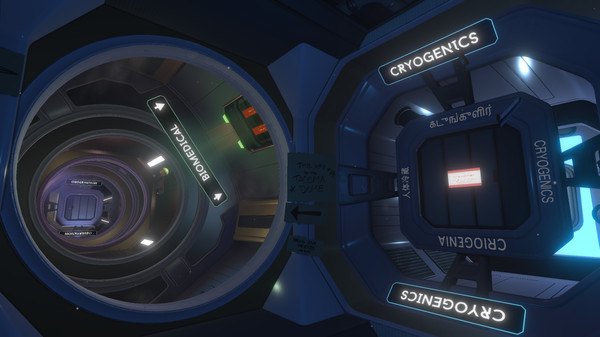 A junction between modules, CRYOGENICS and BIOMEDICAL signage glowing at mismatched orientations — Steam store screenshot
Putting the Mechanics into Words
The AR recordings are what the helpful positive reviews raise, almost without exception. You can play, rewind and fast-forward, and you walk around inside the scene while it runs. The crew starts a conversation in one room and then scatters, so a single pass cannot follow everyone. One reviewer calls it real gameplay for a genre known for the appearance of interactivity; another marvels at the labour of scripting and performing that many overlapping conversations cleanly.
In this site's vocabulary the game has three verbs: walk, look, move time. The third is the notable one. In most exploration works, observation resolution is set purely by where the player stands. Tacoma grants the same freedom along the time axis, so resolution becomes two-dimensional — a fairly direct implementation of observation as play.
The negative side keeps saying there is nothing to solve: no noteworthy puzzles, no avenues worth exploring, never challenged in any meaningful way. Worth noting that the developer's own store page calls this a non-combat, non-puzzle-focused game. So the complaint does not actually contradict the maker's stated intent. Something else on that page does — I will come back to it.
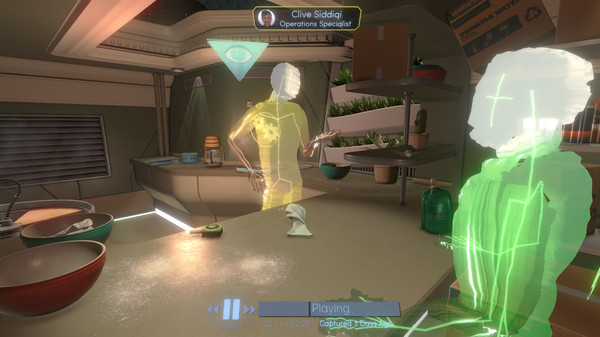 A yellow and a green AR figure facing each other by a kitchen counter, with a playback bar reading “Playing” along the bottom of the screen — Steam store screenshot
The Feel of the Story
What the positive reviews describe at length is people and domestic detail. Each crew member carries a distinct faith, family situation, ambition — even body shape is individuated. Several reviewers value that the 2088 setting, where labour is subcontracted and corporate loyalty is literally paid out as a currency, is seen from the vantage of ordinary employees rather than heroes. Almost everyone mentions the voice work and the score.
The negative side goes after the plot: corporation-is-evil material seen in books and films before, over before any attachment forms. What is interesting is that a recommending review posted in November 2025 reaches nearly the same diagnosis — world and characters more compelling than the main thread, that thread underwritten, the AR sections nonetheless a clear advance on the studio's previous game. The camps differ in verdict, not in symptom.
Read as design, this is a different lineage from a deduction piece like Return of the Obra Dinn. That one wires observation to a verification step; Tacoma does not. When conversations run in parallel, the player only chooses whom to follow. The choice changes narrative resolution without producing right or wrong — the gap between exploration and deduction, visible directly in the verb set.
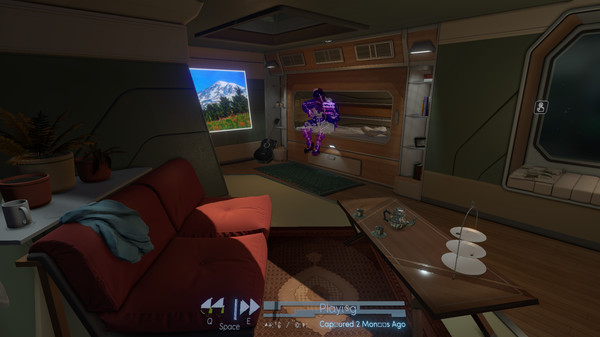 A crew cabin with a red couch, houseplants and a wall display showing a mountain; a purple AR figure hangs in the middle of the room — Steam store screenshot
Pacing and Length
Line up the self-reported completion times and “short” gets concrete: 1.8 hours at the low end, then 2.4, 2.7, 3.9, 4.2, 4.6, 4.8. Careful players report six to seven, and those who replay with developer commentary go past that. The store's own estimate of two to five hours matches the distribution well. Nobody is misstating the length.
The 2017 dissenters could still weaponise it because the word never travelled alone — it travelled attached to a price. The game launched at $19.99. A store forum thread titled around twenty dollars for two hours drew 105 replies, and one poster there counted the Metacritic reviews that mention length: fifteen out of twenty-nine. Duration had become the shared language for discussing this game.
In the recent pool that axis has simply dropped out. In August 2026 the list price of $19.99 carries a 70% discount to $5.99, and the historic low is $1.99. Posts from the last thirty days state the shortness as plain fact and recommend anyway; pacing is called slow, the story good, price unmentioned. The control complaint survives unchanged: you cannot run, so moving takes as long as it takes.
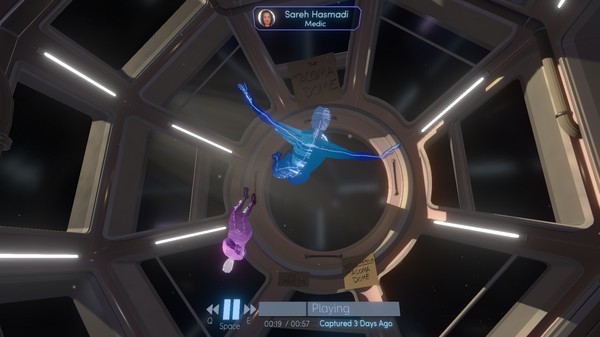 A blue AR figure drifting through a ring-shaped corridor, a name tag above it reading Sareh Hasmadi / Medic — Steam store screenshot
Sources
This piece was written from the Steam user reviews as they stood on 2026-08-12.
· Steam: Tacoma (4,123 recommended / 659 not recommended out of 4,782 in all languages, labelled Very Positive; English 2,271 at 89%, last 30 days 84% of 19)
· Read: the top 10 by all-time helpfulness (7 positive, 3 negative), the 4 most recent, and 2 individual review pages (1 positive, 1 negative) — 16 reviews in total.
· The top 15 posts in the store forum thread on twenty dollars for two hours of gameplay (105 replies), which includes a user's count of 15 of the 29 Metacritic reviews mentioning length.
· Price history and review trend taken from SteamDB and Steambase.
Closing
Back to the line I deferred. The store blurb promises that you will explore every detail of how the crew lived and worked, finding the clues that add up to a gripping story. One dissenting review quotes exactly that and answers: you do not really find clues, you go to the next area, listen, decrypt the AR devices, repeat. The mismatch is not in the non-puzzle-focused disclaimer but in the marketing verb, find. The verb the designers removed stayed in the sales copy.
So the intended reach is clear enough. It works for anyone who enjoys the act of rewinding time to watch other people's lives repeatedly. Anyone who found the house-search of Gone Home inert will get real value from the simultaneity of the AR scenes. It does not work for anyone who wants to submit observation as their own inference — that is Her Story's job. The split is not about taste but about which side of that line you stand on.
Steam's overall is 86%; my score is 7.6. Turning time into a verb and opening observation resolution into two dimensions still has few imitators, and for 2017 it was well ahead. The deduction is the one point I grant the dissenters: having built a machine that runs several conversations at once, the game never asks you to decide anything with it. Fine instrument, too light a load.
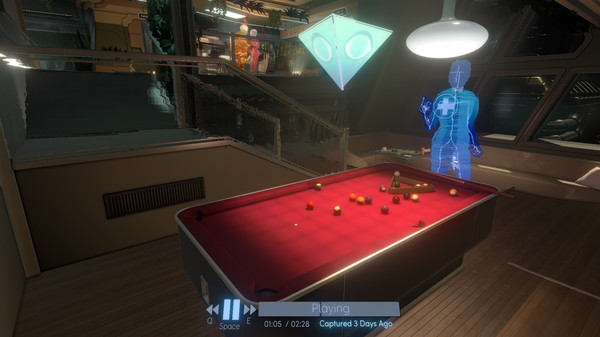 A common lounge with a pool table and hanging lamps, a cyan diamond hologram overhead and a blue AR figure at the right — Steam store screenshot
Where are you with this game?
Press one and the game goes on your shelf. You can see it on your account page.
Reactions (no login)
Anonymous • one of each per visitor per day
Read next

Related reviews
Gone Home
A first-person exploration game: home on a rainy night in June 1995 after a year abroad, you open every door and drawer of an empty house and reconstruct a year of family history from the letters, cassettes and magazines left behind. No combat, no puzzles, no fail state — the verbs are open, pick up, read. The first game from Fullbright, founded by veterans of BioShock.
The Magic Circle
A first-person meta-puzzle set inside a fantasy game that has been in development for twenty years and is still unfinished. You steal behaviours from creatures and objects, paste them onto other things, and rewrite your way toward the exit. Puzzles have no single intended answer. Released in 2015 by Question, a studio whose members are credited with work on Thief and BioShock.
RiME
A boy wakes on an unfamiliar island after a storm and runs, climbs, swims and shouts at the stonework, guided by a red fox toward the peak of a distant tower — a five-chapter puzzle adventure with no combat, no HUD and no dialogue, released by Tequila Works in 2017.

