REVIEW · 2013-08-15
Gone Home
Reading a house with no puzzles in it — the 'is it a game' argument as design
First Impressions
I am reading this game through thirteen years of accumulated Steam user reviews. The label is Mostly Positive: 77% of 13,583 reviews from Steam purchasers, and 14,201 of 18,412 recommend it once every purchase type is counted (snapshot 2026-07-31). English sits at 77% of 10,864; only Russian, at 512 reviews, falls to Mixed.
Across the helpful positive reviews the recurring words are atmospheric, haunted, and cried — often in the same confession: bought it expecting horror, fell in love instead. The negative side keeps returning to boring, short, and 'barely even a game,' plus '$20 for two hours' and 'a museum of the nineties.'
What matters is how often the two sides point at the same fact. 'Nothing happens' is, for one camp, the quiet required to read a house; for the other, the absence of any arc. My job is not to settle it but to name where in the design the fork occurs.
 Gone Home main capsule image — Steam store key art
The Feel of the Story
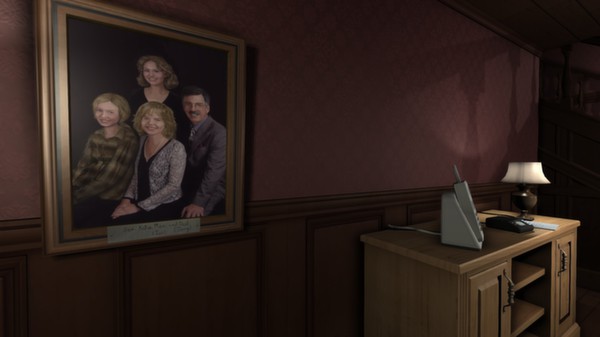
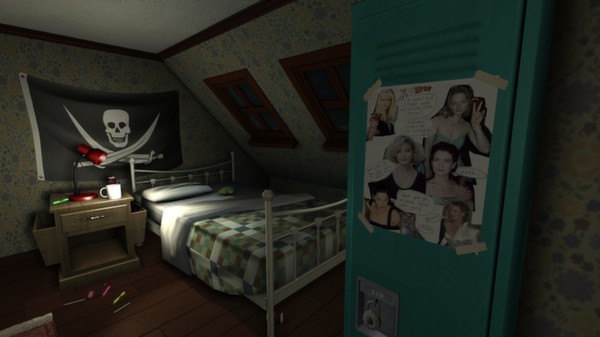
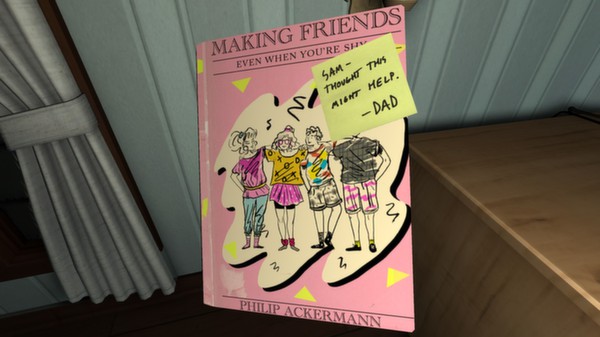
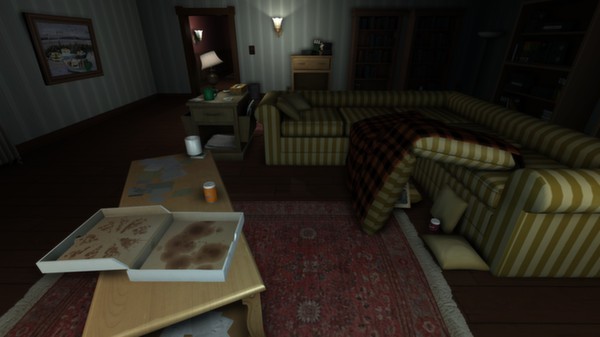
The objects do the talking: a father stalled as a novelist, a mother whose own footing is unsteady, and at the centre a year in the life of Sam, the younger sister. The positive reviews praise this as never being pushed on them — letters, cassettes and clippings thicken the picture in proportion to how much you read. It belongs to the lineage of Her Story: a story driven by observational resolution.
The negative side aims at the content. The early menace never turns into blood, the line is straight, there is no twist. One long, heavily upvoted negative review argues in detail that a character's consistency is sacrificed at the end to force a happy ending. Again the two camps grade different floors: one the shape of the reading, the other what the reading turned out to contain.
In design terms, the game spends its budget on the density of planted clues rather than on paying them off. The redundancy that keeps the story intact whichever room you enter first — the same information spread across several objects — is insurance bought to make order of reading free. The premium is that no single blow can land hard. The split verdict is a verdict on that trade.
 Gone Home library hero image — Steam store key art
Putting the Mechanics into Words
The verb set is small: walk, open doors and drawers, pick up an object and turn it, read, listen. The store page states outright that there is no combat and no puzzles, and that you can play at your own pace 'without getting attacked, stuck, or frustrated.' It is a rare case of a developer declaring the subtraction up front — what is removed is the fail state, enemies, timers, and puzzles.
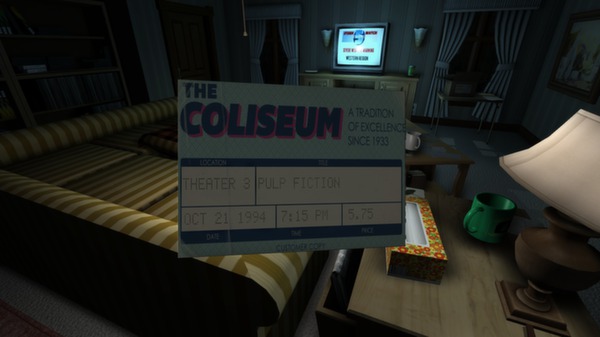
The praise the positive reviews keep repeating — that you can lift anything and read the price sticker on its base — is the flip side of verb subtraction. A verb that solves nothing is placed there for resolution, not for progress. Nothing you pick up moves the board; the only thing that moves is how the player sees.
The negative complaint, 'is this even a game,' points at the same structure accurately. If verbs do not change state, no strategy can form. It is not quite zero: safe and locker combinations survive as the one gated mechanic, which sits in mild contradiction with the no-puzzles claim — the trace of a decision to keep a minimum gate inside a failure-free design.
 Gone Home store header image — Steam store key art
Pacing and Length
Completion times cited inside the reviews scatter from just over an hour to fourteen, but they cluster at two to five. The store page itself says two to four. So the length is not being misread; what is contested is the ratio of length to price. It launched at $20, currently lists at $14.99, and drops as much as 80% on sale.
A large share of the negative reviews reduces to that ratio. The positive side answers with 'buy it on sale' and 'read the tag that says short.' What is striking is how little the argument has moved between 2013 and now. Recent reviews have thinned to a few dozen a month, and the positive rate stays close to the lifetime figure (it drifts between roughly 65% and 73% depending on when and how you read it).
As design, the length looks like a target rather than an oversight: one house, read through in a single sitting that needs no break. With no branching and no retry, a second run is worth little. Shortness is part of the subtraction — and the subtraction simply failed to agree with the price list. Set beside Unpacking, another short piece told entirely through objects but with a far higher positive rate, the gap looks more like pricing and expectation management than quality.
 Gone Home hero capsule image — Steam store key art
Sources
This piece was written by reading the Steam user reviews and hub posts as of 2026-07-31. No review text is quoted directly; typical claims are reconstructed.
- Steam: Gone Home (Mostly Positive; 77% of 13,583 reviews from Steam purchasers, and 14,201 positive against 4,211 negative across all 18,412 reviews; 77% of 10,864 English reviews; Russian is Mixed at 512)
- Read via WebFetch: the top 10 most helpful English reviews (all time), 5 from the recent view, the top 10 most helpful Russian reviews, and 4 individual review permalinks including one Not Recommended — 29 in total. Plus the hub threads 'Game definitely NOT worth it' and 'What the heck is up with the reviews?' with their replies.
- Press and data: The Escapist, 'Gone Home Has Left An Enduring, If Divisive, Legacy', and public metadata from SteamDB (Metacritic 86, released 2013-08-15, developed by Fullbright, published by Fullbright / Serenity Forge)
- Note: image files could not be downloaded for visual checking in this environment, so the figures are limited to Steam official store assets whose type is certain (capsule, header and library images), with generic captions. No screenshots are used.
Closing
Steam's overall figure is 77%, which converts to roughly 7.7 out of ten — almost exactly my 8.0. The 0.3 I add is for one thing: this game was built after its subtraction had been declared. Inside a failure-free space it cuts the verbs loose from progress and raises only observational resolution. In 2013 that arrangement was notably deliberate.
Who it suits is legible straight from the reviews. It suits people who want to open every drawer, who like inferring a person from their possessions. It does not suit people who want resistance or a solution to find. That is a question of design scope, not of quality — the developer wrote 'no puzzles' first, and kept the promise. The press score (Metacritic 86) sits above the user 77% partly because criticism does not deduct for what lies outside a work's declared scope.
One last note about the review pool itself. The hub has long-standing complaints that helpfulness votes fall unevenly here. An aggregate is not the average of opinion; it is also a product of voting behaviour. So the right way to use the percentage is as an entrance to the material, not as a conclusion — especially for a game where the split runs along reading speed rather than difficulty.
 Gone Home library portrait capsule — Steam store key art
Where are you with this game?
Press one and the game goes on your shelf. You can see it on your account page.
Reactions (no login)
Anonymous • one of each per visitor per day
Read next

Related reviews
Tacoma
A first-person exploration adventure set aboard an emptied space station in 2088, where you replay, rewind and walk around volumetric recordings of its six-person crew to reconstruct the days before they left. From Fullbright, the studio behind Gone Home.
La-Mulana
A 2D exploration-puzzle action game in which an archaeologist descends into the vast ruins of La-Mulana with a whip and a laptop, decoding tablet inscriptions while surviving traps and monsters. NIGORO's remake of their own MSX-inspired maze game, ported to PC.
FEZ
An exploration platformer where you rotate a 2D world in 90-degree turns, shifting how the plane reads to connect platforms. Collect cube fragments while wandering a crumbling world — Polytron Corporation's signature take on rotation.


