REVIEW · 2019-03-05
The Occupation
When the unit of retry is one real hour
First Impressions
Counting all languages and all purchase types, Steam records 247 positive out of 413 reviews: about 60%, labelled Mixed (snapshot 2026-09-19). As splits go, that is a clean one.
The professional verdict lands in nearly the same place. OpenCritic averages 67 with 29% of critics recommending; Metacritic's PC page shows 68. Users and critics rarely agree on a number like this.
The positive pool keeps returning to tension, immersion, characters who move on a timetable, choices that carry weight. The negative pool keeps returning to no saving mid-chapter, dialogue you cannot skip, awkward controls, and run-ending bugs.
Listed side by side they look like two different subjects. Read further and both sides turn out to be pointing at one dial: this game's unit of retry is one real hour.
 Key art for The Occupation — Steam store key art
Putting the Mechanics into Words
The setting is Saturday 24 October 1987, in North West England. Per the store description you play a journalist, slipping into restricted areas and interviewing people to gather evidence. You have roughly four hours, and the in-game clock runs at the speed of the real one.
In Puzzlebyrinth's vocabulary, this game has no undo verb. Most puzzles rewind one move at a time. Here the smallest rewindable unit is a chapter: somewhere between fifteen minutes and an hour of real time.
What the positive pool calls tension and the negative pool calls unfair is one number. Enlarge the unit of retry and every move gains weight, and every mistake gains a price. The two sides are describing the same lever with opposite signs.
Observation also carries a price here. In Return of the Obra Dinn and The Operator, looking was free. In this game looking and acting are drawn from the same purse, which wires environmental observation straight into the resource.
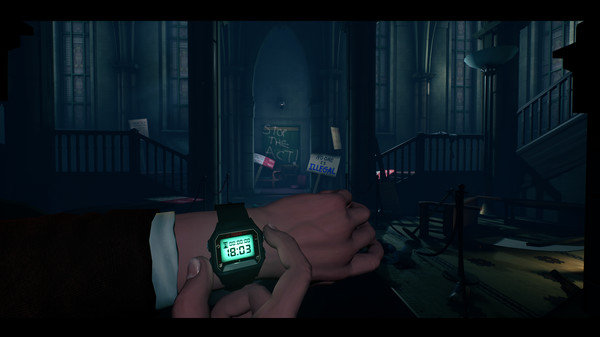 The Occupation in play — image 1 as listed on the Steam store page (Steam store screenshot)
The World
The thing both pools agree on is the building. A 1987 office block, papers on desks, objects placed with care. Even reviewers voting the game down write that it looks superb.
Characters moving on a timetable comes up almost as often. People are somewhere specific at a specific hour, and you thread the gaps between them. A world that runs as a system, as the positive pool likes to put it.
Density and breadth get graded separately, though. Hardly anyone can be spoken to, and half of each area goes unused, the negative side writes. Proof of concept rather than finished game is a phrase that also turns up in a positive review scoring it highly.
Read as design, that detail is an investment in observation resolution — and the clock will not let you spend it. Shadows of Doubt stands on the opposite side of the same problem, handing out unlimited time instead.
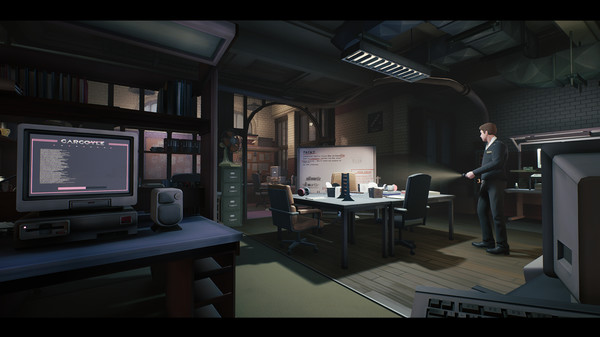 The Occupation in play — image 2 as listed on the Steam store page (Steam store screenshot)
Pacing
Five to six hours for a single run is the common figure. The median recorded playtime across the reviews I read is around eleven hours, but that number includes replays for the other endings. The game itself is short.
The problem is not length but save granularity. A chapter is the save unit, and there is no saving inside one. A pause, a mistake, or a bug all cost exactly the same thing: one chapter.
So the bug complaints read less like a deduction and more like an amplifier. Every game has bugs. A bug becomes an hour-eating bug only when the unit of retry is an hour. This is where the negative pool is angriest and most specific.
And the game expects replays. There are several endings, and the clock runs the same way each time — yet dialogue cannot be skipped. A design that invites repetition has not made repetition cheap. Outer Wilds took the opposite route with its 22-minute loop.
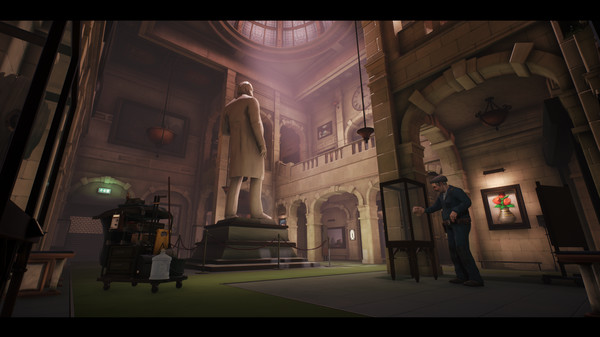 The Occupation in play — image 3 as listed on the Steam store page (Steam store screenshot)
Feel of the Controls
The most concrete complaints sit in the controls. Button combinations for a single action, almost no carrying capacity, a cursor that goes missing. Clumsy is the word that keeps coming back.
Guards split the room. Stealth is solidly built, says the positive pool. When you are spotted you are spotted instantly, says the negative one. The same moment read either as a working system or as a blunt detection check.
The same lever is doing the work again. In a game where time is the resource, a fumbled interaction is paid for in seconds. Rough controls get multiplied by the clock.
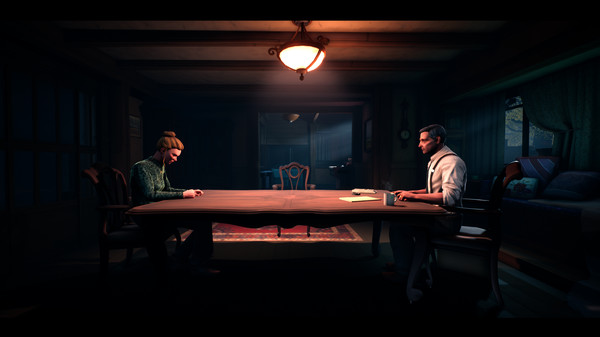 The Occupation in play — image 4 as listed on the Steam store page (Steam store screenshot)
Reviews I Read
This piece was written from the Steam store page and the Steam review API as of 2026-09-19. No review text is quoted; the recurring claims are reconstructed.
・Steam: The Occupation (counting all languages and all purchase types gives 247 of 413 = about 60%, labelled Mixed, snapshot 2026-09-19)
・30 reviews read in total: the 12 most helpful positive, the 10 most helpful negative, and the 8 most recent. The critical reception was checked against OpenCritic (average 67, 29% recommending) and Wikipedia's reception section (Metacritic PC 68).
・Developer, release date and description follow the Steam store listing. The publisher is currently listed on Steam as Balor Games; at release it is recorded as Humble Bundle. Images are the screenshot URLs and header image returned by Steam's appdetails API, copied verbatim. This session's network could not open the image files themselves, so only the existence of each URL was verified and the captions deliberately make no claim about what is shown.
Closing
Against Steam's 60%, OpenCritic's 67 and Metacritic's 68, I land on 6.5. Roughly the same place, for a slightly different reason. What I mark down is not the bug count but the fact that the hour-sized unit of retry was never matched by an hour worth polishing.
The idea itself is real. Very few thinking games put real time on the board and draw observation and action from one resource. The question this game asked in 2019 has not been answered since.
The honest framing is one of range. If you can spend an uninterrupted hour and take the losing as part of it, the tension here has no substitute. If you want to stop often, or to learn by trying things, the price is too high. The difficulty lives on the side of losing, not on the side of the puzzle.
 The Occupation in play — image 5 as listed on the Steam store page (Steam store screenshot)
Where are you with this game?
Press one and the game goes on your shelf. You can see it on your account page.
Reactions (no login)
Anonymous • one of each per visitor per day
Read next

Related reviews
Unheard - Voices of Crime
A deduction adventure played over a top-down floor plan: you move between rooms and scrub a recording of the day back and forth, listening. There are no subtitles — you name the figures and answer the case questions using only what you heard. From NExT Studios.
Hypnospace Outlaw
An observation adventure set in 1999. You patrol Hypnospace — a virtual internet people browse in their sleep — as a volunteer Enforcer, wandering personal homepages and digging out rule violations and hidden pages with nothing but a weak search box and thin clues. Designed by Jay Tholen at Tendershoot.
Phoenix Wright: Ace Attorney Trilogy
A courtroom adventure in which you play defense attorney Phoenix Wright, matching one line of testimony against one piece of evidence to break a lie. Capcom's collection gathers all fourteen episodes of the three games first released between 2001 and 2004, with the art redrawn frame by frame.


