REVIEW · 2013-07-23
Ittle Dew
Two items only, all the way down
First Impressions
Across all languages the review pool holds 1,345 entries, 1,234 of them positive — 91.7%, labelled Very Positive (snapshot 2026-09-16). High for a small 2013 release.
Yet in the helpful-sorted positive reviews the praise lands on one spot only: the puzzles are well designed. Combat and story are barely praised at all.
The negative side attacks exactly those two. The two camps are not disagreeing so much as dividing the labour — grading different organs of the same game.
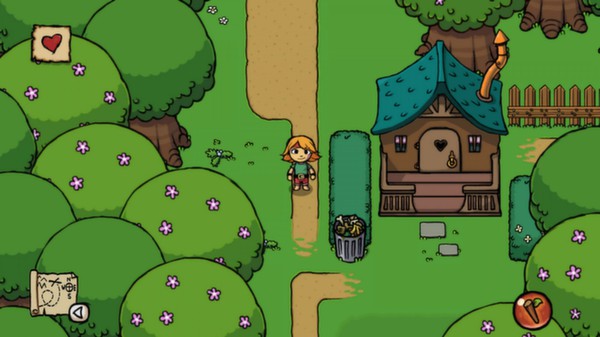 A gameplay screenshot of Ittle Dew, the 1st on its Steam store page — Steam store screenshot
Putting the Mechanics into Words
There are only three items: a fire sword, an ice wand, a portal wand. Gamezebo's review states the main plot can be finished with any two of them; all three are needed for 100%.
What fills the rooms is block pushing. The negative side writes "almost entirely block puzzles"; the positive side writes "surprisingly varied from the get-go". Same boards, opposite verdicts.
In our vocabulary the verb set here is nearly a single verb: push. The two wands do not add verbs — they rewrite where a push can travel, much as logs do in A Monster's Expedition.
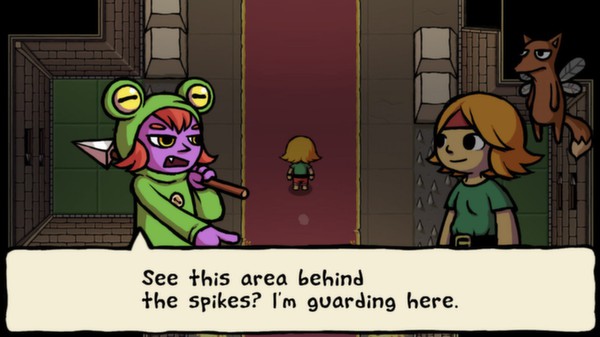 A gameplay screenshot of Ittle Dew, the 2nd on its Steam store page — Steam store screenshot
Subtraction
"Finish with any two" is a design that refuses to let the player accumulate. You do not get stronger as items pile up; the rooms re-solve themselves around what you lack.
One positive reviewer says the different tool combinations are why the game keeps pulling them back. Another calls the way items interact to re-solve the same puzzle "pretty smart". What is praised is the absence, not the addition.
A recent review mentions a "Just Dew It" achievement, apparently for a run taken without buying items — the author's own marker for how far the subtraction can be pushed.
Subtraction is not a mercy applied to difficulty. Take options away and each remaining move gains weight. Choosing two of three is, on its own, worth the price of entry.
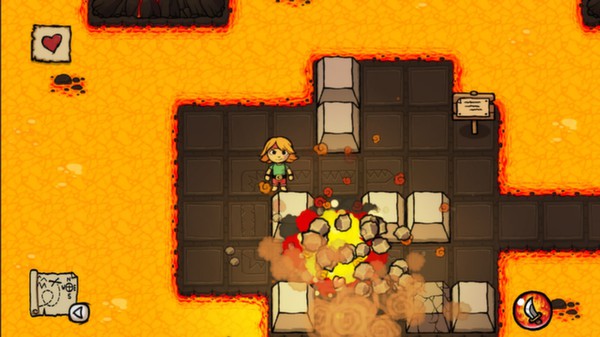 A gameplay screenshot of Ittle Dew, the 3rd on its Steam store page — Steam store screenshot
The Texture of Difficulty
Few games split this cleanly on difficulty. "You need to think for minutes or even hours" and "quite simple, nothing spectacular" are said about the same rooms.
The split has a cause. Sort the negative reviewers' sticking points and you get two kinds: mechanics demanded before they were taught, and solutions already known but hard to execute quickly.
The first is a hole in the learning curve; the second is not a puzzle problem at all but a controls problem. Neither is the logic of the board. The negative votes cluster outside the puzzle.
Leaving a room and re-entering resets it. There is no undo, but retrying is cheap — the opposite of a high-cost explorer like La-Mulana.
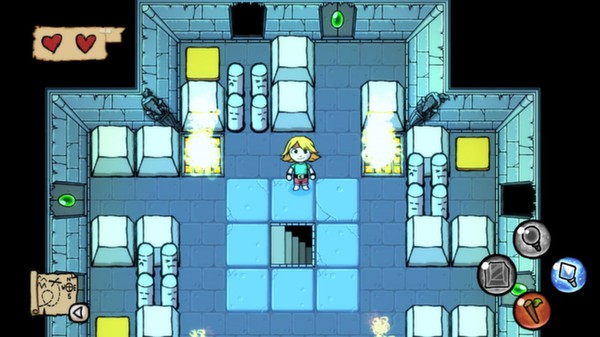 A gameplay screenshot of Ittle Dew, the 4th on its Steam store page — Steam store screenshot
Feel of the Controls
The sharpest negative language is reserved for the bosses: hitboxes that "do NOT follow that grid pattern", a room you cannot see most of, no boss health indicator. Every complaint points at missing information.
The boards move on a grid; the fights step off it. That mismatch is the problem. The observational resolution the puzzles carefully built becomes unusable the moment a boss appears.
The positive side does not defend this either. "Memorise their movements and you win" is as far as it goes — which is praise for memory, not for reading a board.
There are also control-bug reports: a gamepad input sticking in one direction, high in the helpful negatives, with the reviewer understanding no further patch was coming. Worth knowing before starting a 2013 title today.
 A gameplay screenshot of Ittle Dew, the 5th on its Steam store page — Steam store screenshot
Reviews Referenced
This piece was written from the user reviews on the game's Steam store page as of 2026-09-16.
・Steam: Ittle Dew (Overall 91.7% positive, 1,234 of 1,345 reviews, labelled Very Positive)
・Read via the Steam review API: top 10 helpful positive, top 10 helpful negative, top 8 recent — 28 reviews in total
・Gamezebo: Ittle Dew Review (Jillian Werner, 90/100) — source for the any-two-of-three item rule and the roughly three-hour playthrough
・Images are official screenshot URLs returned by Steam's appdetails API. In this run the image CDN was unreachable, so the pictures could not be opened one by one; captions therefore say only which screenshot it is and describe no scene.
Closing
Steam's overall sits at 91.7%; from a design standpoint I give it 7.5. The puzzle layer alone would be close to 9. The combat and bosses wrapped around it pull the whole down, and that is where the gap comes from.
Playtimes cited in the reviews cluster around four to six hours, and Gamezebo puts a standard run near three. Short — but the kind of short a positive reviewer calls "not bored for a single second". It belongs beside titles that chose brevity, like Toki Tori 2+.
Who it suits is unusually clear. Come for the block-pushing boards and it is easy to recommend. Come for adventure texture or satisfying combat and it will bore you inside half an hour. That is reach, not rank.
 A gameplay screenshot of Ittle Dew, the 6th on its Steam store page — Steam store screenshot
Where are you with this game?
Press one and the game goes on your shelf. You can see it on your account page.
Reactions (no login)
Anonymous • one of each per visitor per day
Read next

Related reviews
Brothers - A Tale of Two Sons
Two brothers set out to find the Water of Life for their dying father. The left stick moves the older brother and the right the younger, both at once, and you cross ravines, waterways and the bones of giants by pairing what each of them can do. Every line is spoken in an invented language. Directed by Josef Fares at Starbreeze Studios, released in 2013.
Tetrobot and Co.
A grid-based thinking puzzle in which you steer Psychobot, a microscopic repair robot, swallowing and spitting blocks to mend the insides of a broken giant. Swing Swing Submarine build fifty-odd levels out of little more than three materials — wood, sand, stone — and one rule: like sticks only to like.
Magrunner: Dark Pulse
A first-person puzzler in which a Magtech glove charges cubes and platforms so that like colours attract and opposites repel, carrying you through 40-plus test rooms. Frogwares' 2013 game pours Lovecraft's Cthulhu Mythos into a Portal-shaped mould.


