REVIEW · 2018-01-11
Rusty Lake Paradise
A hand-drawn island of ten plagues — reading the debate over its obscurity
First Impressions
I wrote this by reading the Steam reviews for Rusty Lake Paradise, not by narrating a playthrough of my own. It is a hand-drawn point-and-click from Rusty Lake (2018), set on an island sinking under the ten plagues of Egypt after a mother's death. Across all languages, 7,416 reviews sit at 95% positive, labelled 'Overwhelmingly Positive'; in English alone, 1,232 reviews at 93% 'Very Positive' (2026-07-25 snapshot).
By the numbers it is beloved. Yet the most repeated proper noun in the helpful reviews is not the game's name; it is 'Rusty Lake,' the series. 'Recommended for dedicated fans, but not as your first game' recurs even inside the positive reviews. The praise assumes you read this within the context of the series.
So from the first impression the game asks for prior knowledge. In my vocabulary, Rusty Lake spends several games teaching a private grammar, and Paradise is the advanced seminar. It shares hand-drawn surrealism with Gorogoa and closed-room observation with The Room, but here it insists you learn its macabre grammar before it lets you solve.
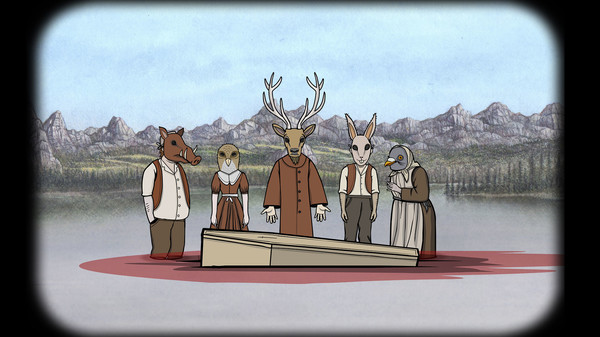 An animal-headed family around a wooden coffin by the lake — Steam store screenshot
The World
On the world, the positive reviews agree on three things: atmosphere, music, and the hand-painted backgrounds, reportedly by the Dutch painter Johan Scherft. Reviewers call the craft 'flawless.' Grafting the ten plagues onto a family's memories and rituals reads as 'distinctive' to many.
The negative side reads the same darkness with the opposite sign: 'too heavy,' 'weird for the sake of weird,' 'overstayed its welcome.' There is no point stoking that conflict. The density of the dark is an authorial choice, aimed at viewers who can tune to it.
In design terms the paintings are not decoration; they are where the solutions hide. Rusty Lake is a contest of observation resolution, of which smudge you decide is 'meaning.' Beauty and difficulty live in the same frame, which is why this world produces awe and confusion from a single source.
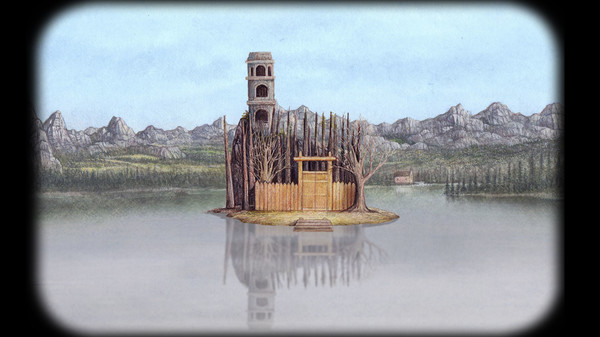 A tower on a small island mirrored in a misty lake — Steam store screenshot
Putting the Mechanics into Words
The mechanics are the basic point-and-click verbs: look, pick up, combine, place. There are only a handful. And yet reviewers keep repeating one piece of advice: do not expect real-world logic, expect Rusty Lake logic. 'Plant a seed expecting a flower, and a bloody hand grows instead,' one writes.
This is verb subtraction working on a second axis: the input verbs are few, but the causal grammar they connect to is cut loose from reality. What players actually learn is not controls but a private system of association, where blood, ritual, family, and plague all point at each other. The positive reviews report acquiring that grammar as the pleasure itself.
Fail to internalise it and everything looks like arbitrary guesswork. The 'illogical and verbose' complaint is the voice of a reader whose observation resolution the associative leaps outran. The same screen is a poem to those with the grammar and noise to those without.
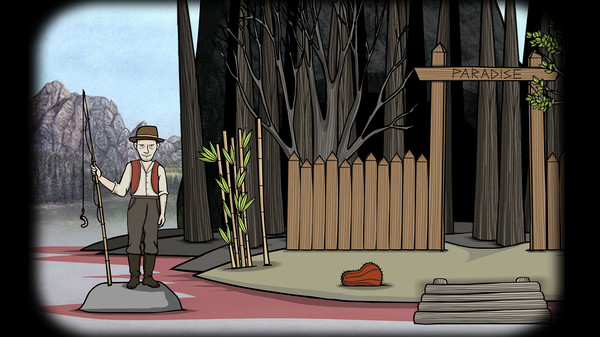 The protagonist at the PARADISE gate, objects on the ground — Steam store screenshot
The Texture of Difficulty
Difficulty is where the split is sharpest. Collect where reviewers got stuck and three kinds emerge: associative leaps (seed to bloody hand), observation gates (which tiny pixel is clickable), and hintless sequence puzzles. Even a positive reviewer screams, 'how was I supposed to figure out the drum puzzle?'
Crucially, this difficulty is not combinatorial explosion. Where sokoban-likes hide difficulty in a search tree of moves, Rusty Lake hides it in interpretation. The options are few; there is just one right reading, with no guarantee it is ever shown. So whether you open a walkthrough becomes the watershed.
Tellingly, plenty of positive reviewers cheerfully admit using a guide and still recommend it; for them a walkthrough is a ticket to see the strangeness through, not a defeat. The negative side will not 'play with a walkthrough on a second screen.' Tolerance for the same act splits the score. Read against Strange Horticulture, you see how far Paradise tilts toward hiding clues in the scenery.
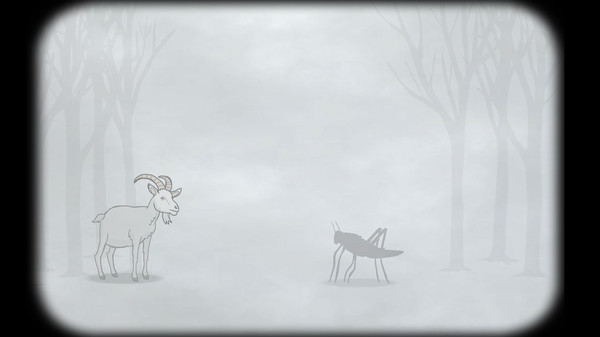 A goat and a small animal in heavy fog, a scene that hides what is clickable — Steam store screenshot
Closing
In the end, Paradise is a short, dense dish of the macabre for anyone who has tasted the series' grammar once. The median clear time cited in reviews is about three hours, and it is cheap. Steam's 'Overwhelmingly Positive' (95%) is a fair vote for that density. From a design view I give it 8.0: hiding clues in the scenery reliably throws off readers whose observation resolution does not match. Not a defect, but a narrow reach, and I mark it as one.
What is left after reading the debate is not a ranking but a picture of range. This game is not open to everyone; to those it opens to, it runs deep. That awe and confusion spring from the same frame is proof Rusty Lake dug narrow and deep on purpose. 'Not your first game' is probably the most accurate review of all.
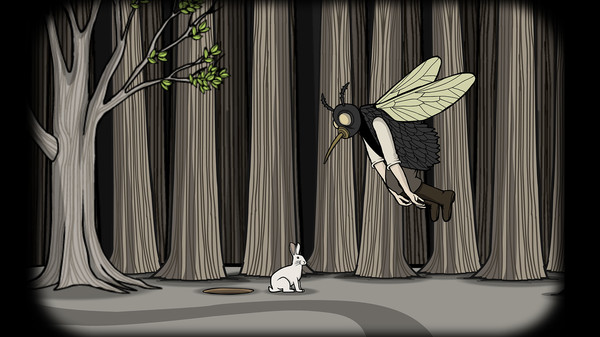 A winged figure and a lone white rabbit — the series' surreal streak — Steam store screenshot
Sources
I wrote this by reading the user reviews on the Steam store page as of 2026-07-25.
- Steam: Rusty Lake Paradise (All languages Overwhelmingly Positive 95%, 7,416 reviews / English Very Positive 93%, 1,232 reviews)
- Read the top 10 helpful positive, top 8 helpful negative, and 6 recent reviews (mostly English, with some Chinese and Portuguese recents)
- Rock, Paper, Shotgun review (professional media)
Where are you with this game?
Press one and the game goes on your shelf. You can see it on your account page.
Reactions (no login)
Anonymous • one of each per visitor per day
Read next
Related reviews
Underground Blossom
A point-and-click escape puzzle that rides down seven metro stations through the life of a woman named Laura. You buy a ticket, search each room, and reassemble the pieces of her memory. A 2023 release from Rusty Lake, the studio behind the Cube Escape series.
La-Mulana 2
A 2D exploration-puzzle action game in which Lumisa Kosugi descends into the ancient ruins of Eg-Lana with a whip and a notebook. You copy down the inscriptions on the walls and match them to contraptions several rooms away. NIGORO's sequel to La-Mulana.
The Past Within
A point-and-click adventure playable only by two people at once: one stands in the Past, the other in the Future, and every puzzle is solved by describing aloud what only your own screen shows. The past is drawn in 2D, the future in 3D. Rusty Lake's first co-op-only game.


