REVIEW · 2017-09-18
Silicon Zeroes
A meta-reading of the reviews: the single road of CPU design
First Impressions
I'm writing this not as a player but as a reader of the 247 user reviews stacked up on Steam (Very Positive, 88% positive, snapshot 2026-07-23). The first thing that struck me: the single most-helpful review isn't praise — it's a 'Not Recommended.' A 148-vote pan and a 132-vote rave sit side by side at the top.
That pairing captures the game. The helpful positive reviews call it 'a great puzzle'; the negative ones say it 'only accepts the one solution the designer had in mind.' Both are looking at the same board and returning opposite words. What makes it worth a meta-review is that they are pointing at the same spot.
My interest is translating that spot into Puzzlebyrinth's vocabulary — verbs, grammar, learning curve, subtraction, observation resolution. You wire adders, latches and multiplexers into a working CPU in a 1960s Silicon Valley startup. Where reviewers groaned, and where they gave up, tells the design story better than the premise does.
 Silicon Zeroes — Steam store key art
Putting the Mechanics into Words
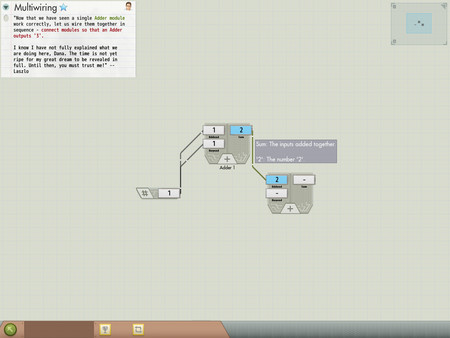
What positive reviews return to is the smallness of the parts. Adders, multiplexers, latches — you start by wiring trivial components and build up to instruction decoding, clocking, pipelining. 'It teaches CPU design without ever saying so' appears in more than one top review, and a 96-hour reviewer insists you don't need to know how the parts work to play.
The negative side sees another face in the same parts: 'real-world knowledge is a hindrance.' Solutions that work in real hardware fail on the board, while some puzzles reward degenerate designs. The most-helpful pan also flags pacing — new parts show up for a puzzle or two, then vanish before you're comfortable.
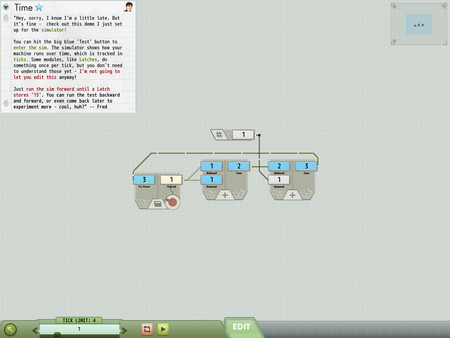
In Puzzlebyrinth terms the verbs reduce to two: place a component, draw a wire. Deep behavior from few verbs is honest subtraction. What's distinctive is the observation resolution — less abstract than Zachtronics, never down to gate level like Turing Complete. It hides the bits and shows only the layer of 'how a part behaves.' That middle resolution is, I'd argue, the source of the split.
 Silicon Zeroes — Steam store key art
The Texture of Difficulty
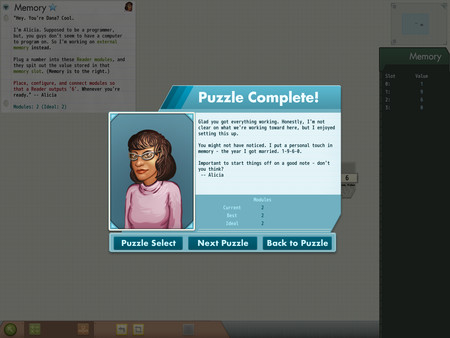
Difficulty is where opinion divides hardest. The negative case: each level has one intended optimal solution, and anything but the smallest deviation is rejected. There's no room for a 'correct but slightly slower' answer; you get bounced one or two cycles short. One reviewer wrote that it 'made me feel stupid for not thinking like the developer.'
The positive side feels the same strictness differently. A 2022 reviewer notes that later puzzles give each component its own delay, forcing you to handle indeterminate values before things settle, and calls it 'a genuine synchronization problem, like real CPU design.' Another lives for the leave-it-a-day, solve-it-later 'aha.'
One 'single solution,' read as unfair by one camp and as authenticity by the other. I'd split the friction into three kinds: insight (you can't see a part's use), optimization (you have an answer but it's a cycle or two too slow), and translation (rebuilding real knowledge into the board's rules). The pans mostly land on the second. Making optimization the condition for progress, not post-clear play, is the line that sets this game's design range.
 Silicon Zeroes — Steam achievement icon 'Ne Plus Ultra?'
Place in the Lineage
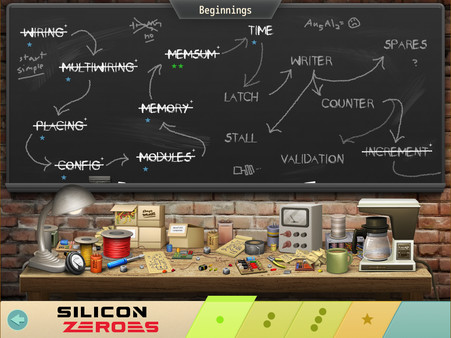
Reviewers almost never describe this game on its own terms; they borrow other names. 'I'd bet money it was Zachtronics' leads the pack, alongside SpaceChem, TIS-100, Shenzhen I/O. That Zach Barth called it 'the best game about CPU design I can imagine' gets cited often too.
The positioning sharpens after Turing Complete arrived in 2021. A 2022 reviewer triangulates by abstraction: for programming polish, Zachtronics first; for a gentle CPU intro, Turing Complete first; and in between — reaching into pipelining and vector processing — Silicon Zeroes. Some name Human Resource Machine as the entry point.
What's striking is that a later release rewrote this game's axis after the fact. A 2017 'good Zachlike' became, post-Turing Complete, 'the specialist volume for the instruction and pipeline layer.' It's read now as a missing chapter in a lineage rather than a standalone — the kind of aging only long-lived puzzles get.
 Silicon Zeroes — Steam store key art
Design Craft
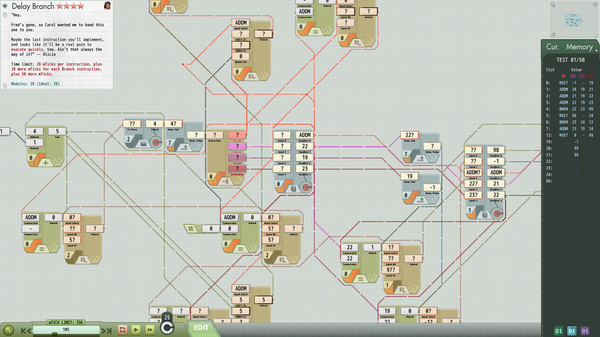
The UI is another place where the same feature splits the room. One detailed positive review calls the component-design UI 'still the best in the genre — actual hardware design, not the disguised programming of Zachtronics or the fussy wiring of Turing Complete.' The negative side lists wires that blur as they multiply (distinguished only by near-identical colors, no buses), the edit/sim mode split, a register file that defaults to 2 instead of the useful 4, and a clumsy solution palette.
Exposition divides them too. One positive review prizes 'the mystery of undefined parts you discover yourself'; a negative one resents being handed a part only to have it taken away with little explanation. The give-then-take structure is named, independently, across several reviews.
I read that give-and-take as an authored learning curve, not a fault: to teach one concept, the game withholds other tools — a temporary subtraction of verbs. Where sandbox optimizers say 'here's everything, go minimize,' Silicon Zeroes says 'today, think with only this.' The thin exposition is the same instinct in reverse: it keeps the observation resolution low enough to leave room for discovery. That reviewers still see the developer answering the community supports reading this as design, not neglect.
 Silicon Zeroes — Steam achievement icon 'Visionary'
Reviews I Read
This article is written from the Steam user reviews as of 2026-07-23 — a reading of the reviews, not a playthrough.
・Steam: Silicon Zeroes (Very Positive; 88% of 247 English reviews positive / 246 positive, 36 negative across 282 all-language reviews; 2026-07-23 snapshot)
・Read ~20 English reviews sorted by Helpful, positive and negative, spanning 2017–2022. The most-helpful review (148 votes) is a pan; the runner-up (132) is a rave.
・Cross-checked against the Thinky Games game page and Metacritic user reviews.
Closing
To sum up: Steam's verdict is Very Positive, 88% of 247 English reviews (2026-07-23 snapshot). But as the most-read review being a pan shows, this isn't a welcome extended to everyone. Cited playtimes scatter roughly across 5–15 hours, with recurring notes that it's 'a bit short' and that only a handful of puzzles are truly hard. From a design standpoint I give it 8.0 — a notch below the 88% because that one line, optimization-as-gate, genuinely turns some readers away.
I still won't call that a failure. Refusing 'correct but slow' is what makes this a design textbook, not an optimization sandbox. Who it's for is clear: anyone who wants to build a CPU's insides by hand and can enjoy sleeping on a stuck puzzle. Those after quick wins or free experimentation will be happier with an open optimizer like Opus Magnum.
When praise and blame point at the same spot, there's an author's choice underneath. Silicon Zeroes chose to trim the freedom of solutions in order to walk you down the single road of CPU design to its end. At the end of that road sits the reviewers' refrain — 'I built a processor myself.' Enter knowing the design range, and it's still a solid volume.
Silicon Zeroes — Steam store key art
Where are you with this game?
Press one and the game goes on your shelf. You can see it on your account page.
Reactions (no login)
Anonymous • one of each per visitor per day
Read next
Related reviews
MHRD
A text-only puzzle game that starts you with a single NAND gate and has you write hardware in a small description language: ANDs, adders, and finally the design of a working CPU. You play a new hire at a fictional company called Microhard, filling twenty-odd specifications in order. Made by Funghisoft.
Human Resource Machine
A puzzle game where you feed a dozen commands to a tiny office worker between an inbox and an outbox, building 'programs' from sorts to multiplication to prime factorization. From World of Goo's Tomorrow Corporation, it hands you assembly-style thinking via drag-and-drop.
SHENZHEN I/O
A programming puzzle in which you play an engineer at a fictional Shenzhen firm, writing terse assembly for cramped virtual microcontrollers and wiring circuits onto a board to build client products. Zachtronics ships no tutorial — its 30-plus-page datasheet manual is the first puzzle.


