COUNTER-REVIEW · 2026-09-03
Counterpoint on Untitled Goose Game — Reading Through the Negative Reviews
What Komugi's review didn't say
Introduction
Komugi's review gave Untitled Goose Game a 7.5 — a stealth comedy from House House, released in 2020, where two verbs (honk and grab) are enough to throw a whole neighborhood into chaos. I went to read the negative side of that praise. Untitled Goose Game — official Steam store asset
Steam calls it Overwhelmingly Positive: 96% of 10,244 reviews as of September 2026. But open the ten most-helpful negative reviews, and eight of them point at the same thing — price and length. This piece is my own read of what those eight, and the remaining two, actually say.
Komugi herself already flagged the gap between the praise and the backlash. The way the design turns a neighborhood's reactions into the board itself is genuinely clever, she wrote — but nothing accumulates across the four gardens. I borrow that line and test each negative claim against it, one at a time. Some I'll agree with. Some I won't.
What the negative reviews say
Reading the most-helpful, most-recent, and negative-only review pages together, the claims cluster into five patterns.
First: short for the price. The single most-helpful negative review (674 helpful votes) sums it up as "$2 worth of fun with a $20 price tag." Another with 600 votes says "$20 for 2 hours" is hard to justify. A two-hour main campaign, four to five hours for every achievement — that's the range several reviews repeat.
Second: too few verbs and too little variety, which makes it feel repetitive. The player's actual verb set is honk and grab, full stop. Some reviewers call the tasks monotonous busywork; others say the novelty fades within minutes and nothing is left afterward. Third: the controls, especially on PC, feel bad. One review calls the movement "painfully clunky," and a more specific complaint says the aim-and-grab hitbox doesn't tighten up on mouse-and-keyboard, which gets in the way of solving the puzzle itself.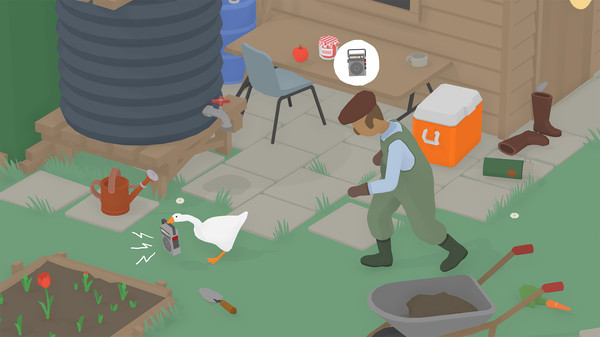 Causing mischief for the neighborhood (Steam store screenshot)
Fourth: skepticism about the hype. One review with 44 votes argues that YouTube popularity has inflated the score beyond what the game actually delivers. Fifth: the two-player co-op mode feels rough, and any miscommunication between players turns straight into frustration. One Russian-language review jokes, "Lost a friend over this. Not recommended."
Examining 1 — is the price complaint fair, and is the repetition a flaw
It's too quick to wave off "short for the price" as a mere feeling. A two-hour campaign at $19.99 is a fixed fact, and it's not just a pricing problem — it's also a structural one, about how little the sense of progress grows as you play. Komugi herself docked points for exactly this: "no staircase of learning between the four gardens." Much of what I read in the negative reviews is the same fact, restated in dollars.
What about "too few verbs"? Cutting verbs down to a minimum is a design move used again and again across puzzle games, and choosing depth from a small toolkit isn't a defect by itself. Honk and grab are enough to make each garden's mischief work differently — so I don't think the verb count itself is a fair target.
But "the verbs never grow" and "using them never gets harder garden to garden" are two different claims. What the negative reviews call repetitive, I read as the second one — a lack of escalating difficulty. That's a problem with how levels are sequenced, not with the verb design itself.
Examining 2 — controls, hype, and the co-op friction
The controls complaint should be split into two: the general "sluggishness" of movement, and the "loose" hit-detection when aiming a grab. The first is intentional clumsiness the theme (a goose) has already given permission for — not a flaw. Looking at it through how input schemes decide a puzzle's difficulty, the second — precise input for solving a puzzle going soft on mouse-and-keyboard — reads to me as a platform-specific gap: something tuned around a controller that leaked through on PC. That one I won't defend.
I don't agree much with the hype skepticism. Metacritic's critic scores sit at 79 (PC) and 81 (Switch) — a scoring path with nothing to do with YouTube virality, and one that lands roughly in the same range of approval. "The buzz built the score" doesn't actually account for how broad that critical consensus is.
On the co-op friction, I side with the defense too. Looked at through information asymmetry in cooperative puzzles, turning miscommunication itself into the joke is the standard move for co-op comedy — the same structure that gets games like Overcooked praised. "I lost a friend" reads to me less like evidence the design failed, and more like evidence the joke landed.
Where I agree
My strongest agreement is about value at full price. Komugi's review flags "nothing accumulates" as a design observation; the negative reviews say "$20 for 2 hours" in everyday terms. Those are two sides of the same fact. Admitting the design is clever and asking whether $19.99 matches the current amount of content are two different questions — and the negative reviews answer the second one correctly.
I also agree about input precision on PC. The goose's wobble is a performance the theme permits, but aim going soft when you're actually trying to solve a puzzle is a separate problem. I think this is a genuine blind spot in Komugi's review, on the practical, solve-it-yourself side of things.
Where I disagree
I push back on "YouTube popularity inflated the score." Critical media scored it highly too, through a channel that has nothing to do with streaming virality. Using popularity as evidence of shallowness gets the order of causation backwards.
I also don't accept calling the co-op friction "a broken implementation." The base game's co-op was never built as a competitive test of precise division of labor — it's designed to turn miscommunication itself into the joke. Writing "not recommended" over a memory of not syncing up with a friend misreads the intent. If anything, it reads to me as testimony that the co-op landed exactly the laugh it was built for.
Reviews consulted
This article was written from Steam's store page and community user reviews as of 2026-09-03. No review text is quoted directly; the claims below are reconstructed typical arguments.
· Steam: Untitled Goose Game (Overwhelmingly Positive / 96% positive, 10,244 reviews, 2026-09-03 snapshot)
· Read the top 10 most-helpful negative reviews and 10 default-sorted negative reviews via the Steam appreviews API.
· Critic scores (79 PC / 81 Switch on Metacritic) are as cited in Komugi's review (2026-08-28).
Closing
So here's the purchase verdict. If you want the sense of escalating difficulty across gardens, or you're strict about value at full price, skip this one. That's exactly the weakness the negative reviews get right.
If you want to laugh for about two hours, or enjoy co-op chaos with family or friends, it's still an easy recommendation. Just wait for a sale — it's dropped as low as 65% off, around $7, before (per the SteamDB record Komugi's review cites).
Komugi scored it 7.5 as a design achievement, and I won't argue with that number. But as a buying decision, I'd put it differently: the verbs are cut down beautifully. The balance between length and price just doesn't hold up at full price. Buy it on sale.
Reactions (no login)
Anonymous • one of each per visitor per day
関連シリーズ
The Counter-Review第21回 / 全23回