REVIEW · 2020-09-23
Untitled Goose Game
The praise is one word, the complaints are arithmetic — what a fully subtracted design does to its own review pool
First Impressions
I did not play this one. I am reading how its verdicts piled up. Numbers first: 10,240 Steam reviews, 96% of them positive, sitting in the "Overwhelmingly Positive" band (snapshot 2026-08-28). The last thirty days add 357 reviews at 97%, which is a lot of motion for a game almost six years old. Counted across all languages, SteamDB puts it at roughly 25,000 reviews and 93.71%.
Open the helpful-sorted list, though, and something odd happens. Close to half of the ten most helpful positive reviews are ASCII art or a single word. The top one, at 771 votes, is three letters: "H O N K". Another, at 533, says it is a short game but a goose game, 11/10. Almost none of them discuss design.
The negative top ten, by contrast, is startlingly uniform. Eight of the ten are about price, and most of them concede that the game is funny before turning the thumb down. The most helpful of them, at 744 votes, boils down to: it will make you laugh, but not at this length for this money — wait for 40% off.
The praise fits in one word; the complaints are arithmetic. Whatever is deciding the sign of a review here, it is not whether the reviewer had fun. I want to read that as a consequence of the design rather than as laziness in the voting.
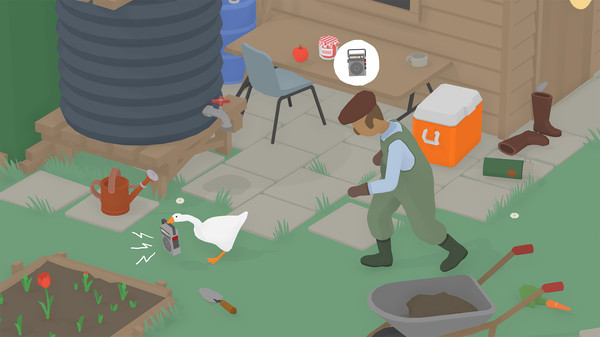 Untitled Goose Game — Steam store screenshot (no. 1 in the store listing)
Putting the Mechanics into Words
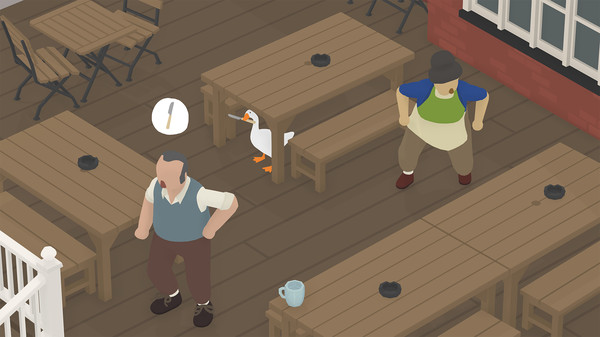
The player holds two verbs, really. Honk, and carry. Everything else is a modifier: run, crouch, spread the wings. The board is just as thin. A to-do list opens in the corner of the screen and tells you in plain words to steal the gardener’s hat, or to ruin the picnic.
A top Japanese review puts it well: the to-do list makes the goal unambiguous. That is the load-bearing part. Most puzzles begin by making you guess what you are supposed to want. This one hands that over up front, and what is left is only how.
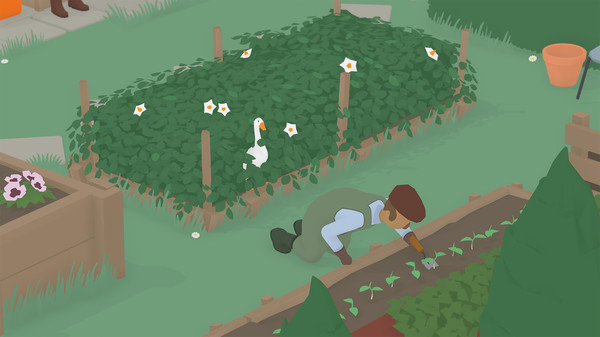
And the how has several routes. Another Japanese reviewer notes that each area’s pranks can be completed in more than one way. Three variables — where a villager is looking, what they are holding, where they are headed — can be knocked over in any order. It is not as extreme as Mosa Lina, which sells that freedom outright, but the solution is plainly not a single line.
What was subtracted is the verb count, not the option count. That is exactly the lineage traced in the subtractive-design piece. With two verbs a player can enumerate the combinations, and once they can enumerate them, the board fits in their head.
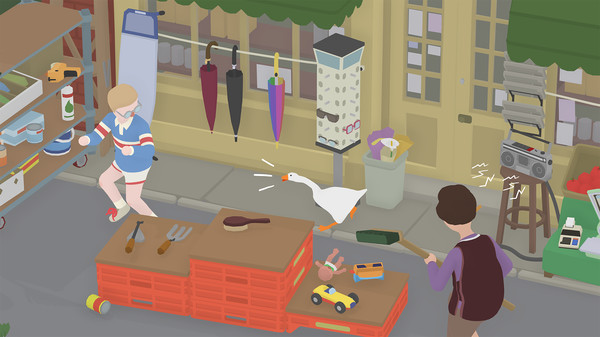 Untitled Goose Game — Steam store screenshot (no. 2 in the store listing)
Design Craft
The same complaint shows up on the negative side in both languages. The controls are clunky. The goose is slow. Grabbing an object needs precision, while the villagers take it back with none. One reviewer refunded at 0.7 hours and called the tasks chores.
And yet the positive side records almost the same observation. One Japanese reviewer writes that the awkward handling is forgivable precisely because you are a goose — that specifications you would never accept from a human character make sense here. Two people watching the same waddle, one calling it a defect, the other calling it agreement.
That is the sharper reading. The lumbering walk, the beak that misses, the slow turn: the subject matter granted permission for all of it in advance. The theme is not an excuse for the specification; the theme rewrites what the specification means. A nimble goose would sink this game.
In Caillois’ terms the drive at work is mimicry (the four drives of play). If the thing you are playing is allowed to be bad at moving, badness stops being a property of the controls and becomes a property of the character. But the conversion only holds while the player is willing to perform the goose. For the person who quit at 0.7 hours, all that is left is a sluggish avatar.
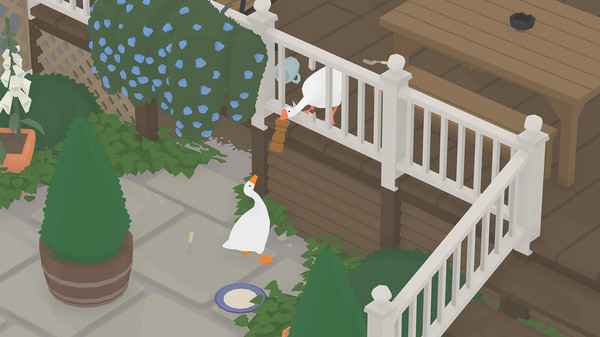 Untitled Goose Game — Steam store screenshot (no. 3 in the store listing)
Subtraction
The main game has almost no hard walls. Japanese reviewers call it a simple stealth game that anyone of any age can enjoy; the English review with 468 votes is a six-year-old playing it with their dad. You cannot fail out. Get caught and a villager simply takes back whatever was in your beak.
The difficulty has not been deleted, though. It has been moved. Of the timed challenges that unlock after the credits, a Japanese reviewer says they are brutal. The hard version exists, quarantined somewhere only the people who want it will go.
The vertical wall described in the learning-curve piece is never built inside the main game here. It stands outside it. For a game a child and an adult can share on one pad, that is the right call. It has a side effect all the same.
A game with nowhere to get stuck offers no handle to criticise. If you cannot talk about difficulty and you cannot talk about bugs, one axis is left: quantity. That, I suspect, is why eight of the ten most helpful negative reviews landed on price. Subtraction moves the target of complaint along with everything else.
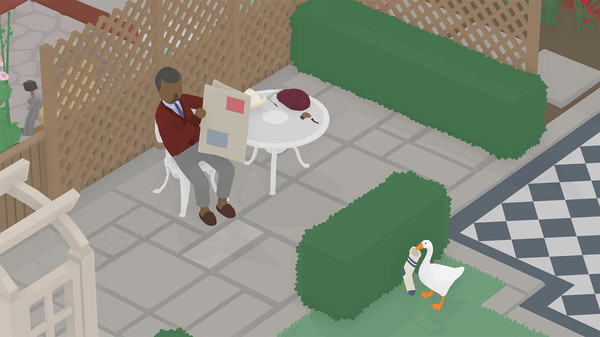 Untitled Goose Game — Steam store screenshot (no. 4 in the store listing)
Pacing
The shape, in numbers: four gardens plus a short finale that stitches them together. Reviewers keep landing on roughly two hours for the main run and four to five for full completion. The list price is $19.99, or 1,980 yen in Japan.
The negative wording is dry. Twenty dollars for two hours is not happening. Two dollars of fun with a twenty-dollar tag. One reviewer works out the per-hour cost against a cinema ticket. A top Japanese review makes the same complaint while still ticking "recommended".
What matters is that the reservation does not stay on the negative side. Among the reviews posted in late August 2026 is a recommendation that says the co-op was lovely but the game is short, so wait for a sale. The price caveat is shared across the line. SteamDB records a low of $6.99, a 65% cut.
Shortness is not itself a fault. Minit and Unpacking both turned brevity into structure. What catches here is that the four gardens sit side by side rather than stacking. The insight you use in the last garden is close to the one you used in the first, so there is nowhere for the expectation of another floor to go.
 Untitled Goose Game — Steam store screenshot (no. 5 in the store listing)
Reviews Consulted
This piece was written from the Steam user reviews and supporting material available on 2026-08-28. No review text is quoted directly; recurring claims have been reconstructed instead.
· Steam: Untitled Goose Game (10,240 reviews at 96% positive, "Overwhelmingly Positive"; 357 reviews at 97% over the last 30 days, snapshot 2026-08-28)
· The ten most helpful positive reviews, the ten most helpful negative reviews, the ten most helpful Japanese-language reviews and the eight most recent — 38 in total.
· SteamDB: Untitled Goose Game (about 25,000 reviews at 93.71% across all languages; historical low of $6.99, a 65% cut)
· Metacritic: Untitled Goose Game (PC metascore 79 from 20 critics; Switch 81 from 49 critics; Switch user score 7.7 from 430 ratings)
· Background facts — the four-person team, Unity, the 2019-09-20 original release and the 2020-09-23 Steam version with its free co-op update, the 2020 DICE and GDCA Game of the Year awards — were checked against the Wikipedia article.
· Note: every image here is an official screenshot served by the Steam store. This writing environment could not open the image files themselves, so the captions identify nothing specific and stay with the store listing order.
Closing
The Steam thumb is binary. It asks whether you had fun and whether the money was well spent, and it takes one answer for both. Here those two answers diverge. So 96% is accurate as a vote on the fun and lossy as a verdict on the purchase.
There is corroboration. Metacritic has the PC version at 79 from 20 critics and the Switch version at 81 from 49, with a Switch user score of 7.7 from 430 ratings. Asked on a ten-point scale, the verdict settles just short of eight. What sits between 96% and 79 is probably the coarseness of the thumb.
I give it 7.5. Turning two verbs and a plain-text list into a board made of villagers reacting is deft work, and the structure by which the subject matter absorbs the roughness of the controls is elegant. The deduction is for the lack of accumulation: no staircase runs between the four gardens.
Who it suits is clear — people who want to laugh out loud, people who want to share one pad with a child, people who are content with a game that ends in two hours. Who it does not suit is just as clear: people who price a purchase by the hour. What the four of House House built is two hours dense enough that the review box only says "HONK". Whether that is expensive is a question from outside the design.
 Untitled Goose Game — Steam store screenshot (no. 6 in the store listing)
Where are you with this game?
Press one and the game goes on your shelf. You can see it on your account page.
Reactions (no login)
Anonymous • one of each per visitor per day
Read next
Related reviews
Röki
A point-and-click adventure through a snowbound forest drawn from Nordic folklore, following Tove as she gathers and combines objects to search for her sister. Polygon Treehouse's game has no combat and no fail state, carried instead by hand-drawn landscapes and a story about loss.
Evan's Remains
A 2D puzzle adventure built from single-screen block puzzles — platforms that vanish once you step off them, blocks that switch other blocks on and off — carrying the story of Dysis, a girl searching for a missing boy named Evan. A game by maitan69.
The Pedestrian
A 2D puzzle-platformer where you rearrange and wire together public signs, building a path through the signage for a little stick figure to cross a living city.


