COUNTER-REVIEW · 2026-08-27
Counterpoint on Maquette — Reading Through the Negative Reviews
What Komugi's review didn't say
Introduction
Komugi's review gave Maquette a 7.0 — half praise, half reservation. I went to read the negative side of that split.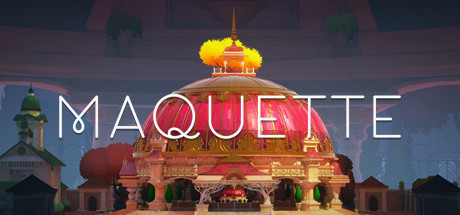 Maquette — official Steam store asset
Steam calls it Mixed. As of August 2026, 69% of 615 reviews are positive, leaving well over a quarter negative. This piece is my own read of what that negative slice actually says.
Komugi had already drawn a line: players who came for combinatorial recursion versus players who came for a prose-poem love story, sharing one store page. I read the negatives to test that line — is mismatched expectation really the whole story?
What the negative reviews say
Reading the top-rated, most-recent, and negative-only review pages together, the claims cluster into five patterns.
First: the puzzle grammar never accumulates. The single most-helpful negative review (234 helpful votes) says each puzzle discards its own rules the moment it's solved — you start from zero, every time. Several reviewers add that they couldn't tell whether they'd solved a puzzle on its own terms or just cheesed the physics.
Second: the camera and controls feel imprecise. Picking up and placing objects doesn't respond the way players expect, and movement in the large-scale world is described as painfully slow. Third: the romance plot reads as 'generic' or 'derivative' to several reviewers, who call the game a narrative wearing a puzzle game's skin.
Fourth: technical bugs and price. One negative review details a crash triggered by picking up an item in the final area — a bug the developers had reportedly known about for over a year without fixing — plus a soft-lock if you hit 'Continue' after the credits. Fifth: at roughly ten to twelve real puzzles, the pre-discount price doesn't match the content, several reviewers say. An object placed in the town model reappears at the world's own scale (Steam store screenshot)
Examining 1 — a narrow verb, a grammar that never builds
Start with 'the verb's reach is narrow.' You can nest maybe one or two objects at a time, across only three scales — small, standard, large. Next to Recursed or Patrick's Parabox, which turn nesting into combinatorial explosion, the reach really is narrow.
But that's a choice, not a flaw. As Komugi notes, Maquette uses recursion as a metaphor for scale and feeling, not as a combinatorial puzzle engine. Narrow reach is defensible as a design decision on its own.
Where I agree is with 'the grammar never accumulates.' The Witness sharpens your observation with every solved panel. What the negative reviews keep repeating about Maquette is that this build-up never quite lands. I read that as an execution problem, not an intent problem.
Examining 2 — is the story generic, and what about the bugs and price
The 'generic romance' complaint is only half right, I think. The Michael-and-Kenzie relationship beats themselves aren't especially fresh. But the structural sync — puzzles get harder exactly when the relationship frays — deserves to be judged on the mechanism, not the dialogue. Read that way, it's the same Annapurna-lineage bet as Cocoon.
The technical bugs are a separate matter. A crash in the final area, a soft-lock after picking up an item — these have nothing to do with design intent; they're straightforward quality problems. And they come with a claim that developers knew about them: the complaint recurs from a review posted in late 2023 through one posted in February 2025. Recent review activity effectively stops there, with no newer voice confirming a fix.
On price: as of my check, the game was on sale (70% off, $5.99). At the full $19.99 for roughly ten to twelve puzzles and a three-to-four hour runtime, the value complaint holds up. At sale price, it mostly evaporates.
Where I agree
My strongest agreement is with the technical bugs. This is also a genuine blind spot in Komugi's review — her analysis stays inside design theory (the verb's reach, the sync with the narrative) and never mentions a crash left unpatched for over a year, a fact that bears directly on the purchase decision. However clever a design is, a bug that halts progress never reaches the player.
I also agree that the learning curve never builds. A narrow verb is defensible as intent; a grammar that never accumulates is an execution problem — and Komugi herself concedes as much, writing that Steam's Mixed rating is 'correct' precisely because the game never fully grew that curve. On this one point, she and I are standing in the same place.
At full price, I also grant the brevity complaint. One of the negative reviews I read advised waiting for a sale. That was good advice.
Where I disagree
I push back on 'this isn't a puzzle game, it's a narrative game wearing a puzzle game's skin.' The store page itself states the game is a 'love story exploring the scale of everyday problems.' That's a stated aim, not a hidden bait-and-switch. Treating a buyer's over-trust in a genre tag as the work's own flaw is the wrong target.
I also don't accept treating 'the verb's reach is too narrow' as a simple defect. Recursed and Patrick's Parabox chose to turn nesting into combinatorial explosion; Maquette never walked in that direction to begin with. Scoring its narrow reach as 'a failed combinatorial puzzle' is scoring it against the rules of a different sport.
On both points, I read this as a mismatch of expectation, not a bad review. Here I end up siding with Komugi's own framing of 'reach.'
Reviews consulted
This article was written from Steam's store page and community user reviews as of 2026-08-27. No review text is quoted directly; the claims below are reconstructed typical arguments.
· Steam: Maquette (Mixed / 69% positive, 615 reviews, 2026-08-27 snapshot)
· Read the top 10 most-helpful negative reviews, the top 10 overall (mixed positive/negative), and the 10 most recent reviews via WebFetch.
· The technical-bug claims (final-area crash, soft-lock) come from negative reviews posted in late 2023 and early 2025.
Closing
So here's the purchase verdict. If you want combinatorial puzzle depth, or a grammar that builds like The Witness or Patrick's Parabox, skip this one. The negative reviews have that weakness right.
If you want a short first-person prose poem — the visual discovery of nesting, wrapped around a relationship metaphor — it's still worth recommending. On two conditions: wait for a sale rather than paying full price, and save often once you're near the final area, given the crash reports.
Komugi scored it 7.0 as a design achievement, and I won't argue with that number. But as a buying decision, I'd put it differently: the verb is beautiful, the grammar never quite builds, and the bugs are still there. Even so, for the final area alone, it's worth the bet — at sale price.
Reactions (no login)
Anonymous • one of each per visitor per day
関連シリーズ
The Counter-Review第20回 / 全23回
Read next

Related reviews
Maquette
Un puzzle récursif en vue subjective dans un monde imbriqué en lui-même : la maquette en son centre est le monde même où vous vous tenez, si bien que réduire ou agrandir un objet se répercute d'une échelle à l'autre — le tout porté par une histoire d'amour.
Primordia
Une aventure pointer-cliquer en 2D où un robot nommé Horatio perd son cœur d'énergie et descend, avec son petit compagnon Crispin, dans la cité de Metropol, désertée par l'humanité. Vous combinez des pièces récupérées pour relancer des machines cassées, et lisez dans les ruines les traces de qui vous a construit. Une œuvre de Wormwood Studios, publiée par Wadjet Eye Games.
Evan's Remains
Des plateformes qui disparaissent dès qu'on les quitte, et des blocs qui activent ou arrêtent d'autres blocs — c'est avec cette seule combinaison que sont construites des énigmes tenant sur un seul écran, tandis qu'on avance dans l'histoire de Dysis, une fillette à la recherche d'Evan, un garçon disparu. Une aventure-puzzle en 2D signée maitan69.


