SOUNDTRACK · 2026-09-22
Soundtrack: Brothers - A Tale of Two Sons — When Melody Speaks for Brothers Who Have No Real Words
Gustaf Grefberg / Daniele Carmosino / Christof Unterberger
Introduction — the first melody for two brothers with no real voice
Brothers - A Tale of Two Sons is a co-op puzzle-adventure that Starbreeze Studios released in 2013, where one controller moves two brothers at once, one stick each. The opening theme, playing as the brothers leave their sick father to set out on their journey, sits at roughly 70 BPM by my ear — strings and acoustic guitar walking side by side, unhurried.
Every character in this game speaks only an invented language with no subtitles. That means dialogue carries almost none of the story's meaning. So music has to shoulder more of the load here than in almost anything else I've covered. Gustaf Grefberg scored the 2013 original; Daniele Carmosino and Christof Unterberger rewrote it for the 2025 remake. Today I'm listening to both eras side by side.
A hidden link to the experience — music narrates the brothers' bond in place of dialogue
The brothers' dialogue is reportedly built from a fictional language based on Lebanese Arabic — not one real word in it. Yet plenty of players say the story still came through, and I think that's because music, alongside faces and gestures, is constantly signaling emotional temperature. The brightness and pace of a theme tells you how someone feels before you'd otherwise know.
The controls split labor just as strictly: left stick for the older brother, right stick for the younger. Each moves on his own verb, on his own timing.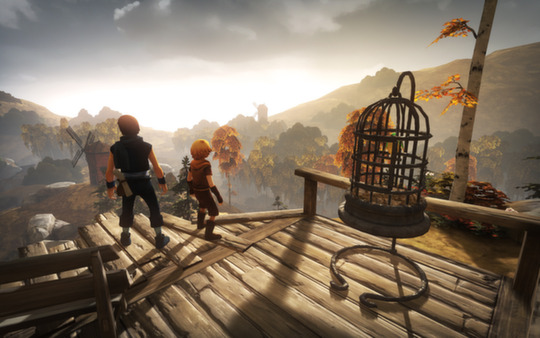 Brothers - A Tale of Two Sons (official Steam screenshot)Seen from the music side, that asymmetric control scheme is really a job of bridging two independent motions with one consistent key. The less a game can lean on dialogue, the more its score has to write the relationship itself.
What the composer revealed — writing more music from raw gameplay footage, not a script
Daniele Carmosino, who rescored the 2025 remake, has described his process on his own site. His starting question was, 'what would they have done back then if they could?' Rather than a script, he spent hours watching actual gameplay footage — and what became clear, he says, is that the emotional journey needed more music than the original carried.
He gave each area its own new theme while still writing for continuity across scenes, keeping the original's prominent themes but re-dressing them in orchestra and choir. Watching footage before reading any script strikes me as a genuinely practical method for scoring a game that can't lean on dialogue. The work, co-credited with Unterberger, won at the 2024 InterContinental Music Awards.
The puzzle analogy — counterpoint as a way to voice two thumbsticks
Music has a technique called counterpoint: two or more independent melodic lines sounding at once, in harmony, with neither one simply accompanying the other. Both lines walk their own path, and they resonate each time they cross.
The controls here have always sounded like counterpoint to me. The older brother braces a ladder; the younger slips through a gap. Two people, different verbs, different timing, becoming one experience on the same screen. Splitting a melody into two independent voices and splitting a controller into two independent sticks feel, to me, like the same idea wearing different clothes.
The music I usually listen for in puzzle games fits the gaps between one person's thoughts. The gaps in this game come from something else: two people dividing labor, not one person thinking alone. If counterpoint is a way of writing so no single voice has to carry the whole melody, this control scheme is the same idea in a different shape.
Tracks worth hearing
From the 2025 remake soundtrack: a video published on Daniele Carmosino's own channel, letting you compare the reworked original themes against the newly written material in one sitting.
The 2013 original score is officially streaming on Bandcamp through OVERKILL Soundtracks, the label Gustaf Grefberg records under. Start with 'Main Theme.' I've gathered that link in the sources section below.
Closing — what I'd steal
What I'd steal is Carmosino's method itself: watch hours of real gameplay footage before you read any script, and observe what's happening on screen without leaning on dialogue, before a single melody comes to mind. I think that's a useful warm-up even for games that do have spoken lines.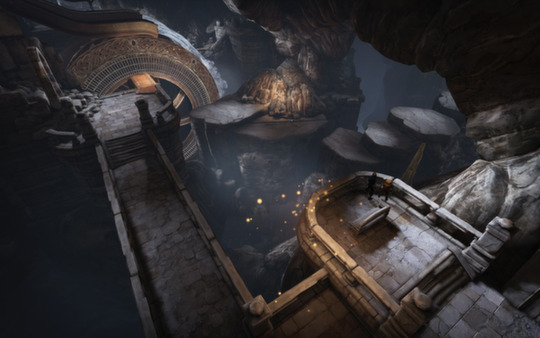 Brothers - A Tale of Two Sons (official Steam screenshot)
The other thing worth stealing is counterpoint itself: two player inputs, two characters, two goals, kept independent instead of ranked, and made to harmonize anyway. If whatever you're scoring right now has a moment that has to carry two people at once, could both of them hold a melody, instead of one falling back to accompaniment?
Sources
・Wikipedia: Brothers: A Tale of Two Sons (fictional language, control scheme, composer credit)
・Daniele Carmosino's official site: Brothers: A Tale of Two Sons Remake production notes
・Steam: Brothers: A Tale of Two Sons Remake - Soundtrack (official OST DLC)
・InterContinental Music Awards 2024: Daniele Carmosino & Christof Unterberger award page
Reactions (no login)
Anonymous • one of each per visitor per day
関連シリーズ
Puzzle Soundtracks第104回 / 全104回
Read next

Related reviews
Tetris Effect: Connected
Le jeu de blocs qui tombent que tout le monde connaît, avec des règles laissées strictement intactes. Sur plus de trente niveaux, la musique et la lumière réagissent au moindre geste. Deux ajouts seulement : une « Zone » qui fige le temps et permet d'effacer plus de quatre lignes d'un coup, et un mode coopératif à trois où les plateaux se rejoignent. Signé Enhance, le studio de Tetsuya Mizuguchi.
FRACT OSC
Un puzzle d'exploration musicale a la premiere personne : on parcourt une vaste ruine faite de synthetiseurs, on actionne des noeuds lumineux et des dispositifs sonores pour reveiller la machinerie et la musique endormies. Presque aucune instruction ; comprendre ce qui est interactif est deja l'enigme. Phosfiend Systems, 2014, laureat du prix de design audio de l'IndieCade.

