PAPER-DIGEST · 2026-10-06
Yamamoto & Shiba: When both options share the same payment, people skip right over it — Fukai Reads
Time preferences and behavioral economics — framing as investment or loan, and what it means for shops and rewards
TL;DR — Can the same deal, shown differently, change how patient people are?
When both options carried the same extra payment, people largely stopped looking at it — and decided whether to wait based only on the shape of what was left. Shohei Yamamoto (Rikkyo University) and Shotaro Shiba (Toyo University) found this in three experiments (1,400 participants recruited in total), all preregistered — the analysis plans were made public before data collection.
Here is the interesting part. Total payouts were identical, yet re-presenting the same choice as an investment (pay first, receive later) or a loan (receive first, pay later) changed how patient people were. Making the shared part much larger did not break the pattern. When real money was at stake, the loan framing's effect clearly held up. This bears directly on shop comparison screens and "take it now or wait for more" mechanics.
Introduction — Who wrote this, and where was it published?
Today's paper is "Framing effects on time preferences: The impact of investment and loan contexts in intertemporal choices" by Shohei Yamamoto (College of Economics, Rikkyo University) and Shotaro Shiba (Faculty of Economics, Toyo University). It appeared in the peer-reviewed journal Judgment and Decision Making (Vol. 21, article e11) on 13 May 2026, open access under a CC BY license.
The research was approved by Hitotsubashi University's ethics committee and funded by Osaka University's Institute of Social and Economic Research and a JSPS grant. All three experiments were preregistered on AsPredicted. Data, instructions and analysis code (R and Stata) are available on OSF.
The paper is about five months old and has not yet been widely discussed. I chose it anyway, because games are full of "pay now, gain later" moments: buying seeds to plant, holding money to earn interest, buying a season pass up front. All of these combine losses and gains across time.
This paper shows that how you slice that combination — and nothing else — can move people's decisions. Same numbers, different screen, different choice. I think it is well worth reading for anyone who builds shop screens or reward systems.
Background — Why is patience so sensitive to presentation?
Economists call the way we weigh "£100 now" against "£100 in two months" a time preference — how much we discount future gains and losses relative to the present. Patient people discount the future only a little; impatient people discount it heavily.
This discounting turns out to be quite unstable. The paper cites two classic findings. One is the sign effect: people tend to discount future gains more heavily than future losses (Thaler, 1981, and others). The other is Loewenstein (1988): people would pay $54 to get a VCR sooner, but demanded $126 to accept getting it later. The same time gap, priced at more than double depending on the wording.
The other building block is cancellation. Kahneman and Tversky (1979) argued that people tend to overlook components shared by both options. The authors combined these ideas. If people ignore the shared part, you can swap the shape of the differing part while keeping totals fixed — an experiment that moves only the presentation. 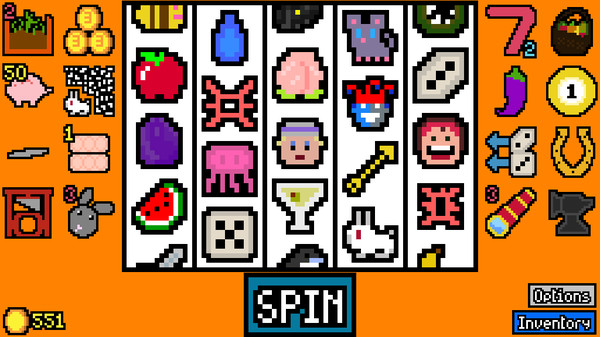 Luck be a Landlord (TrampolineTales, 2021), a slot-machine roguelite. Rent that comes due again and again creates a rhythm of gains and losses over time (Steam store screenshot)
Method — Splitting each choice into a shared part and a differing part
All experiments ran on Prolific, an online research platform, with participants of UK nationality. Participants chose between two sets of "projects." Each project paid or charged money twice: today and in two months. Amounts were in pounds, ranging from a few pounds to several dozen.
The key move was to present each option as two components. One is the common payment (CP), identical across both options. The other is the focal payment (FP), which differs between options. In Study 1, for example, the totals were always "24 today, 24 in two months" versus "16 today, 32 in two months," in every condition.
What changed was how the totals were split. With No frame, the differing parts were both pure receipts. In the Investment frame, they took a "pay today, receive later" shape (e.g. −8 today, +16 later). In the Loan frame, they took a "receive today, pay later" shape (e.g. +16 today, −24 later). The common part made up the difference, so the totals never changed.
Patience was measured by adjusting amounts step by step. The immediate amount of one option moved up or down depending on the answers — starting in £4 steps, halving at each preference reversal, and stopping below £1. This located the point of indifference, which was converted into a monthly discount factor (the paper's IDF; closer to 1 means more patient).
Findings — Same totals, different shape, different patience
In Study 1 (300 recruited), the three frames clearly differed when the choices were mostly gains. No frame vs. Investment: p = .02; No frame vs. Loan: p < .001; Investment vs. Loan: p < .01 (p is roughly how likely a difference this large would be by chance alone — the smaller, the less likely). The authors note that IDFs appear lower in the No frame than in the other frames — that is, people looked less patient without a frame.
When the choices were mostly losses, No frame also differed from Investment (p < .01) and from Loan (p = .04). In the No frame, the sign effect appeared as usual — losses were discounted less than gains (p < .001). In the Investment and Loan frames, that gap disappeared. One reading: when the differing parts had the same shape, people judged them the same way whether the totals were gains or losses.
Study 2 (800 recruited) pushed the size of the common part to extremes. Across six conditions, the differing parts stayed fixed while the common part ranged from zero to very large — in the most extreme case, the two-month total became a net payment. Even so, IDFs did not differ significantly across the six conditions (p = .59). But when the differing parts themselves were changed to match those totals, a clear difference appeared (p < .001). People were looking at the differing part, not the total.
In Study 3 (300 recruited), one in ten participants had one of their choices paid for real, with the delayed part paid two months later. The Loan frame still differed from No frame (p = .02), but the Investment frame did not (p = .37). Split by income, the Loan frame's effect appeared among lower-income participants (p = .03) but not among higher-income ones (p = .20).
Further analysis — A debt-aversion scale did not explain the effect
The authors also used a seven-item debt aversion questionnaire (Schleich et al., 2021), expecting that people who dislike debt might react more strongly to the Loan frame. In all three studies, that interaction was not significant — a prior finding (Walters et al., 2016) did not replicate here.
Another notable point: a non-negligible share of participants showed negative discounting — preferring to delay gains or to take losses sooner. The authors report that this share also varied by frame. The assumption that "sooner is always better" may be weaker than we think.
Use cases — Shop comparisons, waiting rewards, rent and interest
First, shop and bundle comparison screens. If two offers contain the same items, players — under this study's conditions — would largely ignore that shared part. What decides the choice is the difference. If you build pack sales or reward-choice screens, laying out the differences side by side makes the intended choice axis clear. Conversely, making the shared part lavish may not do much to separate the offers.  Slay the Spire (Mega Crit, 2019). On the card reward screen, you choose by comparing only how the candidates differ (Steam store screenshot)
Second, "take it now or get more later" mechanics: crops in farming games, harvests in idle games, the timing of login bonuses. If you are making an idle game, the same reward framed as "pay a cost now, receive later" versus simply "wait and it grows" may change how many players wait. Both presentations are worth A/B testing in playtests.
Third, debt and rent. In Study 3, with real money, the Loan frame's effect held up most clearly. Rules like a card that gives you something now in exchange for repaying next turn, or rent that comes due periodically, can be strong levers on how players wait. If you add borrowing to a roguelite, whether you display the repayment as a total is part of the design.
Fourth, how interest and investment are explained. In games where unspent money earns interest, the loss of "not spending now" combines with the gain of "more later." Following this study, describing interest starting from "money you can't use now" versus "money you'll gain later" might change saving behaviour. Which side you lead with can be treated as a difficulty knob.  Balatro (LocalThunk / Playstack, 2024). Money you hold earns interest at the end of a round, so "spend now or save" is a decision every time (Steam store screenshot)
Fifth, monetization and fairness. The authors compare a paid premium membership to the Investment frame and an instantly usable free account to No frame, writing that users may be more patient under the premium plan and prefer it even when totals are comparable. That maps onto season passes and subscriptions. But in Study 3 the effect appeared among lower-income participants, and the authors advise integrating all components, shared ones included, before deciding. For designers, the honest use is to provide a screen that shows the total at a glance.
Limitations — What can't we conclude yet?
First, the weaknesses the authors acknowledge. All loss-domain choices were hypothetical: taking real money from participants raises ethical problems, and giving them money first would itself create a new common payment that confounds the analysis. Second, why the Investment frame's effect vanished in Study 3 is unclear. The authors suggest the true effect may be modest and that the between-subjects design may have lacked statistical power to detect it.
The authors also acknowledge an alternative explanation: people may not be cancelling the common part at all, but simply reacting to the presence of mixed gain-and-loss options. The experiments do not fully separate the two. They also state that, because the data were highly skewed, they used rank-based tests rather than the preregistered ones.
Now the points I, Fukai, would add. First, participants were all UK nationals, amounts were tens of pounds, and there was a single delay: today versus two months. Game rewards are smaller and waits run from minutes to days, so transfer is uncertain. Second, in what I read, results are reported mainly as p-values, with the actual IDF sizes shown in figures; check the figures to judge how large the effects are. Third, the authors themselves note that income was unbalanced across conditions in the real-money study.
Fukai's reading — Players play the difference, not the total
This part is my own opinion. I read this study as numerical support for an old piece of design wisdom: presentation is part of the rules. At the screen, players do not compare ledger totals; they compare the difference between options. And whether that difference looks like "pay first" or "receive first" changes the weight of the very same deal. In design-criticism terms, how you slice a reward becomes part of its difficulty. You can tune players' patience without changing a single number. That is a powerful tool — which is exactly why, I think, it should come with the responsibility not to hide the total.
Closing — What to read next
If you want to go deeper, the classics this paper builds on draw the map: Kahneman and Tversky's prospect theory (1979) for cancellation, Loewenstein (1988) for how wording changes the price of time, and Thaler (1981) for the different discounting of gains and losses. The paper also cites Ma et al. (2021), on how discounting varies with the mix of losses and gains, and Meissner and Albrecht (2022), on people preferring saving to borrowing.
On this site, related pieces cover Nagaya et al., where presenting "don't bet" differently increased risky choices, and Chien et al., where payout-rate wording made winning look more likely. They share one thread: show the same content in a different shape, and people move. This morning I brewed another coffee and kept following that thread.
References
Papers and materials referenced in this article:
・DOI: 10.1017/jdm.2026.10034 (peer-reviewed, open access, CC BY)
・OSF: data, instructions and analysis code (preregistrations: AsPredicted #57211 / #97463 / #127343)
・Related work cited in the paper: Kahneman & Tversky (1979) (prospect theory, cancellation) / Thaler (1981) (sign effect) / Loewenstein (1988) / Ma et al. (2021) / Meissner & Albrecht (2022) / Walters et al. (2016) / Schleich et al. (2021). See the paper's reference list for full citations.
・Related on this site: Nagaya et al. on removing "don't bet" (Fukai Reads) / Chien et al. on payout-rate framing (Fukai Reads)
Reactions (no login)
Anonymous • one of each per visitor per day
関連シリーズ
Paper Digest第104回 / 全104回