REVIEW · 2018-10-22
EXAPUNKS
Un fanzine en main, dans le réseau avec quelques instructions
Introduction
The year is 1997. You used to be a hacker; now you have the phage, and you have a deal: one hack, one dose. You write instructions for tiny execution agents called EXAs in a made-up assembly language and send them burrowing through the networks of banks, universities and TV stations. That is EXAPUNKS, made and published by Zachtronics, released October 22, 2018.
I write this from the Steam review pool. The label is 'Overwhelmingly Positive,' 96% of 1,357 reviews (snapshot 2026-07-08). Across all 1,874 reviews there are only 97 negatives. By the numbers it is an uncontested success — but line those 97 up against the caveats tucked inside the praise, and the shape of who this game is for comes into focus.
The first thing you notice reading the pool: praise and complaint often point at the same design choice. There is no in-game help; the manual is a printable underground zine. The positive side calls that 'ingenious'; the negative side calls it 'needlessly obtuse — I couldn't even figure out how to play.' I use that shared point as my axis.
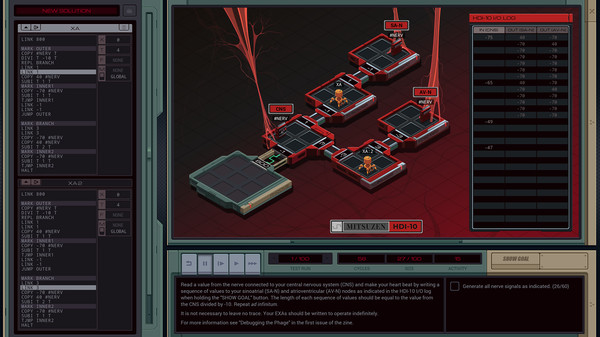 The game opens on a 1997 desktop — Steam store
First Impressions
One sentence recurs almost verbatim across the top helpful positive reviews: 'best Zachtronics game yet,' 'up there with Opus Magnum.' Players who came up through TIS-100 and Opus Magnum place this at the peak of that lineage. Which means even the first impression is spoken through the line 'do you already know Zachtronics?'
The other constant is three words: polish, charm, atmosphere. The 90s cyberpunk art, the zine as a physical object, the restrained music. One reviewer says every detail is 'dripping with TLC.' What gets described first is not the puzzles but the feel of touching this world.
To me that framing is itself the achievement. Programming puzzles have a high barrier; EXAPUNKS puts story and art at the door as a second motive. Where TIS-100 filtered people with an austere manual, this game first hands you the wish to be a hacker, then teaches. It distributes a reason to solve before the solving.
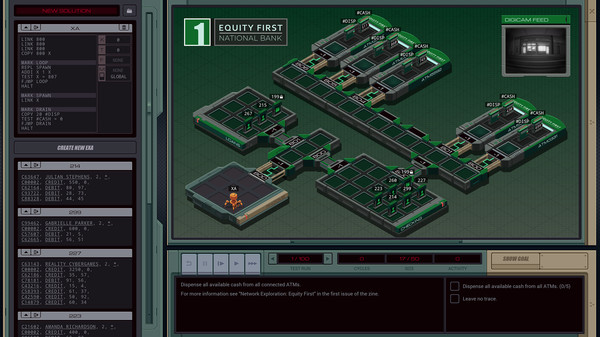 A run-down apartment and a terminal — Steam store
Putting the Mechanics into Words
The core, positives repeat, is a made-up assembly language. COPY, ADDI, and LINK to bridge one EXA to another — a dozen-odd instructions (verbs) that read, rewrite and replicate files across a network. Reviewers cite 'the joy of optimizing for cycles and lines of code,' and 'getting hooked squeezing out one more cycle after it already worked.'
That 'few verbs, bottomless depth' is exactly what Puzzlebyrinth means by verb design. The instruction set is small, but EXAs run in parallel — you sync two, split the work, wait on each other — and there the combinatorial explosion happens. When a review says this is 'the only game that made hacking feel real,' it means the sensation of building large structure from a tiny grammar.
The negatives read the same parallelism backwards: 'exas run in parallel naturally, yet the constraints make the fun parallel solutions impossible,' 'most levels have effectively one solution,' 'programming with the fun parts stripped out.' I read this as a choice about how wide to open the solution space. The author narrows the optimum into a single road from 'it works' to 'elegant and fast.' Reading that road as a climb or a cage is where scores split.
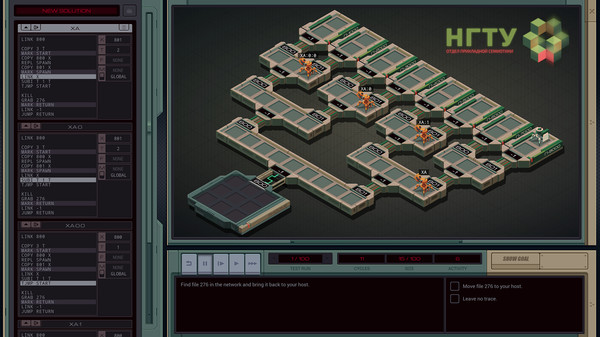 Writing pseudo-assembly into an EXA — Steam store
Teaching
The most-discussed single element is not in-game help but a printable underground zine, TRASH WORLD NEWS. Reference and hints arrive framed as hacktivists coaching a beginner. Positives call it 'an ingenious use of documentation,' 'physical pages that are fun to rifle through,' 'not icing but the main course.' One says the manual 'isn't written assuming you already know what you're doing, so an amateur like me could get in.'
To me this hides the learning curve inside the fiction. Tutorials usually float outside the game as pasted-on explanation. EXAPUNKS turns the explanation into a story prop and folds reading into role-play. Call it subtraction: remove the UI text, move it into a fictional printout, and the fact that you are being taught stops registering.
The same design flips for the negatives: 'the PDF/print buttons do nothing, so I can't tell how to play,' 'the manual is needlessly obtuse,' and even a positive review admits 'having to keep a PDF viewer open because you can't read the manual in-game is annoying.' The store says 'no experience needed'; a top helpful review corrects it — 'they say that, but you do need to understand programming logic.' Dissolving the manual into fiction costs you the path to the manual.
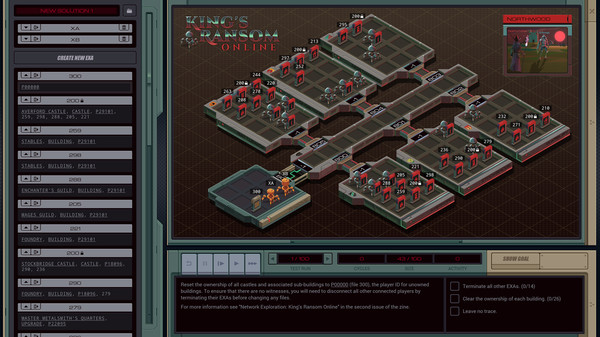 TRASH WORLD NEWS, the zine that serves as manual — Steam store
The Texture of Difficulty
On difficulty the pool isn't split down the middle so much as split into two layers. Reviewers who name a CS degree or years of work write 'this takes me back to learning assembly, wonderful,' and welcome the hard walls as a source of accomplishment. Reviews that stopped after minutes describe the step instead: 'an easy intro, then they pop your floaties and drop you in the arctic ocean at midnight.'
I read this as an entry fee named prior knowledge, not a quantity of difficulty. The curve is gentle for anyone who already holds programming logic and near-vertical, just after the intro, for anyone who doesn't. The same slope looks like a cliff depending on where you stand. The common line — 'easier than TIS-100, harder than Human Resource Machine' — is that entry fee placed on a genre scale.
What's interesting is the critique from experts. One reviewer argues the speed-optimal 'answer' tends to be a hardcode exploiting gaps in the randomized tests, against the spirit of the puzzle — a jab at the scoring metrics themselves. Not too little difficulty, but difficulty pointed the wrong way. That is a resolution problem in how the combinatorial explosion is judged, worth recording as a third view outside the simple for/against.
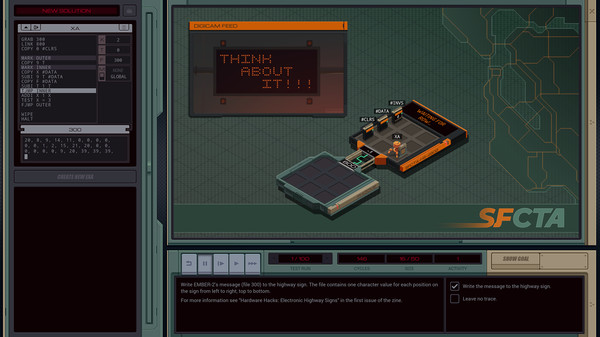 More tangled networks arrive in the back half — Steam store
Sources
This piece was written by reading the user reviews on the Steam store page as of 2026-07-08. No review text is quoted directly; typical claims are reconstructed.
- Steam: EXAPUNKS (Overwhelmingly Positive, 96% of 1,357 reviews; across all 1,874: 1,777 positive / 97 negative)
- Read via the Steam review API: the top 10 helpful positive reviews, 5 negatives (English, all time), and the 15 most recent
- Press: quoted on the store, PC Gamer ('EXAPUNKS doesn't mess around') and Vice ('the only game that made hacking seem real')
Closing
Steam reads 96% positive; my design-critique score is 9.0, and the two don't diverge. A small verb set, a learning curve dissolved into fiction, a combinatorial explosion opened by optimization — the grammar Zachtronics honed over a decade is here in its most playable form. Reviews point to Opus Magnum as the on-ramp and this as the next step, and I don't disagree.
One reservation rather than a deduction: the internals show that 96% is carried heavily by people who already hold programming logic. The author flies 'no experience needed' while quietly charging an entry fee. That's a matter of reach, not a flaw — and the material for judging whether it's for you is packed into the split itself. Reported playtimes cluster in the 10-30 hour range, with a few optimizers reaching the hundreds.
The pool's near-unanimous verdict is plain: 'if you like other Zachtronics games, you'll like this one.' Inverted: if writing instructions for a little robot in pseudo-assembly stirs no curiosity at all, walk away. The value of this game is decided by which verbs you find fun — and the 97 negatives and 1,777 positives measure that for you.
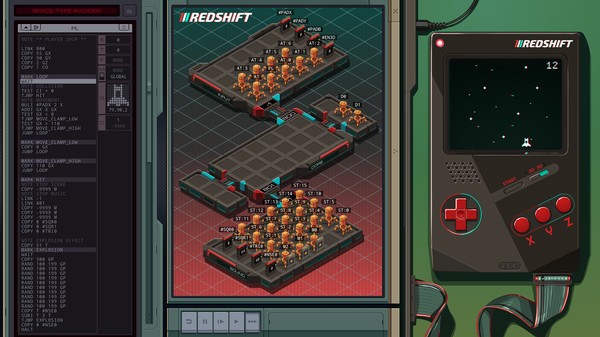 Slipping an EXA into a live network — Steam store
Where are you with this game?
Press one and the game goes on your shelf. You can see it on your account page.
Reactions (no login)
Anonymous • one of each per visitor per day
Read next
Related reviews
SHENZHEN I/O
Un puzzle de programmation où vous incarnez un ingénieur d'une entreprise fictive de Shenzhen, écrivant un assembleur concis pour des microcontrôleurs étriqués et câblant des circuits sur une carte pour fabriquer des produits. Zachtronics ne propose aucun tutoriel : son manuel de plus de 30 pages est la première énigme.
MOLEK-SYNTEZ
Dans un appartement exigu de la Roumanie de 2092, on programme un synthétiseur artisanal pour assembler, à partir de benzène et d'acétone, de petites molécules pharmacologiques. Un puzzle d'optimisation signé Zachtronics, où l'on ne peut agir que depuis le pourtour d'un plateau fini.
Opus Magnum
Un puzzle en 2D où, dans l'atelier d'un alchimiste, on combine des bras rotatifs et télescopiques avec des rails pour transporter et lier des atomes, produisant automatiquement potions et métaux. Le plateau et le nombre de pièces sont illimités ; la vraie compétition commence après la résolution, autour de la question « comment construire avec le plus d'élégance, de rapidité et de compacité ? » — l'œuvre phare de Zachtronics.


