REVIEW · 2021-03-26
Genesis Noir
Un noir cosmique, et le débat sur ce qui compte comme un jeu
Introduction
You play No Man, a watch peddler diving through moments in the history of the universe to stop a single gunshot — the Big Bang — aimed at his love, Miss Mass. It is a nearly wordless point-and-click adventure told in hand-drawn black-and-white line art and jazz, made by Feral Cat Den and published by Fellow Traveller on 26 March 2021.
I write this from the Steam review pool. The label is 'Mostly Positive': 79% of 1,675 Steam-purchaser reviews (snapshot 2026-07-27). Counting all 2,254 reviews, 1,781 are positive and 473 negative. Press aggregates land in the same place — Metacritic 77, OpenCritic 78.
The numbers agree. The review texts do not. What makes the split interesting is that both sides write the same sentence: 'this is not a game in the usual sense.' From that identical observation, one side walks to its highest praise and the other to a refund. My job is to translate the fork into design terms.
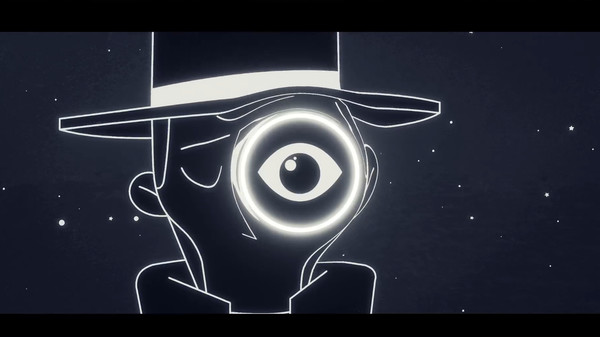 A close-up of the hatted protagonist peering through a glowing ring held to one eye — Steam store screenshot
First Impressions
Line up the helpful positive reviews and the vocabulary rhymes: stunning, gorgeous, unlike anything I've played, one of a kind, audio-visual feast, jazz. Most open by saying words won't carry it, then praise how flat line art is laid over 3D space, how the style changes chapter to chapter, how the saxophone and cello are placed. Almost none complain about the five-to-six-hour length.
The negative vocabulary is just as consistent: boring, not a game, walking simulator, vague, 'pretty but dull.' A striking share of them were written under an hour of playtime — several at 0.1 to 0.8 hours, saying every action felt like extra effort. Read the recent ones and the talking points have barely moved since 2021.
What matters is that both camps start from the same observation. One top helpful positive says it isn't really a game but an interactive animated film — and then calls it a triumph. One negative says they bought it for the art style and it isn't a game at all — and stops there. The first half of each sentence is nearly identical; only the step after it points the other way.
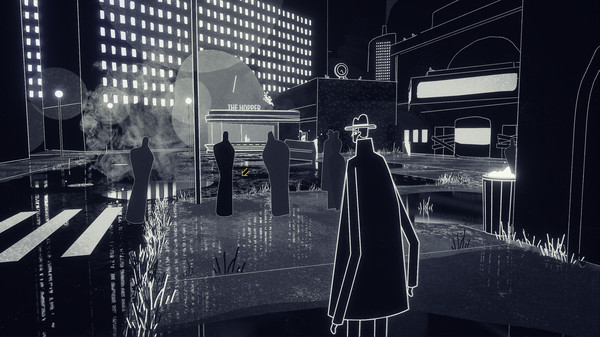 A rain-slicked night street with neon towers, a sign reading THE HOPPER, and the coated protagonist seen from behind — Steam store screenshot
Putting the Mechanics into Words
The developer says outright that the play here is experimentation rather than logic. The store page promises 'tactile puzzles and exploration' where you manipulate objects to see what happens, and the pinned support thread on the official forum warns that the puzzles are about experimenting, so some can be tricky to work out. In Puzzlebyrinth terms the verbs have been subtracted hard: push, turn, grab and move. No inventory, no dialogue choices.
Subtraction is good practice — I wrote about it in When Fewer Verbs Make a Richer Game. The trouble comes after. Once the verbs are few, what matters is the resolution at which the game shows you where to aim them. A positive review admires how the puzzles were made intuitive with no words at all, only sound and image. The negatives and the qualified positives point at the exact same place: no directions, no markers, five minutes of clicking and dragging at random. Praise and complaint are both describing thin affordance.
The pool does not think the game is hard. Several positives say the puzzles can be brute-forced and could have been more complex. The one exception is the third monitor puzzle in the Collision chapter, which has its own standalone guide. The curve is nearly flat with a single spike in it. The friction isn't difficulty; it's legibility, and that distinction is the watershed of the whole debate.
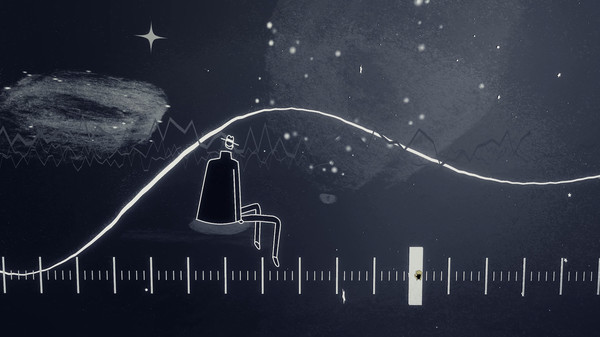 The protagonist sitting on a white waveform curve above a long ruled scale with a slider — Steam store screenshot
The Feel of the Story
The story splits along the same seam. The positive side calls it open to interpretation and says it changed how they see things; the negative side calls it swaddled in metaphor, a collection of ideas the developers liked. Plenty of reviews sit in between — one admits the romance only made sense after reading the store page description.
The structure explains why. There is almost no dialogue. Each chapter opens with a short astronomy text and then proceeds in image and sound alone, which hands the story's resolution entirely to how closely the player reads the screen. The observation-resolution problem I described in Observation as Play shows up here on the narrative side rather than the puzzle side.
The telling detail is that several reviewers independently ask Steam for a neutral option. The thumb has only two positions, so the most accurate verdict available — wonderful as an experience, painful as a thing to play — gets rounded one way or the other. I read a fair amount of that rounding error inside the 79%.
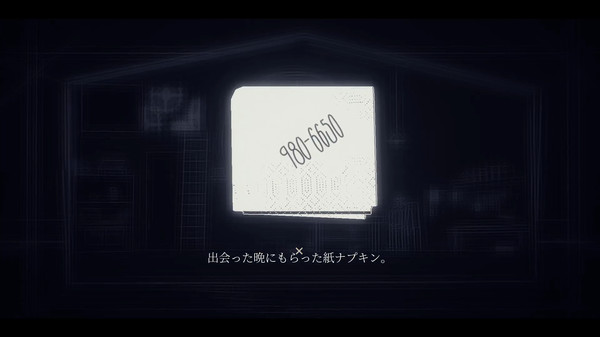 A glowing paper napkin with a hand-written phone number floating in a dark room, with the game's Japanese subtitle below — Steam store screenshot
The World
On the world itself, the pool barely disagrees. A 1930s jazz club, rain-slicked asphalt, neon towers — noir signage assembled from white, black and a little gold, with nebulae, constellations, line-drawn deer and planets set beside it in the same hand. Even the negative reviews follow a formula: say it's beautiful, then start the complaint.
The audio scores just as well. Saxophone, cello and trumpet tangle in loose jazz, and some chapters swap to Japanese-flavoured scales. There is no voice acting. The soundtrack is sold as separate DLC and carries a 'Player Favorite' tag on the store.
What interests me as design is that the strength of the world could not cover for the weakness of the interaction. The screens are dense, the lines are thin, and something is always moving. The very density that makes it beautiful is what makes it hard to spot which object can be touched. Here, the resolution of the world and the resolution of the controls trade off against each other directly.
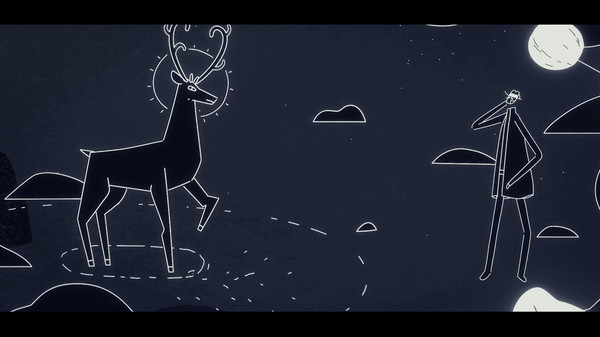 A large antlered deer drawn in white line art, with the hatted protagonist standing and raising a hand, dotted footprints on the ground — Steam store screenshot
Sources
This piece was written by reading the user reviews on the Steam store page as of 2026-07-27. No review text is quoted directly; typical claims are reconstructed.
- Steam: Genesis Noir (Mostly Positive, 79% of 1,675 Steam-purchaser reviews; 1,781 positive and 473 negative across all 2,254)
- Read via WebFetch: the top 10 helpful positive reviews, 10 negative reviews, and several from the recent view. The top three helpful reviews in the German-language view were consulted as well
- Developer statements: the store page copy and the pinned 'Stuck? Puzzle Support' thread from Fellow Traveller
- Aggregates: Metacritic 77, OpenCritic 78 (39 reviews), plus the PC Gamer review
Closing
Steam reads 79% positive and Metacritic 77; my design-critique score is 7.5, so we don't diverge much. The credit goes to holding five hours together on a handful of verbs, and to the craft density of rebuilding the art and the score chapter by chapter. The deduction is that the resolution showing where to aim those few verbs never quite settled.
Reviewers who mention completion times cluster at five to six hours. For that length, if you can pay for density of experience rather than the feeling of having solved something, this is an easy recommendation. Come looking for the click of a solution and the negative vocabulary — vague, boring — becomes your own. Anyone who liked the wordless tactility of Gorogoa or the sound-led guidance of FRACT OSC is probably inside its reach.
The 79% measures the match rate of expectations more than the quality of the work. The developer said from the start that this was experimentation, not logic. Read that first and the same five hours become a different object than they are for someone who picked it off the puzzle shelf. The split is not a record of failure; it is a record of range.
 The Earth floating in space with a scattered cluster of stars beside it — Steam store screenshot
Where are you with this game?
Press one and the game goes on your shelf. You can see it on your account page.
Reactions (no login)
Anonymous • one of each per visitor per day
Read next

Related reviews
Happy Game
A point-and-click adventure that walks a sleeping boy through three chapters of nightmare. You pull, turn and pick at the screen to open the way forward, and what waits there is smiley faces, pink bunnies and rooms the colour of blood. Amanita Design's first turn toward horror, scored by the Czech band DVA.
Moncage
A wordless optical-illusion puzzle adventure. Each face of a glass cube holds a different world, and rotating your view until two silhouettes line up locks them into a single mechanism. You move between a factory, a lighthouse, an amusement park and a church, picking up scattered photographs that assemble the story of a father and a son. From Optillusion.
Machinika: Museum
Une boîte à énigmes en vue subjective où l'on scanne des appareils extraterrestres d'origine inconnue livrés à un musée, où l'on regarde à l'intérieur et où l'on réimprime leurs pièces manquantes jusqu'à les remettre en marche. Une œuvre courte de Littlefield Studio qui ouvre sept machines l'une après l'autre, avec le geste d'une archéologie de science-fiction.


