REVIEW · 2016-07-22
Human Fall Flat
En tête des avis positifs, une demande de fonctionnalité ; en tête des négatifs, Linux — les 95 % de 30 811 avis ne notent pas les énigmes
Premières impressions
Commençons par les chiffres. La page boutique Steam affiche 95 % d'avis positifs sur 30 811, avec l'étiquette « Extrêmement positive ». Rien que sur les trente derniers jours, 951 avis supplémentaires ont été postés, dont 93 % positifs. Un jeu de 2016 continue de recevoir des avis à ce rythme dix ans plus tard.
Mais en ouvrant les dix avis positifs les plus utiles, la déception est immédiate. Sept sur dix disent presque la même chose : donnez-nous un éditeur de niveaux, ajoutez le support du Steam Workshop. Ils datent tous d'octobre 2017 à septembre 2018.
Les dix avis négatifs les plus utiles sont tout aussi uniformes. Six sur dix parlent de l'abandon du support Linux. Ce n'est pas une question d'énigmes. Ce n'est même pas une question qui touche au contenu du jeu.
Autrement dit, sur ces vingt avis, très peu de phrases évaluent réellement les énigmes de ce jeu. Alors, sur quoi porte ce chiffre de 95 % ? C'est autour de cette question que je vais lire ce corpus d'avis.
 Human Fall Flat — capture d'écran n°1 de la page boutique Steam
Mettre les mécaniques en mots
Il y a peu de choses à faire : marcher, sauter, et tendre chaque bras séparément pour attraper. Les bras suivent la direction du regard, si bien que tourner la caméra devient en soi une manière d'exercer une force. Un avis japonais très bien noté décrit d'ailleurs cela comme un mécanisme singulier où la manipulation de la caméra génère de la force.
Le camp positif décrit cette sensation avec des mots comme hilarant, drôle, physique. Le camp négatif préfère imprécis, mollasson, et parle d'une physique qui cesse d'être une alliée pour devenir un adversaire. Un avis négatif ayant reçu 128 votes utiles (novembre 2017) raconte que le plaisir a fini par tourner à l'irritation.
Ce qui est intéressant, c'est que les deux camps pointent la même conception. Un seul verbe, attraper, suffit à écrire pousser, tirer, grimper, lancer et faire tomber. Le nombre de verbes a été réduit au strict minimum — exactement la soustraction dont je parlais dans Quand moins de verbes produit plus de richesse.
Mais ce qui a été réduit, c'est le nombre de verbes, pas la précision de l'entrée. Dans un Sokoban, une case reste une case ; ici, le même geste d'attraper produit à chaque fois un résultat légèrement différent. La difficulté de ce jeu se loge dans le corps, pas sur le plateau.
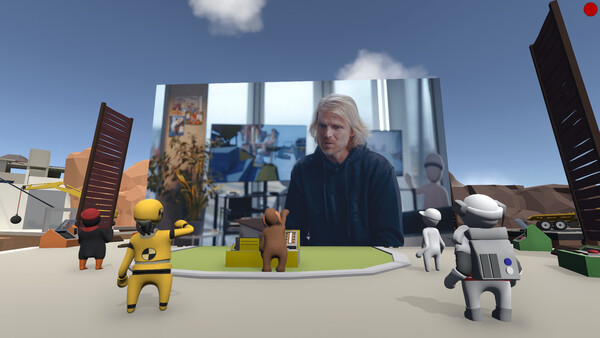 Human Fall Flat — capture d'écran n°3 de la page boutique Steam
Ce qui n'a pas été soustrait : la largeur de la solution
Le texte de la boutique affirme explicitement que les énigmes admettent plusieurs solutions, et le corpus d'avis le confirme. Face au même obstacle, les auteurs d'avis positifs le franchissent chacun d'une manière visiblement différente.
C'est là, je pense, la raison pour laquelle les avis ne parlent pas des énigmes. Quand un plateau n'a qu'une seule solution prévue, on peut dire « voici comment j'ai résolu ça ». Quand la solution est large, c'est plus difficile à dire — on ne peut même pas déterminer soi-même si son propre chemin était la solution ou un simple accident.
Ce qui se raconte alors, ce n'est pas une méthode mais un événement. Un avis japonais très bien noté contient cette phrase : on rit des scènes d'accident façon accident du travail. Que la section des avis se remplisse de comptes rendus d'accidents n'est pas de la paresse de la part des auteurs. C'est une conséquence de la conception.
J'avais lu un phénomène similaire dans le corpus d'avis de Poly Bridge. Dans les jeux régis par la physique, les joueurs ont du mal à s'approprier leur propre solution. Cela rejoint aussi la structure des puzzles coopératifs que j'ai décrite dans La grammaire de résoudre à deux.
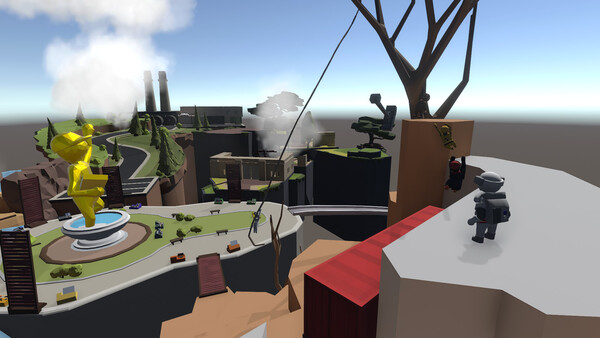 Human Fall Flat — capture d'écran n°5 de la page boutique Steam
Une requête figée en tête de liste
Le support du Workshop que réclamaient sans cesse les avis positifs les mieux notés a fini par arriver. Son ajout a été rapporté en avril 2019, le développeur ayant publié deux niveaux d'exemple pour lancer les créateurs. La page boutique annonce aujourd'hui plus de 5 000 niveaux créés par la communauté.
La coopération en ligne jusqu'à huit joueurs n'existait pas non plus au lancement ; elle a été ajoutée en octobre 2017. Ce jeu est donc devenu, en cours de route, une expérience différente. Et pourtant, le haut de la section d'avis reste occupé par des messages de 2017 et 2018, parce que les votes utiles s'accumulent plus facilement sur les anciens avis.
Il n'y a qu'une seule case d'agrégation. Mais les votes qui s'y sont accumulés ont été déposés pour au moins trois jeux différents : le jeu solo de 2016, le jeu à huit joueurs à partir de fin 2017, et le jeu doté du Workshop à partir de 2019.
Le camp négatif suit la même logique. L'arrêt du support Linux a été confirmé par le développeur sur le forum de la boutique le 29 octobre 2018, et un sujet qui n'est pas un jugement de conception occupe le haut du classement depuis près de huit ans. Mieux vaut considérer la section d'avis non comme un miroir de l'état actuel du jeu, mais comme un sédiment. Dans Mini Metro, j'avais noté que l'agrégat ne dispose d'aucune case pour « mitigé » ; ce que l'on voit ici est la même lacune, mais le long de l'axe du temps.
 Human Fall Flat — capture d'écran n°9 de la page boutique Steam
Sources
Cet article a été rédigé à partir de la page boutique Steam et du corpus d'avis d'utilisateurs de la Communauté Steam, tels qu'ils se présentaient le 27/08/2026.
· Steam : Human Fall Flat (étiquette « Extrêmement positive », 95 % d'avis positifs sur 30 811 ; 93 % sur 951 avis lors des trente derniers jours)
· SteamDB (environ 226 000 avis toutes langues confondues, 93,5 % positifs), Metacritic (PC : 70 sur 22 critiques ; note utilisateurs 7,2 sur 359 votes)
· Lecture intégrale des 10 avis positifs les plus utiles, des 10 avis négatifs les plus utiles, des 8 plus récents et des 10 avis japonais les mieux notés, ainsi que d'un fil du forum de la boutique consacré au support Linux.
· Les informations de base (studio, fonctionnalités ajoutées, ventes, annonce d'une suite) ont été vérifiées via l'article Wikipédia et l'article de Destructoid d'avril 2019 annonçant le support du Workshop.
· Les images de cet article sont des captures d'écran publiées sur la page boutique Steam. Cette session ne pouvant pas accéder directement au CDN d'images, leur contenu n'a pas pu être vérifié visuellement ; les légendes indiquent donc uniquement l'ordre d'affichage sur la boutique, sous une forme générique.
Conclusion
La page PC de Metacritic affiche 70 sur 22 critiques, avec une note utilisateurs de 7,2 sur 359 votes — loin des 95 % de Steam. Les critiques ont noté un jeu d'énigmes ; les votants de Steam ont noté une soirée entre amis. Lu ainsi, cet écart n'est pas une contradiction.
Du point de vue de la conception, je lui donne 7,0. Le choix de se limiter à un seul verbe est le bon. Mais en laissant la solution large sans resserrer la précision de l'entrée, ce jeu abandonne le sentiment d'avoir « résolu » quelque chose. Ce n'est pas un défaut, c'est un échange : il rend le sentiment d'appropriation et reçoit en retour des accidents que l'on peut partager.
Il convient à qui veut rire d'échecs partagés en regardant le même écran que quelqu'un d'autre. Il ne convient pas à qui veut acheter du temps seul face à un plateau. Les temps de jeu affichés dans les avis les plus utiles vont de 7 à 51 heures, mais les critiques formulées côté solo se concentrent sur deux mots : monotone et court.
Ce qui est resté après la lecture, ce n'est pas un verdict sur ce jeu, mais un doute sur les agrégats eux-mêmes. Un jeu peut continuer d'évoluer pendant dix ans ; chaque acheteur ne vote pourtant qu'une seule fois. L'argument développé dans Quand le système de commande décide de la difficulté se replie ici sur l'axe du temps.
 Human Fall Flat — capture d'écran n°14 de la page boutique Steam
Where are you with this game?
Press one and the game goes on your shelf. You can see it on your account page.
Reactions (no login)
Anonymous • one of each per visitor per day
Read next
Related reviews
Trine 2: Complete Story
Un jeu de puzzle-action à défilement horizontal dans lequel on alterne entre un chevalier, une voleuse et un mage pour empiler des caisses et des planches soumises à la physique et franchir les obstacles. Deuxième volet de la série des Finlandais de Frozenbyte, l'édition Complete Story réunit la campagne principale, l'extension « Goblin Menace » et un niveau supplémentaire.
Lara Croft GO
Un puzzle-aventure au tour par tour où l'on descend des ruines isométriques une case à la fois. On esquive serpents et pièges à lances, on tire des leviers, et l'on compte les tours qu'il reste à un sol qui se fissure. Square Enix Montréal a replié le saut, l'escalade et le tir de Tomb Raider en un seul coup sur le plateau : c'est le deuxième volet de leur série GO.
INSIDE
Un jeu de plateforme-puzzle narratif en 2.5D qui guide un garçon traqué toujours vers la droite à travers une sombre installation dystopique, en résolvant à l'aide de pousser-tirer, de l'eau, de la lumière et du pouvoir de contrôler à distance d'autres corps. Sans dialogue, raconté entièrement par son environnement — la suite de LIMBO par Playdead.


