REVIEW · 2018-11-13
The Room Three
Scruter les machines du Craftsman à la lentille
About the Game
Lured to a remote island, "I" am confined in a mansion left by a figure called the Craftsman, solving box after box of mechanisms to find a way out. That is The Room Three, a first-person escape puzzler by Fireproof Games of Guildford, UK; the PC version released on November 13, 2018. It is the third entry in a series that first made its name on mobile, rebuilt for PC, the developer says.
I write this not from my own playthrough but from reading the Steam review pool. There are 12,831 reviews across all languages; the 6,066 English ones are 95% positive — the label reads Overwhelmingly Positive, and the last 30 days hold at 91% (2026-07-15 snapshot). By the numbers, opinion has swung almost entirely to the positive side.
That does not leave nothing to read; the opposite. It is in a review pool this positive that you can read the reservation tucked inside the praise. Across the helpful positive reviews, the same small caveat keeps recurring after the applause: how to judge the expansion of scale — a series that grew from a single box to a whole estate.
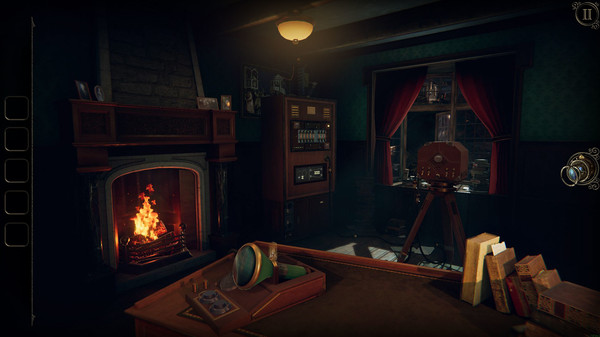 The Craftsman's mansion on a remote island — Steam store
First Impressions
The first impression the helpful positive reviews record is tactile, not visual. "Twisting and turning things feels great," "the mechanisms opening are like unwrapping a gift," "the sense of being there." Many reviewers treat fiddling with a box until it moves as a reward in itself, before any puzzle is solved.
In Puzzlebyrinth terms: the verb the player holds is subtracted down to nearly one — touch, turn, pull, insert — and carries no failure cost. Nothing punishes a wrong move, and a right one answers instantly. That is why the observe-and-manipulate loop keeps turning so pleasantly. This tactile design runs straight back to the series root, The Room.
Notably, the last 30 days still sit at 91%. An eight-year-old port keeps its first impression intact, and the recurring line — "it never feels like a cheap mobile port" — reads as evidence that the rebuilt assets are doing their job.
 Peering into a box of mechanisms — Steam store
The World
The words positive reviews reach for most are "atmosphere" and "immersion," plus the proper nouns "Lovecraftian" and "Myst-like." Grey Holm island, the faceless Craftsman, letters scattered through the rooms. Players enjoy soaking in a thin unease more than chasing a plot.
The Room began, literally, as a single box; the second game became a room; the third opens out to a mansion and an island. Positive reviewers welcome this as "going Myst." But in Puzzlebyrinth's view, widening a world both adds things to observe and disperses the density per unit of space — a tension that returns as the flashpoint in the difficulty section.
Press reviews (IGN, Game Informer, VICE) agree with users on atmosphere and craft. This "look and immersion" axis is one of the few where critics and the crowd line up cleanly. Where they part ways is not the surface but the structure.
 The mood of Grey Holm — Steam store
Putting the Mechanics into Words
The keyword at the center of the positive reviews is the eyepiece. "Look closer," "observe, experiment, understand how things work — never guessing" recur again and again. Reviewers value the game as one solved by understanding, not by guesswork.
Restated in Puzzlebyrinth's vocabulary, the eyepiece is a tool that operates observation resolution itself. Peer in and another mechanism appears inside the gap; raise the resolution and the board nests deeper. A game that turns adjusting observation resolution into a mechanic, rather than mere exploration, is rare.
"Never guessing" means the solution is designed to be deducible from observation. With the verb subtracted to nearly one, the lens acts as a resolution gate that contains the combinatorial explosion — so however complex a mechanism looks, the clue is always somewhere in view. That consistency is what holds the series' trust.
 Looking inside a gap through the eyepiece — Steam store
The Texture of Difficulty
This is where opinion splits most. Even some positive reviews admit "the story mode is effortlessly easy," then add that "earning all the endings is a real brain-twister." The reserved and negative side keeps coming back to backtracking, to "doing the same puzzle four times" across the endings, and to the late-game "no hints from here on" rule.
Sort this by the texture of difficulty and it is two-layered. The main story props the learning curve up from below with tiered hints; enter the ending hunt and that scaffolding is pulled away on purpose — solve it on observation resolution alone. The difficulty shifts not by numbers but by the presence or absence of a foothold.
The backtracking complaint is friction more than difficulty: the verb count never grows, but the widened space raises the cost of moving and remembering. Contrast Return of the Obra Dinn, which compresses movement to concentrate on observing. It is a question of design range — the expansion is a mark against those who prize the intimacy of one box, and a mark for those who like to explore.
 Roaming the estate to link mechanisms — Steam store
Sources
This piece was written by reading the user reviews on the Steam store page as of 2026-07-15. No review text is quoted directly; typical claims are reconstructed.
- Steam: The Room Three (Overwhelmingly Positive, 95% of 6,066 English reviews; 12,831 across all languages; 91% in the last 30 days)
- Read via WebFetch: the ~10 most helpful positive reviews (All Time), representative reservations on the negative side (backtracking, multiple-ending padding, hints removed late), and several recent reviews
- Press: IGN, plus Game Informer and VICE via the quotes shown on the store page
Closing
Read as a meta-review, The Room Three is less a divided game than a game blanketed in praise-with-a-reservation. Inside that 95% sits a small, consistent caveat about the expansion of scale, stamped in place again and again. Because the praise is so uniform, the reservation takes the same shape too.
From a design standpoint I give it 8.5 against Steam's 95% (Overwhelmingly Positive). The verb subtracted to touch and the lens that turns observation resolution into a mechanic are top marks; from there I subtract the friction the widened space introduces and the padding of the multiple endings, which thin the density. Reviews put the main story near six hours, roughly double that to collect every ending.
As an entry point: for anyone who prizes the intimacy of a single box, I would point them to the original over this expanded third. For anyone who wants to roam an estate that multiplies the more you peer, it is the series' high point without hesitation. What divides the two is not quality but the maker's choice between intimacy and expansion.
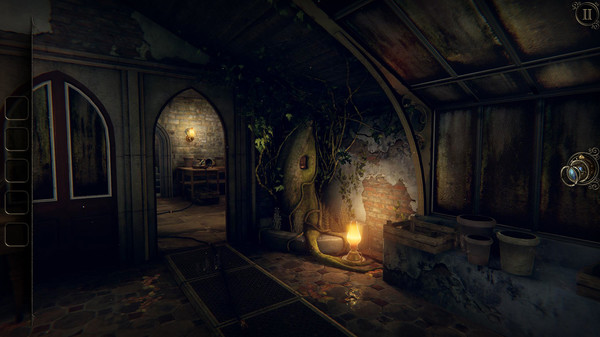 The Room Three — Steam store
Reactions (no login)
Anonymous • one of each per visitor per day
次に読む

関連レビュー
The Room Two
机や部屋に据えられた奇妙な機械仕掛けの箱を、覗き込み、回し、特殊なレンズで隠れた印をあぶり出しながら一段ずつ開けていく一人称の脱出パズル。前作の一つの箱から、互いに絡み合う複数の仕掛けへと広がった、英 Fireproof Games の The Room シリーズ二作目。
The House of Da Vinci
1506年のフィレンツェ、姿を消した師レオナルドの工房で、内部を透かし見るレンズと過去を再演する装置を使い、木と真鍮の機械仕掛けを一つずつ開けていく一人称の脱出パズル。解いた仕掛けの内側からさらに仕掛けが出てくる入れ子構造を軸にした、スロバキアの Blue Brain Games による2017年の一作。
The Room 4: Old Sins
屋根裏で見つけた古いドールハウスを覗き込み、部屋ごとの仕掛けを開けては、別の部屋で欠けている部品を埋めていく一人称の仕掛け箱パズル。Fireproof Games の The Room シリーズ第4作を、PC 向けに作り直した一本。


