RETRO-REVIEW · 2026-08-14
Chip's Challenge (1989) — The Maze That Outlived Its Handheld on Office Desks
How an Atari Lynx launch title crossed a decades-long rights freeze and returned to Steam in 2015
Introduction
This is a work of 1989. Chip's Challenge, released by the American company Epyx as a launch title for the Atari Lynx handheld, is a top-down tile puzzle designed by Chuck Sommerville. Its hero, a boy named Chip McCallahan, sets out to earn membership in the "Bit Busters Club" run by Melinda the Mental Marvel, collecting computer chips as he works through 148 levels of mazes. Sommerville himself has said he personally designed roughly a third of the original level set.
But the inside of the board is not the only reason I take this game up. This maze was tossed about by history outside the play: the defeat of its host handheld, the financial collapse of its developer, and a rights dispute that sealed away its finished sequel for many years. And yet it did not die. It survived on office Windows PCs, in fan-made editors and emulators, and finally on Steam in 2015.
When we speak of puzzle history we tend to ask only where a game was born. With this one, asking how it survived teaches us far more. Buffeted by the lifespan of hardware and the convenience of rights holders, a puzzle — as a set of rules — outlived its platforms. This is that kind of lineage story, a rare record of endurance.
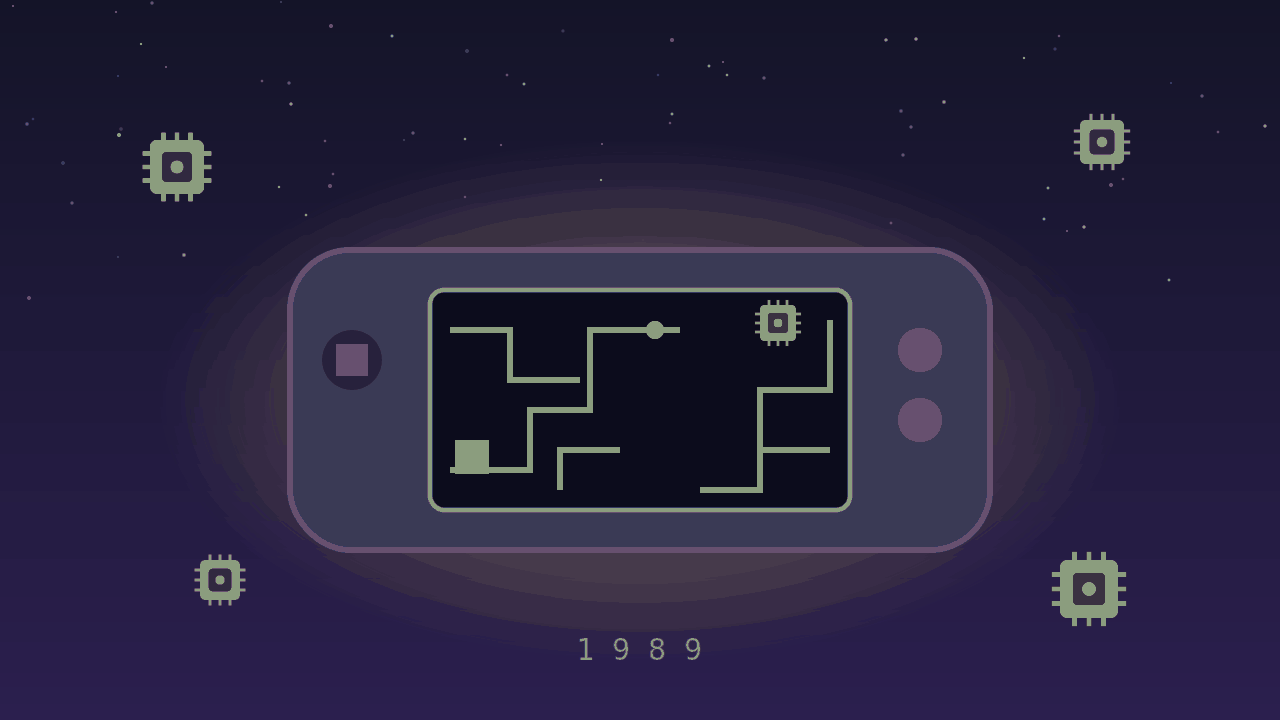 1989: a labyrinth lit up on a small handheld screen (illustration, AI-generated)
The Context of Its Era
In the autumn of 1989, the Atari Lynx arrived as a handheld with a backlit color LCD. Nintendo's Game Boy had launched earlier that same year, and the contest against a monochrome but cheap, battery-frugal champion ended, in hindsight, in the Lynx's defeat. Epyx, the software house that had also helped design the hardware, was already faltering financially and would soon be selling off its assets. This launch title was standing on a sinking ship from the moment it was born.
The irony lies in where the game met its true audience. In 1992, a port was included in the fourth volume of the Microsoft Entertainment Pack, a series of casual game collections Microsoft sold for Windows 3.x. Programmer Tony Krueger built it by reverse-engineering the MS-DOS port, and the level count grew to 149. It was later reissued in the Best of Microsoft Entertainment Pack as well.
The Entertainment Pack series slipped onto office desks under the slogan "No more boring coffee breaks," and according to the English Wikipedia it sold more than 500,000 copies. Through the same channel as Solitaire and Minesweeper — the work desk, not the game-console aisle — this maze became a shared experience of 1990s PC users. A board that should have gone down with its handheld survived beside the spreadsheet.
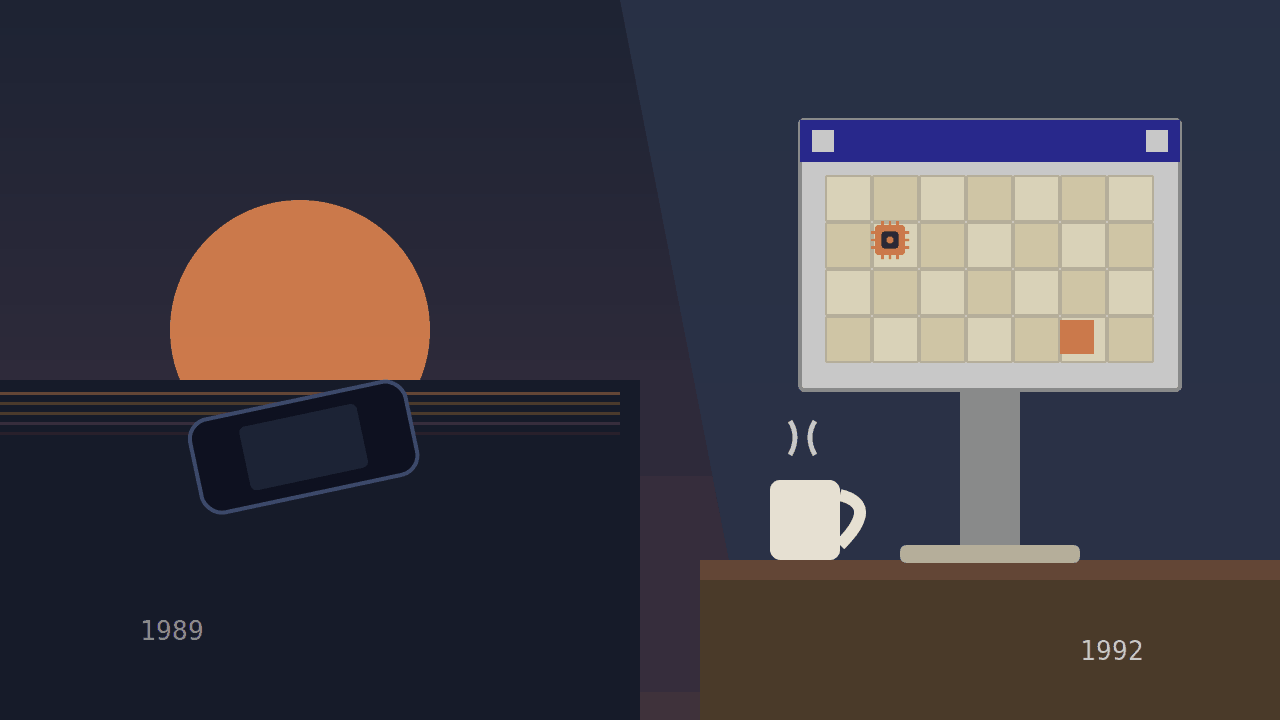 From a sinking handheld to the office desk (illustration, AI-generated)
Mechanics
The rules are complete on a top-down tile board. Each level scatters a number of computer chips; collect the quota and the chip socket opens, clearing the way to the exit. You cannot enter water, fire burns you, ice will not let you stop, and force floors sweep you along. Colored keys and doors, pushable blocks, monsters patrolling on fixed rules — and most levels add a time limit on top.
Where Sokoban (1982) was complete within the static logic of a single verb, "push," Chip's Challenge put interaction between elements at the center of play. Push a block into water and it becomes a stepping stone. Boots negate fire; other boots let you walk normally on ice — rule cancellation by equipment. Declare a rule per tile, then weave levels out of the combinations: I place this game as an early large-scale commercial practice of the tile-plus-rules grammar that PuzzleScript would formalize in 2013.
One more thing deserves note: how the game reached the makers' side. Soon after release, fans built their own level editors, passed them around on BBSes and the early internet, and traded unofficial level packs. The English Wikipedia records this as an early example of software modding. Because the board's grammar was simple and legible, players could turn into makers — a fact that foreshadows how the game survived the frozen years described below.
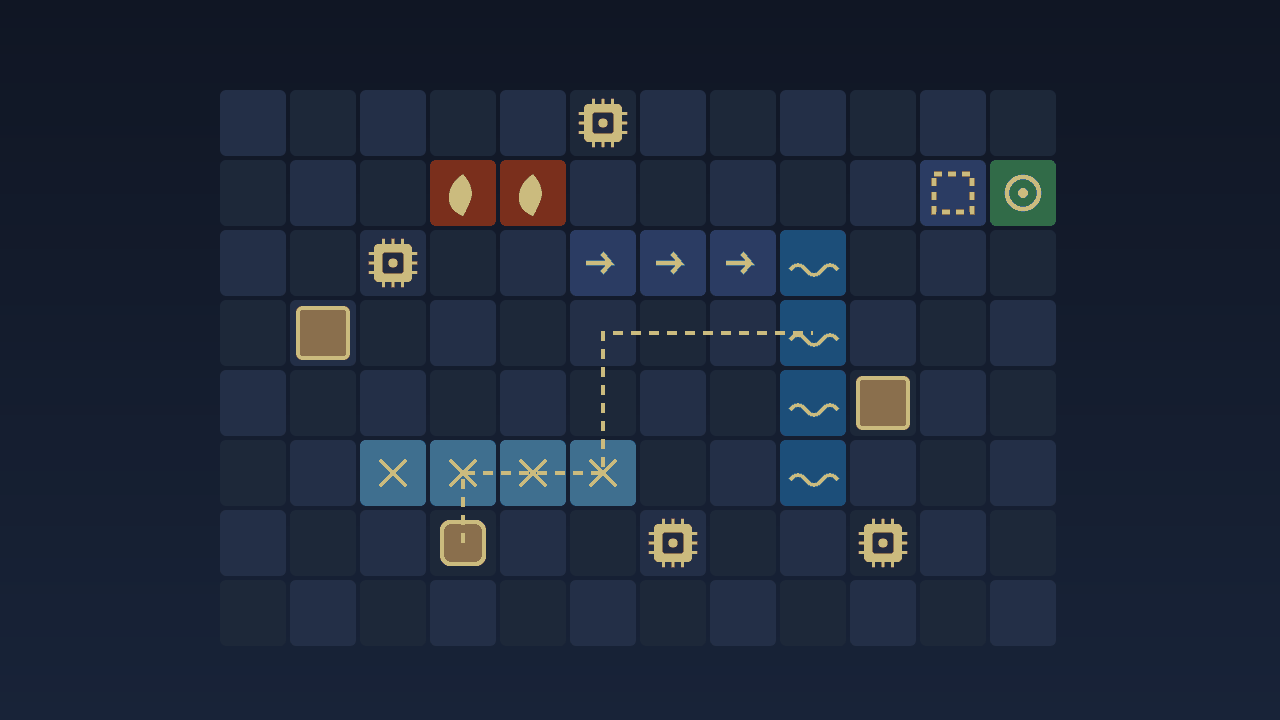 Declare a rule per tile, weave a level from combinations (illustration, AI-generated)
Lineage to the Present
The latter half of this lineage is a story about rights. With Epyx's collapse, the property passed to Bridgestone Multimedia Group, a company focused on Christian media. Sommerville had completed a sequel, Chip's Challenge 2, but the company had no interest in publishing it. "They wouldn't want to help me publish it. Not only that, they were asking for a ton of money just for me to use the name," he later recalled, adding, "I would have a yearly conversation to try and get the rights back, but Bridgestone would never budge." A finished puzzle sat sealed on a shelf over the ownership of a name.
During the freeze, it was the community that kept the board alive. Tile World, an open-source emulator written by Brian Raiter, became the game's home in the years without an official release, and the fan community assembled the Chip's Challenge Level Packs, selecting standout levels by vote. CCLP1, released on March 28, 2014, was chosen by voting across candidate sets of 33 packs of 50 levels each. The practice continues today through CCLP5 and CC2LP1 for the sequel.
The turning point came around the original's quarter-century mark. Sommerville founded Niffler in 2010 and shipped the spiritual successor Chuck's Challenge 3D to mobile in 2013 and Steam in 2014. Then Bridgestone finally relented: on May 28, 2015, Chip's Challenge 2 was unsealed and released on Steam, and the original went free the same day as Chip's Challenge 1. A handheld launch title from 26 years earlier lined up again, in official form, on a modern storefront.
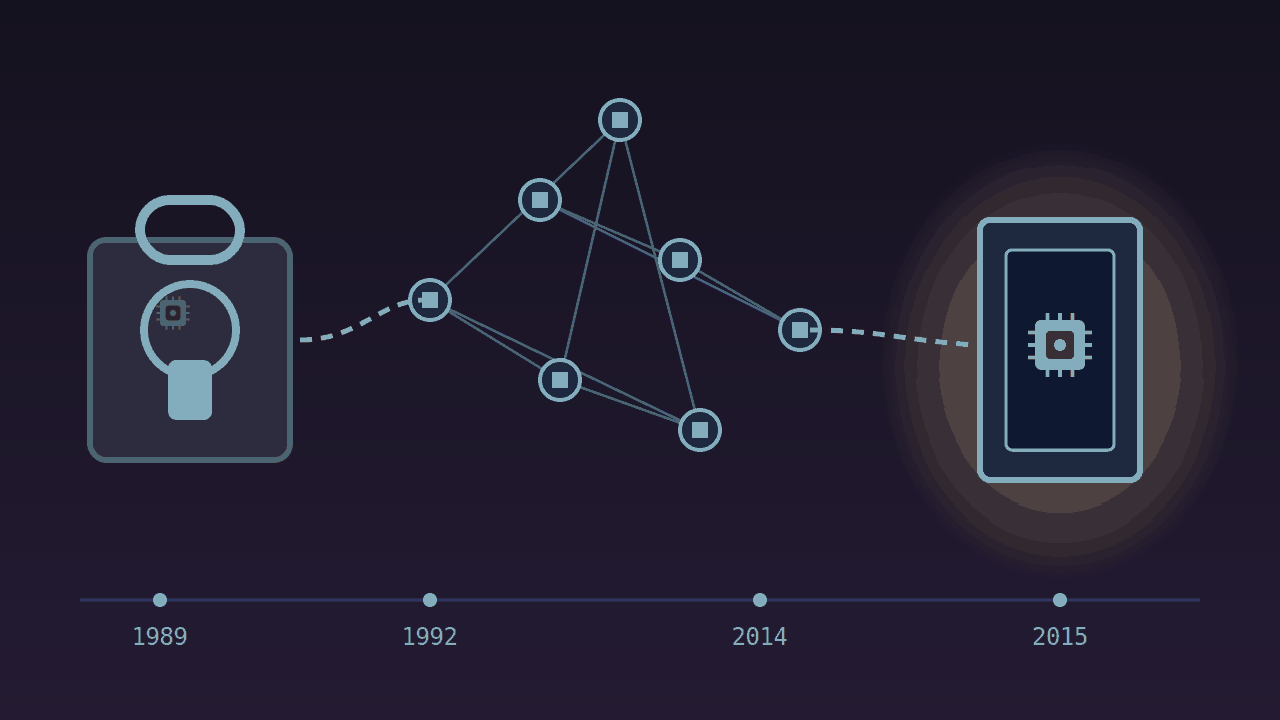 From a 1989 vault to a 2015 storefront, carried by a community's web (illustration, AI-generated)
Sources
Sources consulted for this article:
・Wikipedia: Microsoft Entertainment Pack
・The Chip's Challenge Wiki (Bit Busters): Chuck Sommerville
・BitBusters.club: Chip's Challenge Level Pack 1
・GitHub: Tile World (Brian Raiter)
・Chip's Challenge Wiki (Fandom): Chip's Challenge
・Steam: Chip's Challenge 1 (Niffler Ltd., May 28, 2015, free)
Closing
What this work demonstrated historically is that a puzzle's true body is neither hardware nor a brand name but a set of rules. The Lynx lost its war, Epyx vanished, and the name was locked in another company's vault. Yet the grammar — collect the quota of chips and the socket opens — kept running for 37 years: inside a reverse-engineered port, inside a fan-built emulator, inside level packs assembled by community vote.
When rules are legible, players preserve them, build on them, and one day return them to the official shelf. The 26 years from a 1989 handheld to Steam in 2015 were, as I read them, time spent proving exactly that. A board outlives its machine — in the end, the lesson this maze left behind fits in that single line.
 The machine fades; the light of the rules remains (illustration, AI-generated)
Reactions (no login)
Anonymous • one of each per visitor per day
Learn — Curriculum
LearnTeil 2 Lineage — Where Puzzles Came FromKapitel 5 Origins of the Digital Puzzle9 / 13
関連シリーズ
Retro Revisited第30回 / 全45回