DESIGNER-STUDY · 2026-08-02
Inside Andrew Shouldice's Philosophy — designing the time before you understand
TUNIC, an unreadable manual, and seven years of notebooks
Intro — the man who wants you to say "this was here the whole time"
Andrew Shouldice is a solo game developer from Canada. He is the creator of TUNIC, released on March 16, 2022 — an isometric action-adventure in which a small fox wanders an island covered in writing they cannot read. Outside the English-speaking world he tends to be introduced as "the guy who made the cute Zelda-like with the fox." But what he actually designs is neither cuteness nor Zelda pastiche: it is the structure of secrecy itself.
The reason to write about him now is that in November 2025, pre-orders opened for TUNIC: Design Works from Lost in Cult, and Shouldice spoke about going back through seven years of handwritten notebooks. "A lot of the ideas are dead ends, but not wasted time" (Finji, November 21, 2025 ↗). It is rare for a designer to open up the underside of a finished game in his own words like this.
This is not a review. It reads across what he has said in public, looking for what he says consistently. Every quote here comes from a source I actually read; my own interpretation is confined to the second-to-last section.
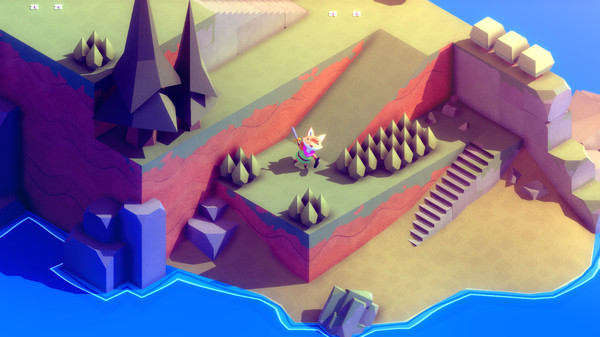 TUNIC (from the official Steam screenshots)
Background — he quit his job before he knew what he was making
Shouldice worked at Silverback Productions on point-and-click adventures. In 2015 he left to develop on his own. According to the English Wikipedia entry, he wanted to make a game with open-ended exploration but quit without knowing his creative direction (Wikipedia, "Tunic (video game)" ↗). The project was originally called Secret Legend; he posted work-in-progress screenshots to Vine.
Publisher Finji joined in 2017, and the game was announced as TUNIC at E3 that year, initially for 2018. It shipped on March 16, 2022 — seven years of development. Shouldice has attributed the overrun to an iterative model in which he redesigned and rebuilt nearly every element "at least once or twice" as he grew more experienced (ibid.). After release it won at the 26th D.I.C.E. Awards and the 19th BAFTA Games Awards.
So his career is not the kind where a vision comes first and execution follows. He quit first and figured it out while building. That order matches his design outlook almost uncannily.
Philosophy — the phase after you know it exists but before you understand it
In his 2023 GDC talk, "'TUNIC': This Was Here the Whole Time," Shouldice breaks a secret into three phases: "You start not knowing [something], that's the ignorance phase. And there's [the] knowledge [phase] where you know something exists, but you don't understand it. Then eventually, you do understand it. Understanding is closure. That's where something 'clicks'" (GDC 2023 ↗; transcription via Game Developer, April 25, 2023 ↗). He immediately qualifies it himself: "this is not empirical in the slightest. This is just sort of a way of thinking about things."
What matters is where he places value. In the same talk: "we're naturally inclined, as players, to follow this progression up. We want progress in a really abstract sense. Maybe that's what playing games is, in general: we want to learn, we want to find meaning." And yet, as the write-up summarizes, the phase he is most interested in is the middle one — knowing a thing is out there while it still keeps its mystery.
The same interest shows up in older words: "I've always loved games where you feel small and lost in a world full of mysteries. Games that make you say, 'wait, this was here the whole time!?' or 'I didn't even know that was possible!' I wanted to make something that evoked those feelings" (Inverse, April 14, 2022 ↗). The talk's title is lifted straight out of that sentence.
Obsessions — putting a mystery where the explanation should be
First, the unreadable language. Writing for PlayStation.Blog, he put it this way: "One of the ways I wanted to help players feel like they were in a world that wasn't meant for them was to fill the game with a strange, unreadable language. Instead of a signpost telling you what's around the next corner, it would show you some baffling symbols. Instead of the inventory screen labeling things sensibly, it would use the same unknowable runes" (PlayStation.Blog piece, via 80 Level, September 2022 ↗). He calls it a "trippy glyph language."
Second, the instruction manual, which the player assembles page by page from the world. Shouldice physically built a real-world manual, then folded, ripped, taped and stained it before scanning each page, chasing the texture of old print. He traces the feeling back to childhood: "if anyone's had the experience of either reading an instruction manual, from a game that's in a language that you don't speak, or even reading an instruction manual, when you're like three years old, and being like, I don't know any of these words... you automatically get that sense of wonderment like, what does this mean? It could mean anything!" (Game Developer interview ↗).
Third, the conversion of explanation into mystery. "It's true that the job of a game is to communicate its mechanics and systems, but if you frame that communication as a mystery to be solved, then the revelation is all the sweeter" (PlayStation.Blog piece, via 80 Level, September 2022 ↗). Note that this is not hiding information so much as deliberately lengthening its route. Page placement was a tuning knob: "a lot of them do have essential information. And those ones might be in obvious spots where you'd find them. Some of the other ones might be more difficult to find. And we can precisely tune how much knowledge they gain from that by where we place those things" (Game Developer interview ↗).
Fourth, an obsession with content nobody needs to find: "that's the thing where you hide something so deeply that you don't care if anyone finds it [because] you just like knowing that it's there. And short answer, yes. There are lots of those" (ibid.). And fifth, pen and paper: "There's an immediacy to pen and paper that I really like. You don't need to worry about its battery being charged... It's really easy to open up a text editor and absolutely fill it with garbage... sitting down with a fresh page in your notebook requires a deliberate act of beginning" (Finji, November 21, 2025 ↗).
Failures — the reviewer who beat the final boss by mistake
The most design-relevant failure he has discussed publicly involves an accessibility feature. TUNIC ships with No Fail Mode. Speaking to Wired: "A few months before launch we set up a Discord for press folks to collaborate on puzzles prelaunch. One reviewer got to the credits, having defeated the final boss using No Fail Mode. It didn't take long for them to realize that they missed out on a big part of the game — you're supposed to fail that fight in order to unlock the game's next act."
The fix was an exception: "As a result, we added a special case, where even if you're using No Fail Mode, you can die in that fight. Our rationale was that if someone turned on that option because they preferred the puzzlier aspects of the game, it made no sense to penalize them and lock off some of TUNIC's more intriguing late-game riddles" (Wired, 2022; quote verified via Zero Counts, which reprints the passage in full ↗). He privileged the player's motive for enabling the option over the tidiness of the rule.
There is also the fear he admitted right after launch: "Now that the game is out, and we've been able to see the reaction, things are better than I could have ever hoped. It feels kind of aloof to say 'people are really getting it,' you know? but in truth I was really scared that people wouldn't" (Inverse, April 14, 2022 ↗).
And more recently, asked what he hopes readers take from TUNIC: Design Works: "I hope people share in an experience I've been having while going through my old notes: being reminded that, more often than not, I have no idea what I'm doing... So naturally, a lot of the ideas are dead ends, but not wasted time. They represent probing an avenue to confirm that it's not quite right, and gaining a better understanding of what would be just right" (Finji, November 21, 2025 ↗).
Dilemmas — putting a no-death option into a game gated by difficulty
One dilemma he has named explicitly: "It's true that challenging combat is a core part of TUNIC. However, including options like No Fail Mode does not 'compromise the integrity' of the game or anything like that. Really early on, I thought it would be a challenge to incorporate that sort of setting into a game that uses difficulty to gate progress, but in the end, it was a very straightforward decision. The truth is that people who enjoy the combat challenges are just not going to use the option, and those who don't want to engage with the combat will" (Wired, 2022, verified via Zero Counts ↗).
In justifying it he restated what he thinks his own game is: "In the end, the core of TUNIC isn't about exclusion based on whether you can press the buttons at the right time. It's about being curious and willing to explore a world you don't understand" (ibid.). Between difficulty and curiosity, this episode settled which one was load-bearing.
On difficulty itself he uses the word "tricky": "Difficulty is a tricky thing. My preference when it comes to difficulty is that a challenge can be overcome by being patient and thinking carefully, rather than with flawless execution." And: "challenge exists in order to make you feel brave. If something is just a little bit scary, you're going to have to muster your courage to get past. When playing games, I love feeling like I got away with something" (Inverse, April 14, 2022 ↗).
A second dilemma is the line between hidden and unreachable. He conceded the risk himself: "It's a game that lets you go the wrong way. If you don't read the manual, you can get really stuck" (ibid.).
Influences — the ones he acknowledges
The origin is childhood Zelda: "Since the very beginning there's been this really particular, highly-specific feeling that I got playing the old Zelda games, this feeling of genuine discovery and mystery, and knowing that there are things about this world that you don't quite understand" (Game Developer interview ↗).
In the same interview he is candid about the rest: "People often say that there's some [Dark] Souls influence here, which is not entirely untrue... Fez has some mysteries and puzzles in it that I definitely drew from and the visuals of a game like Monument Valley is something that I admire greatly" (ibid.). Without speculating further: those three, plus Zelda, are the works he names.
For an influence from another designer, he credits a talk by Frog Fractions' Jim Stormdancer. At GDC 2023 he quoted Stormdancer's framing that playing a game of the 80s "meant entering the unknowable world operating under confusing rules where anything could happen," adding, "I think that's just a really lovely way of putting that" (Game Developer, 2023 ↗).
And the fox has an origin too, though not a lofty one: "The silly answer is the true answer. I didn't really know how to do 3D modeling all that well, when I first started work on [the game]... So an animal made sense. And you know, foxes get up to trouble" (Game Developer interview ↗).
Kizuki's reading — he doesn't hide information; he hands over its existence first
What follows is my own reading. Shouldice is usually described as a maker of secrets, but lining up his statements, what he actually designs is not secrecy — it is the dwell time of the state "I know it's there and I don't understand it." Since he says himself that the middle phase is what interests him, the unreadable glyphs and the scattered manual are not devices for withholding answers. They do the opposite: they hand over the bare fact that meaning exists here, and defer the meaning itself. A player kept in ignorance searches for nothing. So he shows existence first, then tunes when comprehension arrives by choosing where each manual page sits. When he says he can "precisely tune" it, I take him to mean the arrival time of understanding, not difficulty.
Read that way, the No Fail Mode episode stops being a bug fix. Requiring the player to lose the final fight in order to open the next act is an elegant use of failure as progression — but its meaning vanishes entirely for someone who chose not to fail. Faced with that, he did not protect the purity of the trick; he guessed at why that person pressed the toggle, and added an exception. Not filtering people by difficulty was, I suspect, less a kindness than a definitional matter for him. He restated the core as curiosity, after all.
One last thing snags on me. Asked whether there are secrets hidden in TUNIC: Design Works, he replied, "I've never hidden a secret in my life!" (Finji, November 21, 2025 ↗). A joke, obviously. But whenever this man speaks publicly about secrets, only half of it seems to be on the record; the other half stays in his hand. A person who hands you a book made of seven years of notebooks says, with the same mouth, that he has hidden nothing. I read that as his habit — prolonging the state of "there is still something" rather than delivering the answer — leaking out past the edges of the game.
Closing — where to start
If you want to understand him, play TUNIC first and watch the talk second. When you pick up a manual page early on, get into the habit of opening it and just looking. The time you spend staring at a page you cannot read is precisely what he designed. Afterwards — or after getting stuck and annoyed — the GDC 2023 talk (free on GDC Vault ↗) shows you what was being done to you.
Two neighbours are worth reading alongside him. On making the refusal to explain into the work itself, Stephen Lavelle is close (our study of Lavelle). On designing when a player's understanding arrives, compare Jonathan Blow (our study of Blow): both handle the same click, at wildly different temperatures. Blow presses the truth on you; Shouldice keeps saying it's fine not to know yet.
I am reheating my hojicha and waiting for the book of his notebooks. The dead-end pages are the ones I want.
Sources
Primary sources consulted for this article (all read in full):
・GDC 2023, "'TUNIC': This Was Here the Whole Time" (talk by Shouldice, free on GDC Vault) ↗
・Wikipedia, "Tunic (video game)" (used only for career, timeline and awards) ↗
Reactions (no login)
Anonymous • one of each per visitor per day
関連シリーズ
The Designer's Philosophy第36回 / 全63回
Read next

Related reviews
Evan's Remains
Plattformen, die verschwinden, sobald man sie verlässt, und Blöcke, die andere Blöcke aktivieren oder anhalten – allein aus dieser Kombination sind die Rätsel gebaut, die jeweils auf einem einzigen Bildschirm gelöst werden, während man die Geschichte von Dysis liest, einem Mädchen auf der Suche nach dem verschwundenen Jungen Evan. Ein 2D-Puzzle-Adventure von maitan69.
Zero Escape: The Nonary Games
Zwei Mystery-Adventures von Spike Chunsoft in einem Paket: Neun Menschen sind in einer Anlage eingesperrt und müssen durch nummerierte Türen entkommen. Enthalten sind das ursprünglich für den DS erschienene Nine Hours, Nine Persons, Nine Doors und der Nachfolger Virtue's Last Reward, die Escape-Room-Abschnitte aus der Ich-Perspektive mit verzweigten Romanpassagen abwechseln.
Machinika: Museum
Eine Ego-Perspektiv-Rätselbox, in der man Geräte unbekannter außerirdischer Herkunft, die in ein Museum gebracht wurden, scannt, ins Innere blickt und fehlende Teile nachdruckt, bis sie wieder laufen. Ein kurzes Werk von Littlefield Studio, das sieben Maschinen nacheinander öffnet, mit dem Gestus einer Science-Fiction-Archäologie.


