SOUNDTRACK · 2026-09-18
Soundtrack: Day of the Tentacle Remastered — one mansion, scored by three composers across three centuries
Peter McConnell / Michael Land / Clint Bajakian
Introduction — the same MIDI, dressed in new tone
Komugi's review gave this 1993 adventure classic 8.8 out of 10. It's a time-travel puzzle set inside a single mansion. The remaster reportedly keeps the original MIDI progressions intact and simply re-voices them through a synth similar to the Roland Sound Canvas.
The composers are Peter McConnell, Michael Land, and Clint Bajakian — a trio familiar from LucasArts adventures going back to the 1993 original. The tempo shifts from scene to scene, but every cue keeps that light, cartoonish step.
It's a little disappointing that this never got a full orchestral re-recording. Still, listening again over black coffee, I think there's a reason for keeping the MIDI and just re-dressing the tone: it protects the original skeleton, a score written as a set of cues for motion.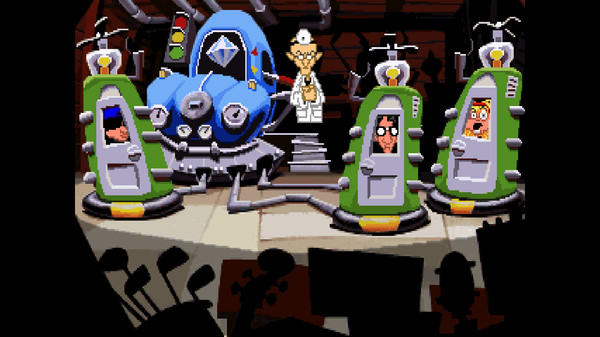 A screenshot of Day of the Tentacle Remastered (via the official Steam store page)
Three eras, three composers — one mansion with three voices
The game's core hook: Bernard (present), Hoagie (past), and Laverne (future) solve one puzzle together, scattered across different centuries of the same mansion. According to Wikipedia, the composing duties were split cleanly along those same three eras — McConnell took the present, Land the future, Bajakian the past — with one exception: Dr. Fred's theme, which McConnell wrote even for the past-era scenes.
Same building, same floor plan, yet the composer changes with the century. I don't think that's just a division of labor — it feeds directly into the player's experience. Because the mansion in the past and the mansion in the future ring out in different composers' "voices," the gap between eras becomes something you can actually hear.
What I find delightful: McConnell and Land are the very people who co-invented iMUSE, LucasArts' adaptive music system (patent US 5,315,057). They built the foundation together, then each took a different century to score on top of it. A screenshot of Day of the Tentacle Remastered (via the official Steam store page)
How iMUSE works — wait, connect, build
iMUSE lets a composer plant "branch points" and "loop points" anywhere in a piece. Until a trigger arrives — the player moves to another room, picks something up — the music waits by repeating a short phrase, then the moment the trigger fires, it flows smoothly into the next section.
Concretely: while the screen is still scrolling to a new location, a short repeating passage plays, and the instant the destination is reached, it continues into a more dramatic phrase. It's close to how a pit orchestra adjusts how long it plays to match what's happening on stage. A design that never falls apart no matter how long the player takes.
The puzzle analogy — like wine turning to vinegar, the music changes clothes across three centuries
The game's signature puzzle: a bottle of wine left in the past reappears, four hundred years later, as a bottle of vinegar in the very same spot. You can't send an object through unchanged — it has to pass through the transformation of time to arrive at all.
The music does exactly the same trick. The same mansion's theme sounds in Bajakian's hand in the past sections and in Land's hand in the future ones. The melodic skeleton still points at the same building, but its "clothing" changes with the century. The same conversion that turns wine into vinegar is happening on the music side too. My habit of measuring everything in BPM turned, here, into counting how many outfits one skeleton could wear.
Videos worth watching — precisely because there's no standalone soundtrack release
I'll say this plainly: I couldn't find a standalone official soundtrack release for this game. So instead of "tracks worth hearing," here are two videos confirmed on an official channel. First, the launch trailer from Double Fine's own YouTube channel, where you can hear the remastered tone for yourself.
Second, also on Double Fine's official channel, there's a documentary called "The Making of Day of the Tentacle Remastered," following the development from behind the scenes. → The Making of Day of the Tentacle Remastered ↗
I think the very fact that there's no standalone release says something true about this music. It was never meant to be lifted out of the mansion and heard as an album — it only completes itself inside the game.
Closing — what I'd steal is splitting one skeleton across three composers
If I write my own score, what I want to steal is the idea of deliberately splitting one theme across multiple composers — or multiple versions of myself. Writing it alone would keep things consistent, but deliberately splitting the "voice" is what lets the same place feel like a different era, through sound alone.
The other thing worth keeping is iMUSE's idea of "wait with a short repeat, then connect once the trigger comes." To stop a retry or a loading screen from cutting the music off awkwardly, you just write a phrase built for waiting, ahead of time. And a piece of music that never becomes a standalone album — I've started to think that's not such a bad goal after all.
References
• Day of the Tentacle — Wikipedia (composing duties split by era)
• iMUSE — Wikipedia (how the adaptive music system works)
• Peter McConnell — Wikipedia (on the iMUSE patent US 5,315,057)
• Day of the Tentacle Remastered Trailer (Double Fine, official YouTube)
• The Making of Day of the Tentacle Remastered (Double Fine, official YouTube)
• Day of the Tentacle Remastered review — Mix n' Mojo (on the remaster's audio approach)
Reactions (no login)
Anonymous • one of each per visitor per day
関連シリーズ
Puzzle Soundtracks第100回 / 全100回
Read next

Related reviews
Tetris Effect: Connected
Das Fallblockspiel, das jeder kennt, mit vollkommen unangetasteten Regeln. Über dreißig Stufen hinweg reagieren Musik und Licht auf jeden Zug. Hinzu kommen nur zwei Dinge: eine „Zone", die die Zeit anhält und mehr als vier Reihen auf einmal löschen lässt, sowie ein Koop-Modus für drei Spieler, deren Felder zusammenwachsen. Von Enhance, dem Studio von Tetsuya Mizuguchi.
FRACT OSC
Ein musikalisches Erkundungspuzzle aus der Ich-Perspektive: Man durchstreift eine weite, aus Synthesizern gebaute Ruine und betaetigt leuchtende Knoten und Klangapparate, um schlafende Maschinerie und Musik wiederzuerwecken. Es gibt kaum Anleitung; herauszufinden, was ueberhaupt interaktiv ist, ist bereits das Raetsel. Phosfiend Systems, 2014, Gewinner des Audio-Design-Preises der IndieCade.

