REVIEW · 2021-08-17
Tetris Effect: Connected
Die Regeln haben sich seit 1984 nicht bewegt — was also bewerteten 5.568 Rezensionen?
First Impressions
I read the Steam review pool for Tetris Effect: Connected as it stood on 25 August 2026. The store page shows 94% of 5,568 reviews positive, labelled Very Positive, and 89% of 46 over the last thirty days. SteamDB counts roughly 8,000 reviews across all languages, 7,327 of them positive - about 91.6%.
The provenance first. It is the falling-block game you already know. Developed by Monstars Inc., Resonair and Stage Games, published by Enhance, on Steam since 17 August 2021. The original Tetris Effect shipped on PS4 on 9 November 2018, and the PC version arrived in 2019 as an Epic Games Store exclusive. Tetsuya Mizuguchi is credited as co-producer.
Read the helpful positive reviews in order and something odd surfaces: nobody is talking about Tetris. They talk about sound, light, serotonin, meditation, healing. The single most-upvoted review says buying it changed their life.
The negative column does the same thing. What sits at the top is handheld performance, an Epic account requirement, the forty-dollar price, and the intensity of the light. Almost no one argues about the board. Plenty of games have a pool where both sides read one feature differently; here the two sides are looking at different objects entirely. That gap is what this piece reads.
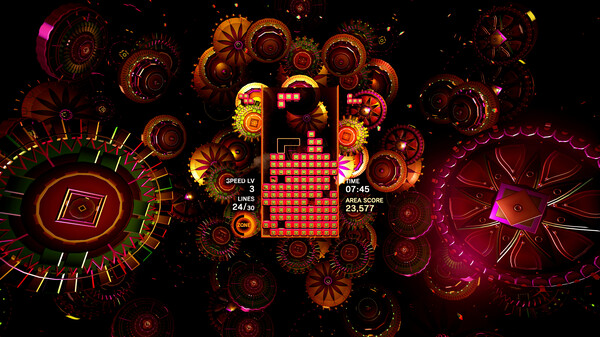
 Screenshot #1 as published on the Steam store page
Putting the Mechanics into Words
The rules have not moved. Seven shapes fall, a filled row disappears. It is a grammar finished in 1984, and free implementations of it exist everywhere. One Japanese review puts the point warmly: what you are doing is ordinary Tetris, so you can relax.
Exactly one verb was added: the Zone. Fill a gauge, trigger it, and time stops along with the falling pieces. Rows cleared during the freeze stack up at the bottom, so you can clear more than four lines at once - something the base rules forbid. The store page leads with this as the new feature.
In Puzzlebyrinth's vocabulary this is neither subtraction nor addition but leaving the grammar in place. Use the rules as they are, and move the presentation instead. HUMANITY, published by the same Enhance, went the opposite way: it buried its verbs in the floor to build a new grammar.
The other addition is Connected: three players fight AI bosses side by side, and at intervals the three boards join into one wide board. This is what critics singled out. Destructoid gave it a nine while writing that the game is not reinventing the wheel, and that this is not a bad thing. The critics said the rules were untouched before the users did.
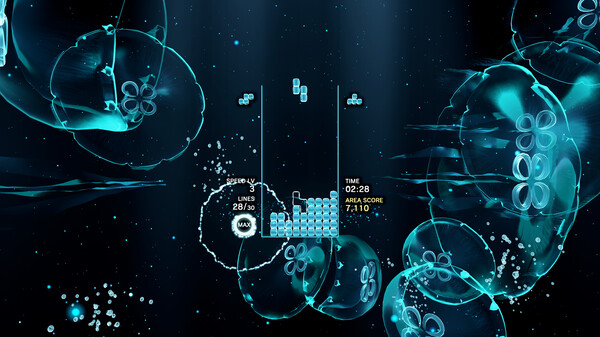
 Screenshot #2 as published on the Steam store page
Design Craft
Once the rules are fixed, what variable is left to the designer? This game answers plainly: presentation. There are more than thirty stages, each with its own music and imagery. Hydelic is credited with the soundtrack.
The craft is that the decoration doubles as a status display. Rotating a piece makes a sound; clearing a line thickens the track by a layer; when the speed rises the whole screen shifts colour. You never read a number to know which phase of the run you are in - your ears and eyes tell you. Designing with sound as the cue is a subject Solving by Ear took up as well.
The review pool puts it more bluntly. The recurring positive words are meditation, healing, catharsis; the Japanese column offers synaesthesia and the most elegant Tetris in the world. None of these judge the board. They judge how the board is delivered. When the pool around Mini Metro reached for elegance, it meant a property of the board itself - a different target.
One figure is worth recording. Playtimes on the helpful positive reviews run from eleven hours to four hundred and forty-two, with the middle band around twenty to thirty. People sinking hundreds of hours into a falling-block game is not unusual. All of them talking about light and sound is.
 Screenshot #3 as published on the Steam store page
The Texture of Difficulty
The texture of difficulty is handed almost entirely to the player's own skill. When the rules are public property, whether you get stuck depends on how good at Tetris you are. So the negative column's complaints about difficulty do not land on the board's design. They land on the absence of adjustment.
The representative review says the speed climbs too fast, that it is impossible to play calmly, that there is no way to choose your own pacing. The pitch promises relaxation; what this group reports is anxiety. The question of fairness that Is Difficulty Unkind? took up appears here as a question of whether the player is allowed to adjust anything.
The Zone works, in this light, as a device that buys difficulty back. Freeze a collapsing board, clear it out before the stack reaches the top. For strong players it is an offensive scoring tool; for weak ones it is insurance. One verb, two roles, sorted by skill. Widening the game's reach while adding only a single verb strikes me as a fine piece of design.
And the complaint that comes closest to the design sits here too: the light hides the board. Reviews on both sides write that you have to squint to see the pieces, that the effects are excessive. One highly rated review warns photosensitive players away outright. In a game where only the presentation was moved, a complaint about presentation is a complaint about the design.
 Screenshot #4 as published on the Steam store page
Sources
This piece was written by reading the Steam user reviews on the store page as of 25 August 2026, together with official information, aggregate sites and one critic review. No review text is quoted directly; recurring claims are reconstructed.
- Steam: Tetris® Effect: Connected (94% of 5,568 reviews positive, Very Positive; 89% of 46 in the last thirty days; $39.99 list)
- Read the top ten by helpfulness on the positive side, the top ten on the negative side, ten most-recent reviews, and the top five Japanese-language reviews
- All-language counts from SteamDB (about 8,000 reviews, 7,327 positive); the critic and user split from Metacritic (88 from twenty-five critics; 7.5 from users, 272 positive / 66 mixed / 50 negative)
- For the press view I read Destructoid's review (9/10). Development credits, release history and awards were checked against the Wikipedia article
- On images. All five in the body are official screenshots published on the Steam store page, and their URLs were confirmed through the appdetails API. The image CDN was unreachable from this environment, so their contents could not be checked by eye; the captions therefore stay generic, naming only the game, the asset type and the store ordering. No diagrams of my own were used
Closing
The gap between the two sides also shows up outside Steam's own tally. Steam reads 94% positive; Metacritic's user score is 7.5, built from 272 positive, 66 mixed and 50 negative ratings, against 88 from twenty-five critics. What looks like 94% in a yes-or-no vote carries 13% negative once the scale has ten points.
Line up the top negative reviews and that 13% takes shape. Performance falling away on handhelds and AMD hardware after a September 2025 update, with a slow response. An Epic account required for online play. The forty-dollar price. Protests about past platform exclusivity. Every one of them is about the packaging, not the game. Recent reviews praise the optimisation again, so the performance problem looks settled, but complaints about multiplayer disconnects were still being posted in August 2026.
Against Steam's 94% I put 8.2. The credit goes to the sheer craft of sustaining dozens of hours without touching a single rule, moving only the presentation. Two deductions. The one variable they did move carries concrete complaints - poor legibility and photosensitivity. And the player is given no way to choose the pacing. That is not a complaint about difficulty but about the absence of a dial. On measuring puzzle difficulty from the outside, see also the study that gauges Tetris difficulty by how fast an AI learns it.
Who is it for? If you would rather not learn a new rule set, and want a game you already know delivered with the best light and sound anyone has put on it, this is close to ideal. It is not for someone who wants new thinking on the board, or for anyone sensitive to hard flashing. Forty dollars is the price of the presentation, not of the rules. Whether you can read it that way decides your verdict before you start.
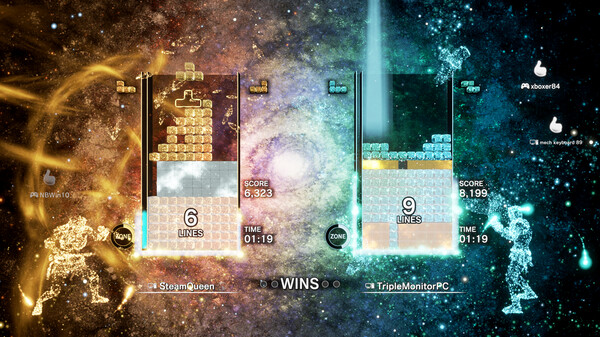 Screenshot #5 as published on the Steam store page
Where are you with this game?
Press one and the game goes on your shelf. You can see it on your account page.
Reactions (no login)
Anonymous • one of each per visitor per day
Read next
Related reviews
Tiny Room Stories: Town Mystery
An escape-room puzzle game in which a private detective, summoned to the deserted town of Redcliff, inspects diorama-like rooms that can be rotated and viewed from any angle, opening keys and combination locks while searching for his father. Made at a very small scale by Kiary Games and ported from mobile.
Mini Motorways
Ein minimalistisches 2D-Puzzle, bei dem man Straße für Straße zeichnet, um Autos zu farbigen Häusern und Zielen fahren zu lassen, die ständig neu entstehen. Einmal pro Woche werden Autobahnen, Ampeln und Kreisverkehre zugeteilt, während man das Straßennetz immer wieder umzeichnet, bis der Stau die Stadt zum Stillstand bringt. Ein Werk des neuseeländischen Studios Dinosaur Polo Club, das auch Mini Metro gemacht hat.
Inscryption
Ein Deckbuilding-Kartenspiel: Man zieht Karten mit Waldkreaturen, opfert eigene Kreaturen, um sie ins Spiel zu bringen, und sitzt dabei dem Erzähler Leshy gegenüber, der sich in einer Hütte verschanzt hat. Steht man vom Tisch auf, wird die Hütte selbst zu einem Escape-Room-Rätsel. Ein Werk von Daniel Mullins, dem Schöpfer von Pony Island.


