SOUNDTRACK · 2026-08-03
Soundtrack: Broken Age — A live orchestra descends on a hand-painted village
Peter McConnell
Introduction — A live orchestra descends on a hand-painted village
The girl Vella wakes and begins to walk through a village up in the clouds. The first thing to reach your ear is the living breath of strings and clarinet. Not the leveled sheen of a sample library, but the faint grain of a bow biting the string, left in on purpose. A slowish triple meter, too free in its step to call a waltz outright; the tempo is hard to count, yet it clearly sways. Onto this hand-painted point-and-click that Komugi reviewed, McConnell brought a wager from the very start: a live orchestral score.
Peter McConnell belongs to the LucasArts lineage. The music of Grim Fandango and the Monkey Island games, then Psychonauts and Sly Cooper for Double Fine. For Broken Age he began from a single idea — that all the musical sound should be as live as possible — and recorded the Melbourne Symphony Orchestra alongside a small San Francisco ensemble, the clarinet quartet Clarinet Thing, and The New Vocal String Quartet. One sip of black coffee. The luxury of layering this much flesh-and-blood sound over painted backgrounds still straightens my spine to hear.
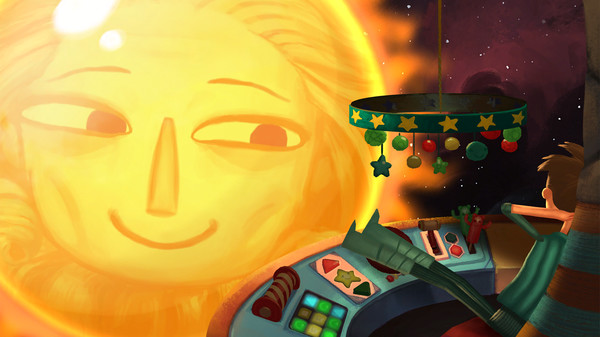 Broken Age (from the official Steam screenshots)
Live sound and iMUSE — a 45-year-old invention that still works on puzzles
The staff comments are telling. Studio audio director Brian Min wrote that in an era when samples are cheap, recording live players 'can have emotional impact that can't be matched by any technology today,' and that Broken Age renewed his faith in that. The process of McConnell recording the MSO and the larger ensemble survives vividly in Double Fine's own documentary, Double Fine Adventure — episodes 11 and 13. The hand writing the score, and the moment an orchestra first sounds it aloud. Watch those, then listen, and the through-composed orchestra suddenly begins to breathe.
And there is one more thing Broken Age always makes me recall: iMUSE. McConnell, together with Michael Land, is the very person who invented the iMUSE adaptive-music system at LucasArts. Switching cues in sync with the beat, layering multiple tracks to raise and lower tension smoothly — the thinking behind that early-1990s invention is still soaked into his writing. Broken Age's music, too, waits for 'which part of the cue is playing' before it transitions between scenes, catching the player at seams with no sharp corners whether they stop or press on. The reason a through-composed orchestra can follow the irregular time of puzzle-solving without falling apart is this groundwork underneath.
The puzzle analogy — wandering hands and a seamless orchestra
You can't tick point-and-click solving off in beats. You wander the screen, pick up an object, combine this with that, hit a wall, stare idly for a while, then suddenly it clicks. Paste a short looping cue over this nonlinear motion and the 'idle time' before the click suddenly feels reproached — because the same eight bars keep coming around. Broken Age avoids this, I hear, because the music is through-composed, moving toward a cadence, yet it meets each scene by raising and lowering layers of tension rather than repeating.
I always have the habit of measuring music in BPM, but on this one I think the 'unmeasurability' is the design. The triple meter of Vella's village stretches and shrinks freely with her stride; the sound of Shay's spaceship loses the center of gravity of the beat, as if weightless. While the player's hand is still, the music does not rush to a conclusion — it adds or removes a single chord and changes only the air. Sounding the unsolved stretch not as a mistake but as 'still on the way' — that is this score's quietest job.
Tracks worth hearing
Start with the full-album version the developer Double Fine posted officially, and follow the rise and fall of moving between village and spaceship exactly as it plays. The texture of live performance comes through well enough even in a compressed stream.
If I pick one track, March in the Clouds ↗ — the village's triple meter, woodwinds and strings stepping softly. Follow it with Shay's side, Time to Get Up, Little Spaceman ↗, and you can hear the same composer play 'grounded warmth' and 'weightless sweetness' apart from each other. Both are official audio from the composer's own Double Fine Bandcamp.
Closing — what I'd steal
If I steal for my own work, it's two things. One is the confirmation that a small live ensemble can carry plenty of emotion. Even without a full orchestra, the living breath of a clarinet quartet and a string quartet alone can hand body heat to a hand-painted world. The other is the iMUSE-like idea — not filling with loops, but raising and lowering layers so the design never reproaches the 'unsolved time.' This work teaches that the time a player stands still is exactly where the music should be most gentle.
To relisten, choose a moment while you're assembling something — cooking, writing, any task where you hit a wall and your hands stop. For related listening, McConnell's own Grim Fandango and Psychonauts. Through live playing and the breath of jazz, you can clearly hear how he has written 'an orchestra that stays close to the story' in different voices.
Reference links
・Steam: Broken Age (developed by Double Fine Productions)
・Double Fine official YouTube: Broken Age - Full Official Soundtrack
・Double Fine Adventure documentary (episodes 11 and 13 cover the MSO sessions and scoring)
・iMUSE — the adaptive-music system by McConnell and Michael Land
Reactions (no login)
Anonymous • one of each per visitor per day
関連シリーズ
Puzzle Soundtracks第63回 / 全100回
Read next

Related reviews
Tetris Effect: Connected
Das Fallblockspiel, das jeder kennt, mit vollkommen unangetasteten Regeln. Über dreißig Stufen hinweg reagieren Musik und Licht auf jeden Zug. Hinzu kommen nur zwei Dinge: eine „Zone", die die Zeit anhält und mehr als vier Reihen auf einmal löschen lässt, sowie ein Koop-Modus für drei Spieler, deren Felder zusammenwachsen. Von Enhance, dem Studio von Tetsuya Mizuguchi.
FRACT OSC
Ein musikalisches Erkundungspuzzle aus der Ich-Perspektive: Man durchstreift eine weite, aus Synthesizern gebaute Ruine und betaetigt leuchtende Knoten und Klangapparate, um schlafende Maschinerie und Musik wiederzuerwecken. Es gibt kaum Anleitung; herauszufinden, was ueberhaupt interaktiv ist, ist bereits das Raetsel. Phosfiend Systems, 2014, Gewinner des Audio-Design-Preises der IndieCade.

