GESCHICHTE · 2026-07-29
Pentomino (1965) — Wie die von Solomon Golomb benannte Fünf-Felder-Figur zu Tetris wurde
Die Benennung 1953, Gardners Kolumne 1957, die russische Übersetzung 1975 — die Jahre, in denen ein einziges Buch die Welt bereiste
Einleitung
Was ich diesmal ausgrabe, ist nicht ein Spiel selbst, sondern ein Buch. 1965 veröffentlichte der amerikanische Mathematiker Solomon W. Golomb (1932-2016) „Polyominoes". Der Erstausgabe lagen Spielsteine aus Plastik bei: alle zwölf Formen, die entstehen, wenn man fünf Quadrate an ihren Kanten verbindet — Figuren, die später „Pentominos" genannt werden sollten.
Das Buch selbst hat die unauffällige Erscheinung eines mathematischen Fachbuchs. Was mich jedoch interessiert, ist die schiere Reichweite seines Inhalts: Zurückverfolgt führt sie zu einer englischen Zeitungsrätselspalte von 1907, vorwärts zu einem sowjetischen Rechnerbildschirm von 1984 und weiter bis ins heutige Regal der Puzzlespiele.
In diesem Artikel verfolge ich die Zeit von 1953, als Golomb der Figur ihren Namen gab, über 1957, als Martin Gardner sie in die Welt trug, bis 1975, als die russische Übersetzung erschien, und schließlich bis 1984, als Alexey Pajitnov daraus Tetris schuf. Ich möchte von der Seite der Geschichte her nachvollziehen, warum eine Fünf-Felder-Figur so weit getragen wurde.
 1965, eine Darstellung des Buches „Polyominoes" (Illustration, KI-generiert)
Der zeitliche Kontext
Golomb wurde 1932 in Baltimore, Maryland, geboren. Er war ein Ingenieur, der seinen Bachelorabschluss an der Johns Hopkins University und 1957 seinen Doktortitel in Mathematik an der Harvard University erwarb. Sein Fachgebiet waren Codierungstheorie und Zahlentheorie, doch bekannt wurde er in der Breite gerade durch seine als Freizeitbeschäftigung betriebene „Unterhaltungsmathematik".
1953 stellte er in einem Vortrag beim Mathematik-Club der Harvard University systematisch Figuren vor, die durch das Verbinden von Quadraten an ihren Kanten entstehen. Er soll die aus fünf Quadraten bestehende Figur, in Anlehnung an „Domino" (zwei Quadrate), „Pentomino" genannt haben. Im darauffolgenden Jahr 1954 veröffentlichte er dies als Aufsatz und prägte offiziell das Wort „Polyomino" als Rückbildung von „Domino".
Der Ursprung der Figur selbst ist noch älter. Die früheste bekannte Erwähnung dieser Art von Rätsel soll sich in Henry Dudeneys 1907 verfasstem „The Canterbury Puzzles" finden (eben jenes Buch, das in einem separaten Artikel dieser Seite mit dem Titel „Dudeney (1907)" behandelt wird). Golomb selbst stellt in seinem Buch die Überlieferung vor, dass schon alte Go-Meister die zwölf Formen entdeckt hätten, die fünf Steine auf einem Go-Brett bilden können — ein Hinweis darauf, dass das Interesse an der Figur schon lange vor seiner Benennung bestand.
Im Mai 1957 griff Martin Gardner in seiner Kolumne „Mathematical Games" im Magazin „Scientific American" das Thema Pentomino auf. So gelangte eine Figur, die in einem einzigen Harvard-Vortrag entstanden war, bis in die Hände gewöhnlicher Leser. 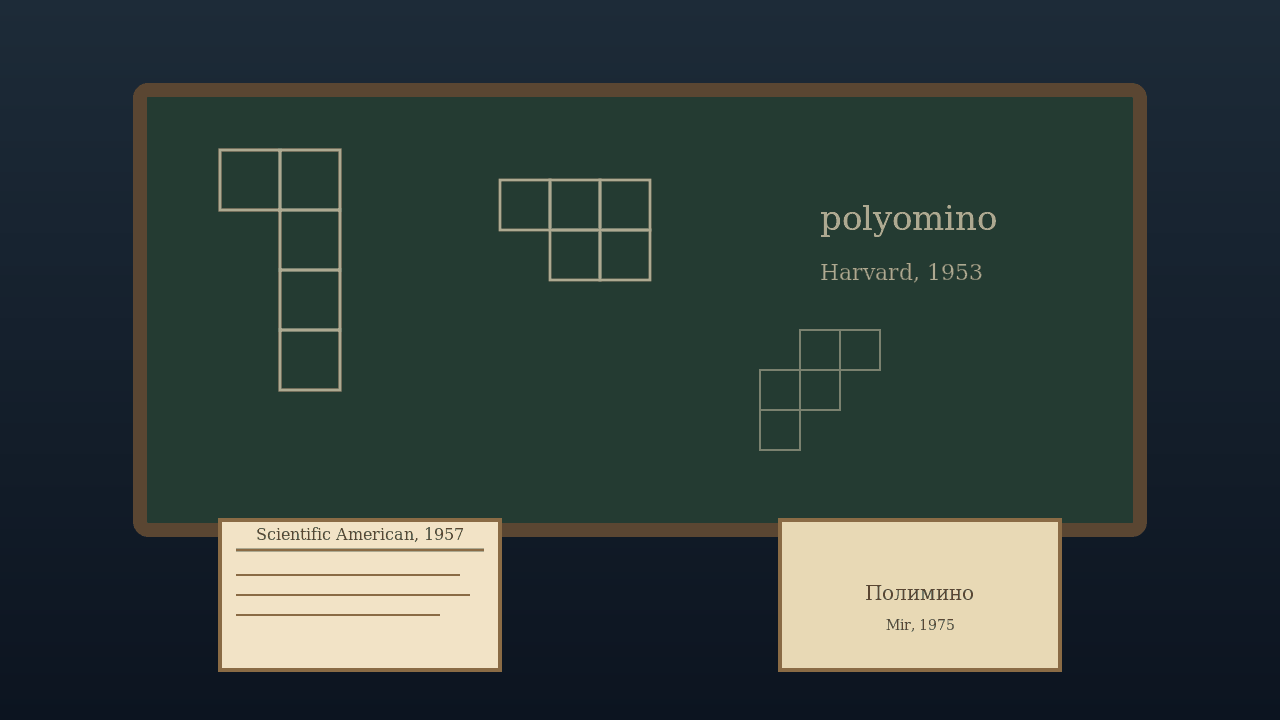 Vom Vortrag zur Zeitschriftenkolumne bis zur russischen Übersetzung (Illustration, KI-generiert)
Mechanik
Die Spielweise von Pentomino ist einfach. Figuren, die durch das Verbinden von fünf Quadraten an ihren Kanten entstehen, gibt es, wenn man Spiegelbilder und Drehungen als identisch behandelt, genau zwölf. Mit diesen zwölf Teilen rechteckige Spielfelder wie 6×10, 5×12, 4×15 oder 3×20 lückenlos auszulegen oder dabei ein Loch bestimmter Form freizulassen — das ist das grundlegende „Auslege"-Spiel von Pentomino.
In seinem Buch von 1965 erklärte Golomb sogar Methoden zur erschöpfenden Suche über die Kombinationen dieser zwölf Teile sowie kombinatorische Werkzeuge, um die Gesamtzahl der Auslegungen zu zählen. Es ist das Verdienst dieses Buches, ein bloßes Zeitvertreib-Rätsel zu einem Lehrmittel der Mathematik erhoben zu haben.
Alexey Pajitnov erzählte in einem Interview 2024, er habe zwei Arten von Pentomino-Kästen besessen: „eine moderne, japanische Version" und „ein traditionelles, russisches Set". Die zwölf Holzteile aus dem Kasten zu nehmen, frei zu Formen zusammenzusetzen und am Ende wieder in den rechteckigen Kasten zurückzupacken — dieses Hin und Her aus „Herausnehmen, Auseinandernehmen, wieder Verstauen", das selbst geübte Spieler 30 bis 40 Minuten kostet, war für ihn ein über Jahre vertrautes Spiel.
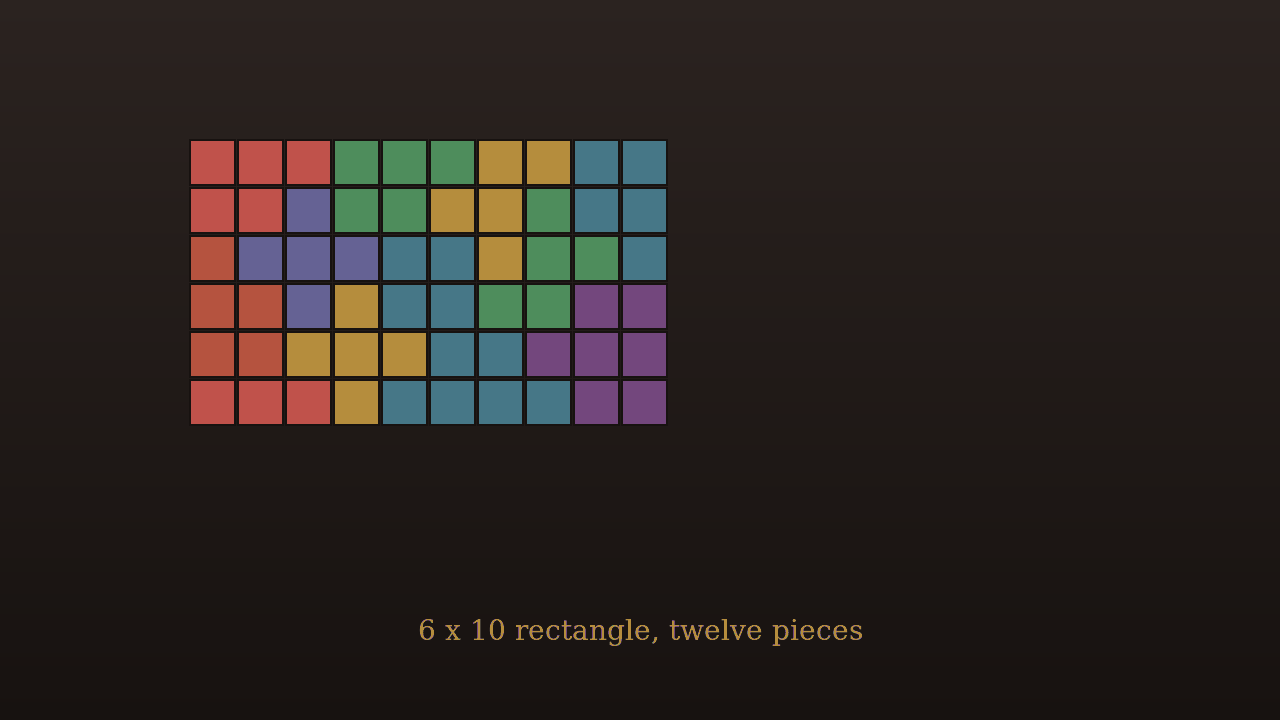 Wie zwölf Teile 6×10 Felder füllen — eine Illustration der Auslegung (Darstellung, KI-generiert)
Die Linie bis in die Gegenwart
1975 erschien Golombs Buch in der Sowjetunion als „Полимино" (Polimino), übersetzt von I. Jaglom und herausgegeben vom Verlag Mir; dieser Ausgabe waren zusätzlich Aufsätze von Golomb und David Klarner beigefügt. Neun Jahre später, 1984, begann der junge Alexey Pajitnov, der an einem Moskauer Institut für Informatik arbeitete, gestützt auf seine seit der Kindheit vertrauten Pentomino-Erinnerungen, damit zu experimentieren, Figuren auf dem Versuchsrechner Electronika 60 zu bewegen — einem Gerät ohne Grafik und ohne Ton.
Pajitnov selbst erklärte in einem Interview 2024 ausdrücklich: „Die wichtigste Inspiration für Tetris stammt aus dem Spiel Pentomino." Er erinnert sich, wie er die Fünf-Felder-Figur zu einer Vier-Felder-Figur vereinfachte und, während er die Rotationsroutine baute und beobachtete, wie sich die Figur auf dem Bildschirm drehte, die Idee bekam: „Könnte man das nicht in Echtzeit spielen?" Es ist der Moment, in dem Pentomino als Spiel zu fallenden Blöcken auf einem Rechner umgebaut wurde.
Auch die Figur Pentomino selbst ist nicht im Schatten von Tetris verschwunden. Auslegeprobleme bleiben bis heute Gegenstand der Forschung in der computationalen Geometrie und der kombinatorischen Optimierung, und Golombs Buch wird noch immer in Aufsätzen zum Polyomino-Tiling zitiert. Eine einzige Figur überlebt somit gleichzeitig in der Spielzeugkiste, in der Fachzeitschrift und in der Heimspielkonsole.
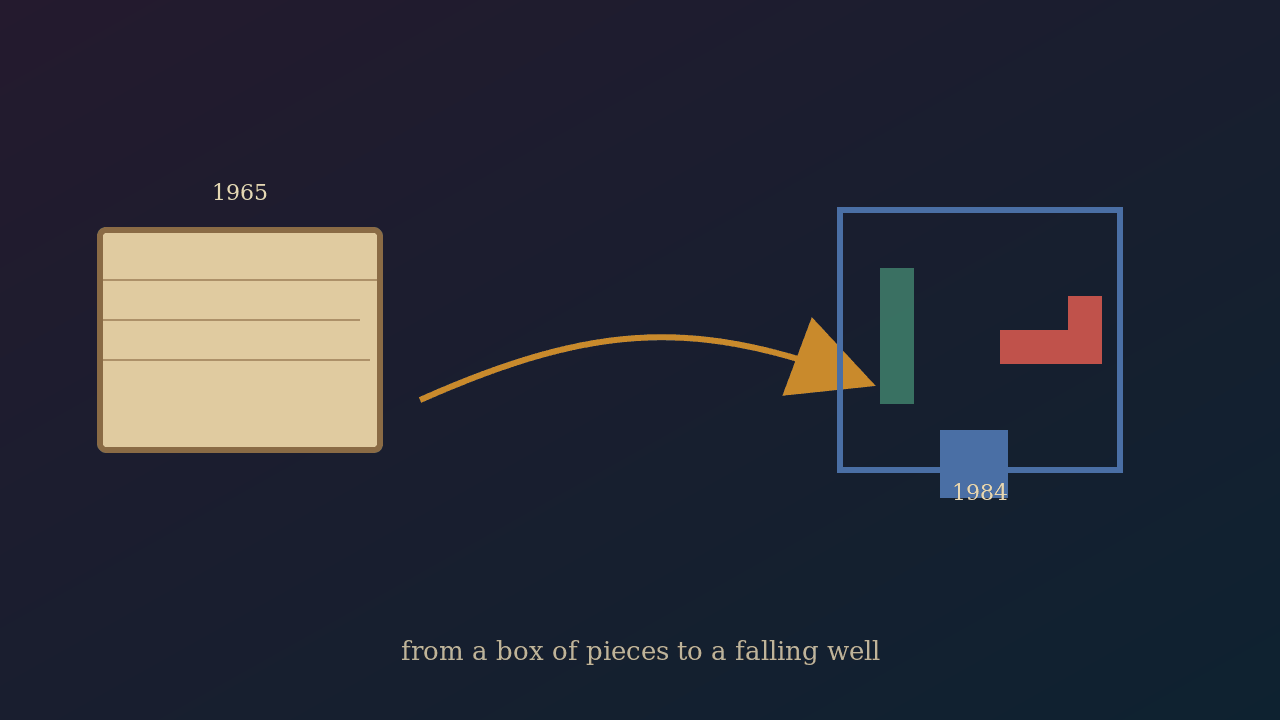 Vom Buch aus dem Jahr 1965 zu den fallenden Blöcken von 1984 (Darstellung, KI-generiert)
Quellen
Für diesen Artikel herangezogene Quellen:
・Wikipedia: Solomon W. Golomb (Lebensdaten, Werdegang, die Benennung von 1953, Hinweise zum Einfluss auf Tetris)
・Wikipedia: Polyominoes: Puzzles, Patterns, Problems, and Packings (Details zur Scribner-Ausgabe von 1965, zur russischen Übersetzung von 1975 und zur zweiten Auflage von 1994)
・Wikipedia: Pentomino (Definition der Figur, Übersicht der zwölf Arten)
・Thought Economics: Tetris Creator & Leaders on Gaming's Greatest Success (2024, Alexey Pajitnovs eigene Aussage, dass Pentomino die wichtigste Inspirationsquelle für Tetris war)
・NPR: Happy Birthday, Tetris. 35 Years Later You're As Addictive And Tetromino-y As Ever (Erläuterung zum Zusammenhang zwischen Pentomino und Tetris)
・Wikipedia: Henry Dudeney (über den Autor von „The Canterbury Puzzles", 1907)
・Wikipedia: The Canterbury Puzzles
・ETH Library: Polyominoes (Hintergrund zum Harvard-Vortrag von 1953)
・Wikipedia: Tetris (Entwicklungsgeschichte 1984 auf der Electronika 60)
Zum Schluss
Zählen wir die Jahre, die ein Buch brauchte, um die Welt zu bereisen. Vom Vortrag 1953 bis zur Veröffentlichung 1965 waren es zwölf Jahre, von dort bis zur russischen Übersetzung weitere zehn, und bis Pajitnov daraus Tetris machte noch einmal neun. Zusammen sind das etwa 31 Jahre. Informationen, die heute in wenigen Wochen um die Welt gehen, mussten damals, getragen vom schweren Medium Buch, den Atlantik und das Uralgebirge überqueren.
Was ich betonen möchte, ist Folgendes: Was Pajitnov „erfand", war nicht das Spiel des Blockstapelns selbst, sondern das Hinzufügen der Zeitachse aus Drehung und Fallen zu dem Hin und Her aus „Herausnehmen, Auseinandernehmen, wieder Zurücklegen", das bei einem bereits existierenden Spielzeug vorhanden war. Aus historischer Sicht betrachtet, ist Tetris kein aus dem Nichts entstandenes Wunder, sondern lediglich der nächste Zug auf der langen Ahnenreihe einer Fünf-Felder-Figur.
Wenn ein modernes Puzzlespiel das Umordnen von Figuren oder das Auslegen von Raum behandelt, liegt irgendwo in dieser Handhabung noch immer der Schatten dieses Buches von 1965. So sehe ich das.
 Sechzig Jahre später immer noch ein Buch im Regal (Darstellung, KI-generiert)
Reactions (no login)
Anonymous • one of each per visitor per day
Learn — Curriculum
LearnTeil 2 Lineage — Where Puzzles Came FromKapitel 3 Puzzles of Paper and Wood9 / 11
関連シリーズ
Puzzle Incident History第16回 / 全40回