HISTORY · 2026-09-10
SameGame (1985) — The Grammar of Clearing Same-Colored Clusters, Born From a Reader Submission
It was first called Chain Shot!. Almost nothing is known about its creator, Kuniaki Moribe, even today
Who First Wrote the Rule: Clear a Cluster of the Same Color?
Tap a cluster of adjacent same-colored blocks to clear them at once. The bigger the cluster, the higher the score jumps. This rule was first written in 1985, in a program submitted to the Japanese magazine Monthly ASCII under the title Chain Shot!.
Chain Shot! is a falling-block puzzle that Kuniaki Moribe submitted to Monthly ASCII in 1985, releasing it for the Fujitsu FM-8/FM-7, built around clearing groups of adjacent same-colored blocks. Almost nothing beyond a name survives about its creator.
Over the next forty years, this rule kept changing its name. SameGame, Clickomania!, Same Gnome, Jawbreaker — the names multiplied, but the rule itself barely changed. I want to reread this one title as a rule that outlived its own name.
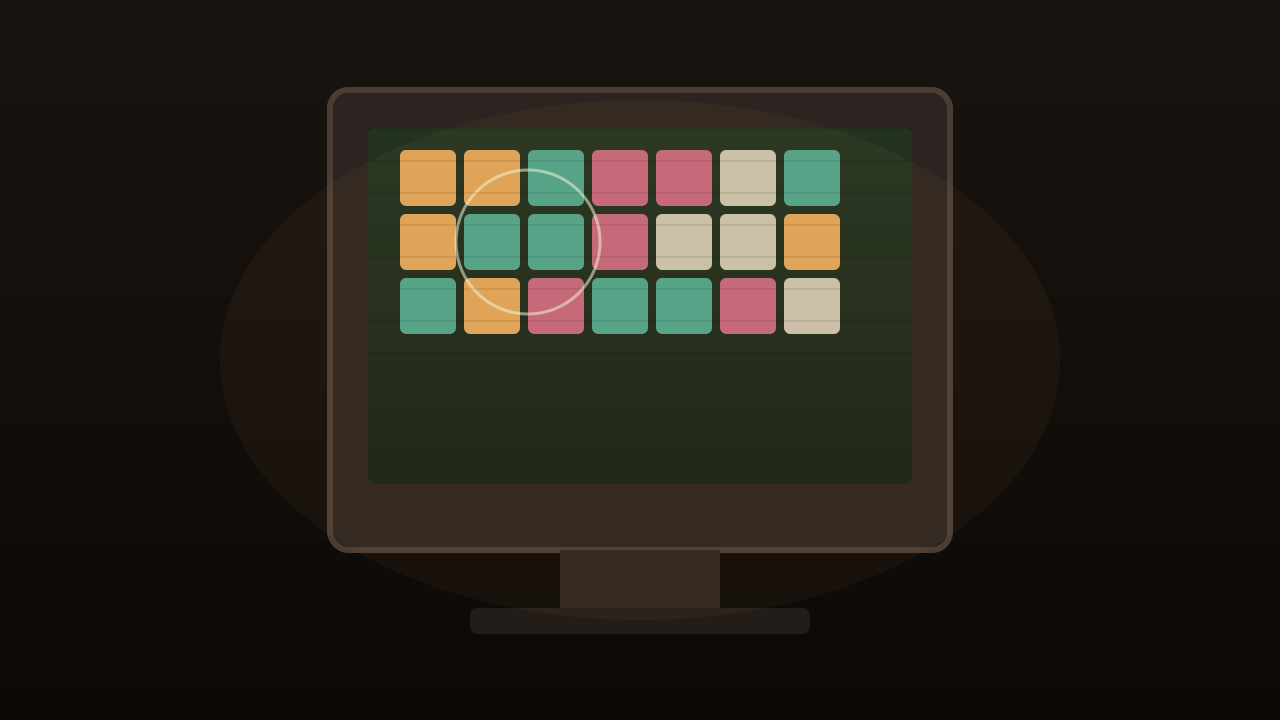 Impression of a board where adjacent same-colored clusters are cleared (illustration, AI-generated)
How Did a 1985 Submitted Program Reach the World?
Japanese PC magazines in 1985 ran columns where readers' own programs were printed as-is. Monthly ASCII was one of them, publishing several BASIC or machine-code listings every issue.
Many 8-bit machines of the era didn't even have a floppy disk drive. The cheapest way to distribute a program was for readers to type each printed line into their own keyboard by hand. Chain Shot! reached the world this way too.
The submitter's name is given as Kuniaki Moribe, published under the name "Morisuke." I have not yet found a primary source confirming whether that was his real name. In the submission culture of the time, this kind of uncertainty about a creator's identity wasn't unusual.
 Impression of the era when submitted programs were printed on magazine pages (illustration, AI-generated)
How Exactly Did Chain Shot!'s Rule Work?
The board originally measured 20 columns by 10 rows, filled with blocks in four colors. Players clicked a cluster of adjacent same-colored blocks to clear them — but a cluster had to be at least two blocks to vanish.
Columns above a cleared cluster fall down, and empty columns slide left to fill the gap. Gravity and left-packing — these two rules alone give the board a collapse pattern unlike either Tetris or Puyo Puyo.
Scoring was designed to reward bigger clusters disproportionately. The exact formula changed with every port: one version used (n-1) squared, another used n squared minus three times n plus four. The formulas differ, but the goal is the same — clear the big clusters, don't leave them behind.
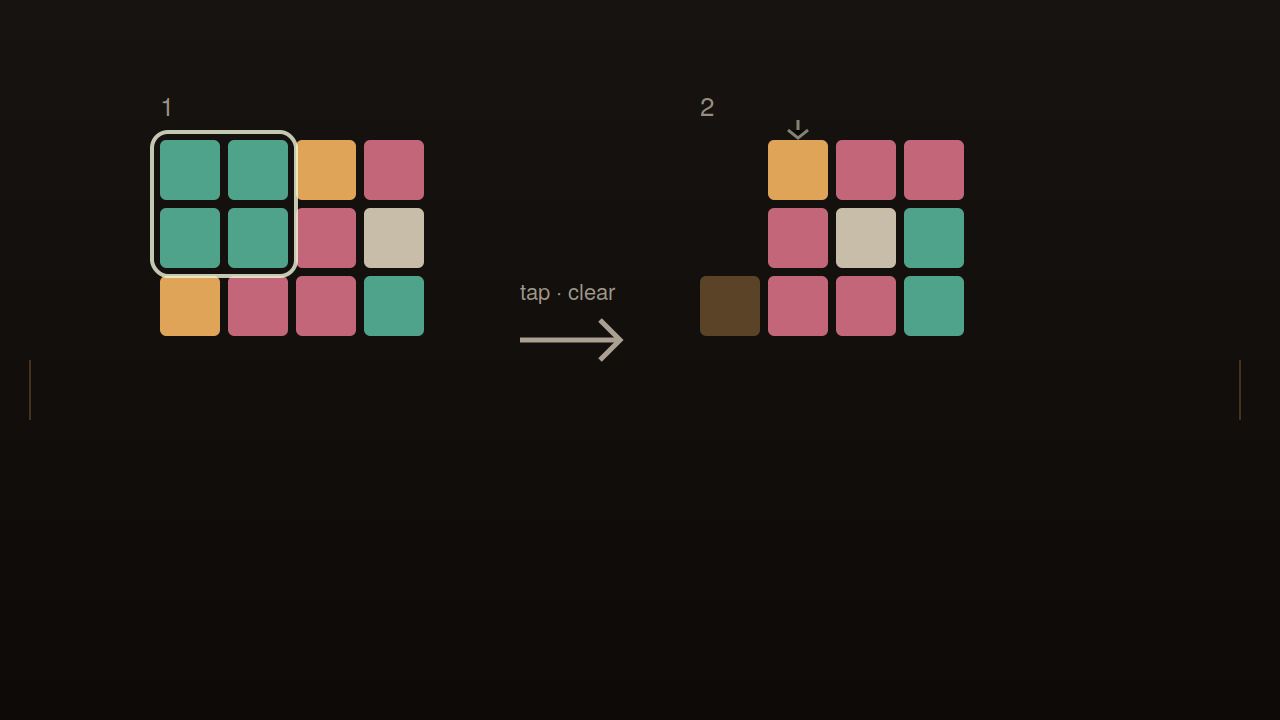 Impression of the fall-and-shift rule after a cluster is cleared (illustration, AI-generated)
How Far Did This Rule Travel Over Forty Years?
In 1992, the rule spread rapidly. Eiji Fukumoto ported it to Unix as a five-color version and renamed it SameGame. That same year, Wataru Yoshioka ported it to the PC-9801, and Eiichiro Mawatari brought it to Macintosh under the name ChainShot!.
In 1993, Ikuo Hirohata ported it to Windows 3.1, and Hitoshi Ozawa translated it into English. The 1994 version by Takahiro Sumiya let players choose between two and five colors, and later records describe it as the most widely distributed version of the original lineage.
More names followed: Clickomania! in 1998, KSame and Same Gnome on Linux, Jawbreaker in 2003. Mathematicians took notice too — in a 2002 paper, Biedl, Demaine, Demaine, Fleischer, Jacobsen, and Munro showed conditions under which deciding whether a board can be fully cleared becomes NP-hard. In 2012, Schadd and colleagues published a Monte Carlo tree search method for solving these boards.
In 2004, Simon Tatham included this rule in his own puzzle collection as "Samegame" (see also this site's piece on the Simon Tatham's Portable Puzzle Collection). That collection was adopted, unmodified, into a 2024 AI-reasoning benchmark paper from a research team at ETH Zürich. Today's mobile puzzles that clear same-colored clusters with a tap still use the same core verb, but I have not yet found any record of a developer naming this title as a direct reference.
 Impression of a rule carried forward across generations (illustration, AI-generated)
Sources
Sources referenced in this article:
・Wikipedia (English): SameGame
・Maastricht University, Games and AI Group: SameGame
・Biedl, Demaine, Demaine, Fleischer, Jacobsen, Munro. "The Complexity of Clickomania." (2002)
・Simon Tatham's Portable Puzzle Collection
・This site's article on Simon Tatham's Portable Puzzle Collection (2004)
Closing — A Rule That Outlived Its Own Name
Almost no one today knows the name Kuniaki Moribe. Only the rule he submitted to Monthly ASCII in 1985 — clear a cluster of adjacent same-colored blocks — survived, changing its name again and again.
SameGame, Clickomania!, Jawbreaker, Samegame. The names differ, but the collapse is identical. I read its place in a 2024 AI benchmark as proof of how simple the rule itself was. The rule its author wrote outlived the name he wrote it under.
 Impression of a nearly-cleared board glowing quietly (illustration, AI-generated)
Reactions (no login)
Anonymous • one of each per visitor per day
関連シリーズ
Puzzle Incident History第34回 / 全40回