REVIEW · 2021-10-19
Escape Simulator
Ein Raum, in dem sich alles anheben lässt – und 4.000 Workshop-Räume
First Impressions
The first thing that struck me in the Steam review pool is that the most-upvoted positive reviews barely praise the game. The top entries are one-liners that compliment the design and then land on the reviewer's own head instead: jokes about an IQ that swings from three digits into the negatives, reports that a friend turned out not to be able to add. Aggregate: 18,014 of 19,178 reviews positive across all languages (about 94%), 95% of 8,905 in English (Overwhelmingly Positive), and 89% of 91 in the last 30 days (snapshot 2026-08-03).
The highest-voted negative review doesn't discuss puzzles either. With 589 helpful votes, it is about one thing only: co-op disconnects, and the absence of any way to rejoin a room in progress. The ones behind it add desync, vanished items, clunky handling. Both sides, in other words, are writing from slightly off to the side of "are the puzzles good."
That isn't an accident. An escape room puts the board inside a shared space, which redistributes the blame for being stuck from one player to the whole table — so when people fail, they laugh at themselves before they blame the game. I read a milder version of this in the Escape Academy pool; here it is extreme. Made and published by Pine Studio, released 19 October 2021, Metacritic 82.
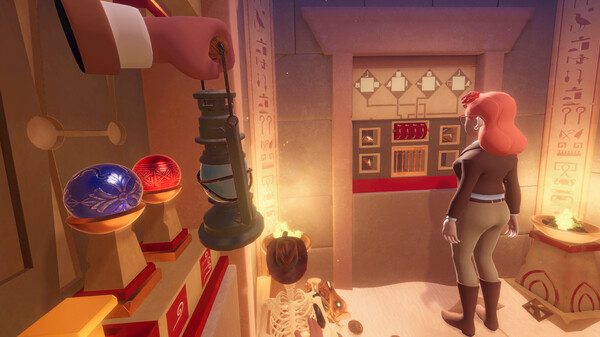 Holding a lantern while a second player stands further down the passage — Steam store screenshot
Putting the Mechanics into Words
What both sides mention most often isn't the puzzles but the fact that things move. The store copy is itself a list of verbs: shift the furniture, pick up and examine anything, smash pots, break locks. Reviewers restate it as "close to a real room." If it isn't nailed to the wall you can hold it — that sentence is the design statement.
I have repeatedly used verb subtraction here as a marker of good puzzle design, and this game goes the other way. It adds verbs, adds physics, makes nearly the whole room movable. What stands in for subtraction is the wall: seal the elements inside one room and combinatorial explosion is capped by the room's size rather than by the verb count.
The same decision becomes the loudest complaint on the negative side. Clues fall through the floor, tools disappear from inventory, both of the shovels you were given go missing. If everything can be lifted, everything can be dropped. "It feels real" and "it breaks" are not opposed claims; they are two faces of one choice to run the room on physics.
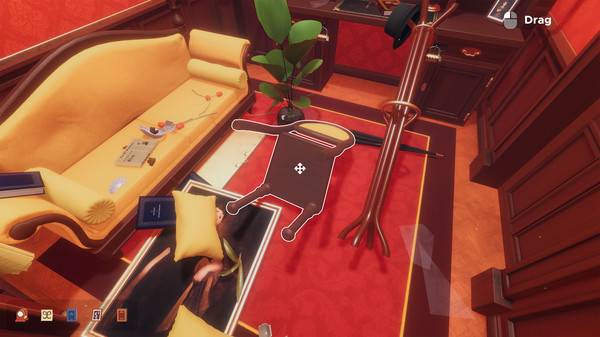 Dragging a rug across the floor, with the Drag prompt shown in the corner — Steam store screenshot
Design Craft
Pine Studio describes the 28 built-in rooms as designed with real-life escape room operators, and that pedigree does come through in the pool. The reviewer at Room Escape Artist, a site devoted to physical escape rooms, called it eerily close to playing in person — and noted that because it runs on a computer, the "magic" that takes enormous effort to fake in a real room simply happens.
But only the puzzles were carried over from the physical version of the form. The other apparatus was left behind: the game master. A real escape room has a person watching you stall and metering out hints. This game has a timer, and reviewers agree the timer means nothing outside achievements. In hint-system terms, an unpunished clock is not a substitute for a hint channel.
Separate per-player inventories in co-op produce the same kind of gap. The developer writes that more heads are better than one, and the positive side does talk about the pleasure of conferring. The negative side keeps returning to the other half: separate inventories hide information from your partner, and with few simultaneous handles in one room you end up taking turns. As I argued in co-op puzzles and information asymmetry, asymmetry is either conversation fuel or waiting time, and the number of parallel handles decides which.
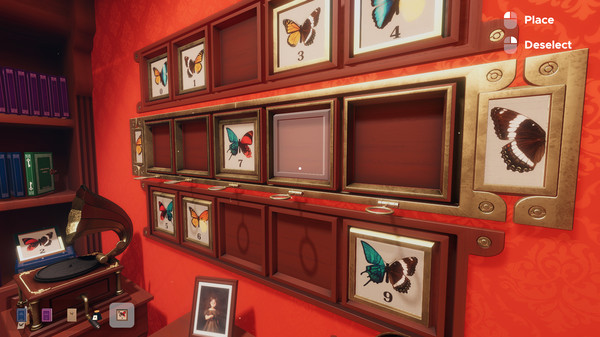 Numbered butterfly specimens slotted into a frame grid, with a Place / Deselect prompt — Steam store screenshot
The Texture of Difficulty
Difficulty doesn't split cleanly here. "Just hard enough" and "ridiculously difficult, sometimes not even possible" sit inside the same pool. The reviewer who wrote the second opens by saying he wanted to like the game, then describes reading a walkthrough and repeatedly slapping his forehead — in a hundred years in that room, he writes, he would never have found it.
Collect the places where reviewers got stuck and the difficulty separates into two kinds. One is inferential, and that kind is mostly praised. The other is finding: sweeping a cursor over a heap of clutter, or a collectible token tucked somewhere almost impossible to see. Room Escape Artist called this a pixel hunt, while noting that the later rooms improve on it.
In our terms, the first is inference load and the second is observation-resolution load. Centring observation is a legitimate design, but it carries one weakness: the player cannot tell whether the information in hand is already sufficient. Someone stuck on inference can keep thinking; someone stuck on observation has nothing to think about. Walkthroughs get opened in the second case. The argument is about the mixture, not the amount.
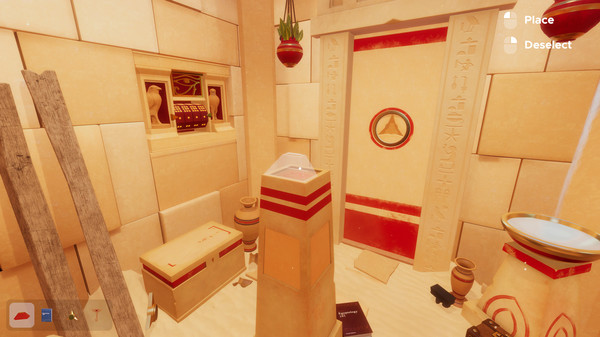 Planks, crates and barrels scattered through a sandstone chamber — Steam store screenshot
Place in the Lineage
Counted as a single puzzle game, this one doesn't square with its own numbers. Across the 30 reviews I read, the median displayed playtime is about 12 hours, with the top end past 50. There are 28 built-in rooms — and, separately, thousands of workshop rooms built with the bundled editor (the developer lists over 4,000). What extends the hours is the toolbox, not the game.
On the workshop, opinion doesn't divide. Instead both sides say the same thing: it's hit or miss. One long positive review notes this is no fault of the developer, and files the variance under cons anyway. As I argued in handcrafted versus generated levels, a puzzle level only becomes a level once somebody edits it. User-submitted rooms aren't generated, but in going unedited they inherit the same problem.
Put it on the shelf. The Room finds bottomless depth in one box; Escape Academy buys breadth by swapping the material room to room; We Were Here Forever makes the channel between two people into the board itself. Escape Simulator shipped an editor instead. Though as Room Escape Artist points out, that editor has a step in it: a door that opens on three buttons takes minutes, while a door that wants them pressed in order remains baffling after hours.
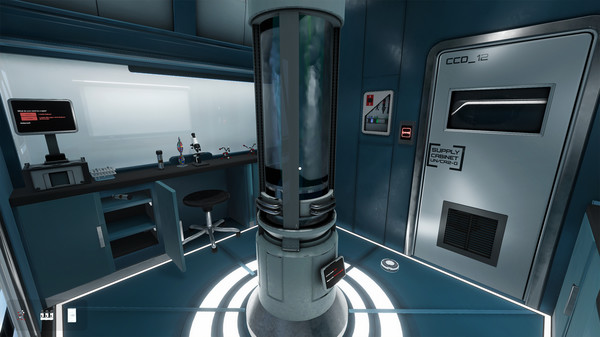 A glowing cylinder in the middle of a blue-lit space station room — Steam store screenshot
Sources
This piece was written by reading the user reviews on the Steam store page as of 2026-08-03. No review text is quoted directly; typical claims are reconstructed.
- Steam: Escape Simulator (95% of 8,905 English reviews, Overwhelmingly Positive; 18,014 of 19,178 positive across all languages; 89% of 91 in the last 30 days)
- Read: the top 10 helpful positive and top 10 helpful negative English reviews (all time) plus the 10 most recent, along with the developer's store copy and the June 2026 update notes.
- Press: Room Escape Artist: Escape Simulator [Review], and the Kotaku pull quote carried on the store page
Closing
Steam reads about 94% positive across all languages, 95% and Overwhelmingly Positive in English. My design-critique score is 7.5, and the gap is real. Two reasons. First, most of the warmth in the pool rests on who you played with — a genuine virtue, but on a different axis from design. Second, the decision to run everything on physics still leaves the state fragile five years on; recent negatives still describe clues dropping through the floor. The slight dip to 89% over the last 30 days sits on that same line.
In fairness, the developer replies to negative reviews, and in June 2026 announced moving the multiplayer server after finding that a router-side filter was blocking it. Work continues into year five. A sequel, Escape Simulator 2, now exists; this piece reads the first game's pool.
So who is it for? The pool answers plainly: anyone with someone to talk to. Outside its reach are players who want to stack inferences quietly alone, or who don't experience searching as play. It imported the design thinking of real escape rooms and left the game master behind — and it fills that one gap with the person sitting next to you. Whether that reads as weakness or strength depends on how many people are in the room.
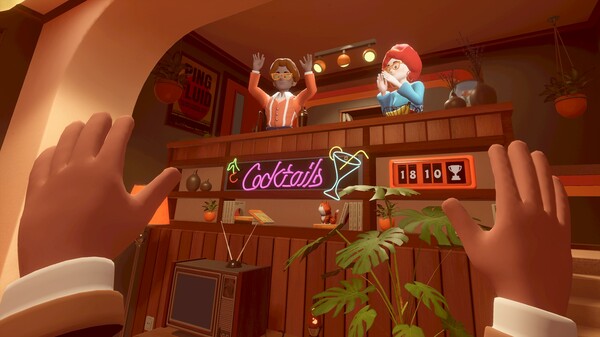 A bar counter under a neon Cocktails sign, two characters behind it — Steam store screenshot
Where are you with this game?
Press one and the game goes on your shelf. You can see it on your account page.
Reactions (no login)
Anonymous • one of each per visitor per day
Read next
Related reviews
Machinika: Museum
Eine Ego-Perspektiv-Rätselbox, in der man Geräte unbekannter außerirdischer Herkunft, die in ein Museum gebracht wurden, scannt, ins Innere blickt und fehlende Teile nachdruckt, bis sie wieder laufen. Ein kurzes Werk von Littlefield Studio, das sieben Maschinen nacheinander öffnet, mit dem Gestus einer Science-Fiction-Archäologie.
Portal Reloaded
Ein kostenloser Community-Mod auf Basis von Portal 2. Neben den blauen und orangen Raumportalen kann man nun ein grünes Zeitportal schießen, das zur selben Anlage 20 Jahre später führt, und löst so 25 Testkammern, indem man zwischen Gegenwart und Zukunft hin- und herwechselt. Veröffentlicht 2021 vom Solo-Entwickler PORTANIS, 2023 um 20 Koop-Level erweitert.
Inscryption
Ein Deckbuilding-Kartenspiel: Man zieht Karten mit Waldkreaturen, opfert eigene Kreaturen, um sie ins Spiel zu bringen, und sitzt dabei dem Erzähler Leshy gegenüber, der sich in einer Hütte verschanzt hat. Steht man vom Tisch auf, wird die Hütte selbst zu einem Escape-Room-Rätsel. Ein Werk von Daniel Mullins, dem Schöpfer von Pony Island.


