REVIEW · 2019-08-29
Wilmot's Warehouse
Ein Lager, das keine richtige Antwort ausgibt — die Grammatik des Sortierens schreibt der Spieler
First Impressions
Two words dominate the entrance to this review pool: chill and sort. The helpful positives all reach for something outside the game to explain it — Stardew Valley and Animal Crossing, or Papers Please, or the state of their own desk. One places it somewhere between Papers Please and keeping your desk tidy. Nobody opens with logistics, even though you are running a warehouse. They open with classification.
The critical side enters through the same door: it started to feel like work, it is monotonous, it is all the thrill of warehouse labour with none of the pay. But the negative with the most helpful votes points the other way, complaining that trying hard and doing nothing produce the same result. The critics split in two directions at once: too much pressure, and no pressure at all.
The numbers first. On Steam, 96% of 508 reviews are positive, labelled "Overwhelmingly Positive" (snapshot 2026-07-29). Across all 542 including non-Steam purchasers, 524 positive against 18 negative. SteamDB's own weighting puts it at 89.36% over 559, below the raw figure. OpenCritic aggregates nine outlets at 82, "Strong", with 71% recommending. The figures look like firm consensus; the texts run on three separate axes.
 The Steam store header image — Steam store key art
Putting the Mechanics into Words
There are only three verbs: walk, pick up, put down. When the positives praise how clean the controls feel, or say the first upgrade feels like a superpower, they are praising a structure where rotation, dashing and carrying capacity are layered onto those three verbs one at a time. In the terms of subtractive design, cutting verbs is not what is new here.
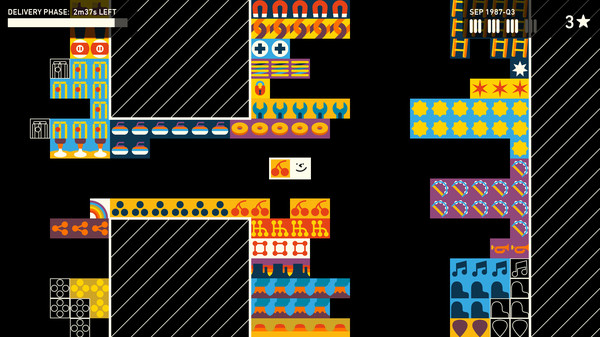
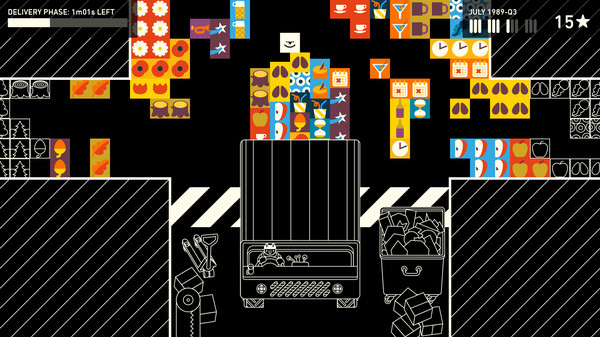
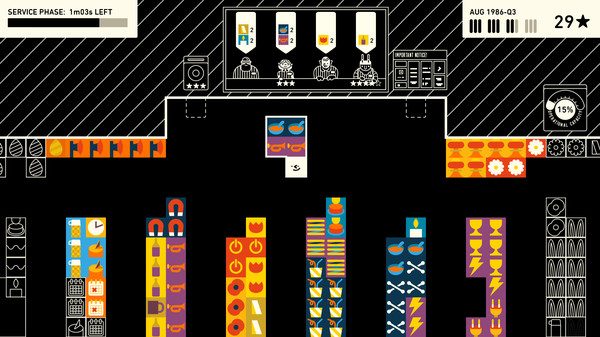
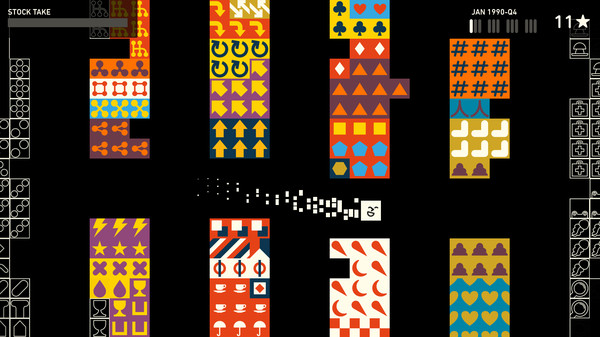
What has been cut is not the verbs but the correct answer. Goods arrive as square pictorial tiles, and the game supplies no rule at all about where they belong. One reviewer asks aloud whether volcanoes go beside mountains, because nature, or beside sailboats, because islands. Do tomatoes sit with apples, as fruit, or with apple cores, as waste. When the positives call it half a language game, that is because the grammar of classification is written by the player.
The developers' own account supports this. In the Road to the IGF interview the items are described as deliberately built to be memorable, to overlap in category, or to resist categorisation altogether. The ambiguity is specification, not accident. So the negative report that you cannot tell what a picture is meant to be reads less as a bug report than as a declaration of standing outside the design's reach.
 The store's main capsule image — Steam store key art
Design Craft
After three working days comes one untimed stock-take day. That day is the structural centre of the game, and it is the part the pool praises most. One reviewer writes UNLIMITED TIME in capitals. Another, who came to it as a recommended organising game, says the stock-take is why a messy warehouse never becomes panic. Finji's own community manager answers anxiety about the timer by pointing at it first.
As design, this is less an alternation of tension and release than a guarantee of editing time. Whatever collapsed over three days can be rewritten by your own hand on the fourth. If the grammar of classification sits with the player, the right to revise it has to sit there too, or the design does not close. It is the exact inverse of A Little to the Left, where the author keeps the standard for what feels right.
The second move is the deletion of failure. Miss a delivery and you simply earn fewer stars; there is no punishment. This is where the pool divides most sharply. The negative with 111 helpful votes says effort and idleness are indistinguishable, and that with no score kept you cannot even chase your own record. The positives describe the same deletion as being surprisingly calm for a game with timers. Subtraction always trades something away. Here it traded tension for safety.
 The wide key art used in the Steam library — Steam store key art
The Texture of Difficulty
Three different things arrive under the single word difficult: difficulty of space, of memory, and of time. Their causes and their remedies are unrelated.
Space and memory. The kinds of goods climb toward two hundred and the aisles silt up with your own stock; one reviewer takes care to note that two hundred means categories, not items. The combinatorial explosion happens in the player's memory rather than in the state space of the board. Those who enjoy it leave behind private solutions — sorting by background colour in ROYGBIV order made it far easier, one says. Because the difficulty is self-built, the curve discussed in learning-curve design is not in the author's hands. The negative verdict that the difficulty curve is a flat slope with no bumps is accurate as description, and possibly mistaken about where the curve lives.
Time. This one is the author's. A reviewer describes the arranging as the fun part, then the hatch opening while everything is still a mess — and recommends the game anyway. Someone who quit after half an hour writes that a game built for winding down keeps prompting them to go faster, so it has no use for them. In the terms of fairness in difficulty, this is not unfairness; it is two standards of fairness sitting side by side.
 The official artwork used as the store page background — Steam store art
Place in the Lineage
Line up the games about tidying and this one's position becomes clear. In Unpacking the objects narrate a life and the shelf has a right answer. In A Little to the Left the author holds the standard for what feels right. Papers, Please hands you the rules and asks you to check against them. Only Wilmot's Warehouse hands over no rules.
The press converges on the same spot. Polygon calls it a small piece of chaotic zen; Eurogamer finds an intriguing roominess at its centre. RPS's Nate Crowley, having said it is not a favourite of all time, still ends by calling it the block he would pull out to show what games could do in 2019. Movies Games and Tech, at 6.5, writes that it is not clear who the game is for. Praise and complaint are drawn from the same observation: the outline will not settle.
The split-screen two-player mode matters for the lineage too. The asymmetry examined in co-op puzzle design shows up here not as information but as filing habits. One long review describes a couple comparing their two warehouses and each being appalled; Spaziogames' 9 also calls small-group play the best form. Put classification in the player's hands and, with more than one player, it becomes an instrument for comparing personalities.
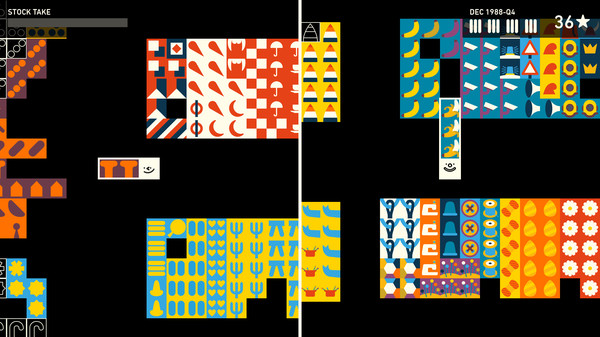 The store's hero capsule image — Steam store key art
Sources
This piece was written by reading the Steam user review pool and its surrounding material as of 2026-07-29. It is a reading of reviews, not a play diary.
· Steam: Wilmot's Warehouse (96% of 508 reviews positive; "Overwhelmingly Positive"; 524 positive against 18 negative across all 542)
· Read: the top 10 positives from the all-time helpful listing and 11 entries from the negative-only listing, four of which were posted in 2025-2026 and all of which stopped within a few hours
· Developer and publisher replies come from the Steam thread "Is there a casual mode in the works?" (opened in 2019, 19 posts, last activity June 2026)
· Alternative weighting from SteamDB (89.36% over 559); press aggregate from OpenCritic (nine outlets, 82, 71% recommended). Production background from the Wikipedia entry and the Road to the IGF interview cited there.
· The figures in this piece are official Steam store assets (header, main capsule, wide library key art, store background, hero capsule, tall library key art). Image files could not be downloaded and inspected from this environment, so the captions state only the asset type and make no claim about depicted content.
Closing
In closing: what Wilmot's Warehouse cut is not its verbs but its correct answer. It moved the grammar of arrangement over to the player and removed failure in exchange. The split in the pool is a split over whether that handover is welcome; the disagreement about the game's quality is smaller than the score gap suggests.
My score is 8.4 — under Steam's 96%, roughly level with OpenCritic's 82. Two deductions. Once the grammar is handed over, novelty in the second half depends on the player's own invention, and when the inventing stops, monotony is what remains. And there is a gap between the store page's promise of unique relaxing gameplay and the actual feel of being graded on time. The casual-mode request thread opened in 2019 has accumulated 19 posts, with activity as recent as June 2026. I label the difficulty standard, but the experience genuinely varies. Reviewers who finished cluster at thirteen to sixteen hours; include those who stopped after a few, and the median falls well below that.
For: readers who want to write the rules of classification themselves, and who welcome a structure where the resolution of one's own seeing becomes the play, as discussed in observation as play. Not for: those who optimise move counts on the assumption that a correct answer exists, and those who cannot reconcile being timed with winding down. The line the critics repeat — it started to feel like work — reads to me not as a fault report but as a coordinate for where a design that withholds the answer stops working.
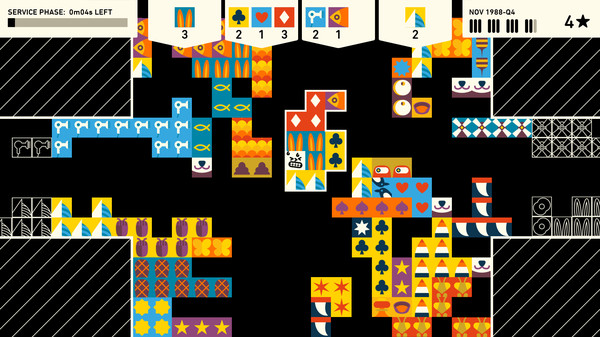 The tall key art used in the Steam library — Steam store key art
Where are you with this game?
Press one and the game goes on your shelf. You can see it on your account page.
Reactions (no login)
Anonymous • one of each per visitor per day
Read next
Related reviews
ISLANDERS
Ein minimalistisches Platzierungspuzzle: Gebäude werden auf prozedural erzeugte Inseln gesetzt und punkten je nach dem, was daneben liegt. Kein Ressourcenmanagement, keine Einwohner – ein einziges Verb: legen. Ein kleines Werk von Grizzly Games.
Autonauts
Ein Automatisierungspuzzle, in dem man auf einem menschenleeren Planeten landet, Holz hackt und Stein schlägt und den Robotern genau die Handgriffe beibringt, die man selbst gerade ausgeführt hat. Mit kurzen, aus Scratch-artigen Blöcken zusammengesetzten Skripten und dem geringen Speicherplatz eines einzelnen Roboters baut man Produktionslinien von der Landwirtschaft bis zur Industrie auf. Ein Titel des schottischen Studios Denki.
Hypnospace Outlaw
1999, im Schlaf verbindet man sich mit dem virtuellen Internet „Hypnospace" — ein Beobachtungs-Adventure, in dem man als freiwilliger Enforcer patrouilliert. Man wandert über private Homepages und gräbt, nur mit einer schwachen Suchleiste und dünnen Hinweisen bewaffnet, Regelverstöße und versteckte Seiten aus. Ein Werk von Tendershoot nach dem Design von Jay Tholen.


