BLOG · 2026-08-20
Summon Night: Swordcraft Story 2 (2004) — The Sword You Forged Yourself Breaks Mid-Fight
Today Is Release Day #33 — August 20, 2004, published by Banpresto for the Game Boy Advance. A 34/40 from Famitsu, and a crossing that took two years
August 20, 2004: an RPG whose hero is a blacksmith
Hello, this is Toki. Episode 33 of "Today Is Release Day." What I dug up today is Summon Night: Craft Sword Monogatari 2, released on the Game Boy Advance on August 20, 2004. That makes it exactly 22 years ago today.
Published by Banpresto, developed by Flight-Plan. Famitsu's release schedule for August 2004 lists it as "August 20, GBA, 5,800 yen before tax." GameFAQs' release data also puts the Japanese version at August 20, 2004 (product code AGB-BSKJ-JPN), and Nintendo Life's game page and the series fan wiki agree. Four separate sources point at the same day, so today's date holds.
An aside: the game I dug up for this column yesterday was also from 2004. August 19 and August 20, two days reaching into the same year's shelf — when you are building a calendar like this, coincidences of that kind are the best part.
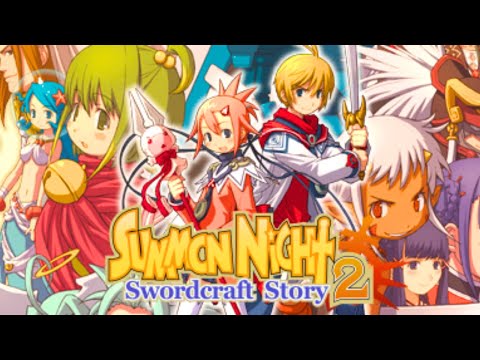 From the thumbnail of "Summon Night: Swordcraft Story 2 (GBA) - HD Longplay Part 1 of 2 | No Commentary" (YouTube)
The main Summon Night line is a strategy RPG built around summoning. This Craft Sword Monogatari branch is a spin-off — and its hero was not training to be a summoner. He was training to be a smith. A Meister.
The weapon you forged breaks while you are still fighting
The main character is an orphan who wants to follow the trade of his adoptive father, Berg, and become a Meister. Early on he makes a Summoner's Vow with a stray Summon Beast, and that beast becomes his Guardian Beast and partner. The summoning setting stays in place; what the player is holding is the hammer.
Battles run in real time on a 2D side view. You can bring up to three weapons and switch between them in the middle of a fight. Enemy health shows as a segmented meter above their heads, with boss health up at the top of the screen.
And then there is durability. Weapons wear down as you use them, and at zero the weapon breaks and stays unusable until it is repaired at the forge. In the first game a broken weapon was simply gone; repairing arrived with this second one. So the game is built on the premise that the weapon you made yourself will break — and the sequel did not withdraw that premise. It turned it into a reason to walk back to the forge.
Forging works through Shapestones, which set the type — sword, axe, spear, knuckles, drill — after which ores and materials are infused to add offense, defense and elemental effects. RPGFan's review notes that this synthesis was rebuilt away from the first game's elemental-property approach. The length grew too, from a little over ten hours to roughly twenty.
A 34/40 from Famitsu, and "you walk the same ground too often"
The reception at the time was straightforwardly good. Famitsu's cross review gave 8, 10, 8, 8 for a total of 34/40 — one of the four reviewers handed it a ten. For a spin-off RPG on the GBA, that is a high row of numbers.
Look inside the reviews and the central feeling is that it was more refined than its predecessor. What drew praise was the quality of the graphics and the humor of the dialogue. The complaints, meanwhile, gathered neatly at two points: a lack of depth in the story, and excessive backtracking through only a small number of areas. A structure built on forging, breaking and returning to repair converts directly into how many times you walk the same road.
It crossed to North America two years later, on October 17, 2006, from Atlus. The scores that came in were spread out. Metacritic averaged 79 across ten reviews: IGN 85, Nintendo Power 80, GameSpot 73, GameSpy 70. The user score sits at 8.4 from seventeen ratings — the familiar gap between critics in the seventies and players in the eighties.
The most specific single review is Patrick Gann's at RPGFan (December 11, 2006), at 86%. On graphics he wrote that it was easily the best 2D GBA game in that department, and he praised the feel of the controls as excelling in ways he struggled to describe. But his objections were clear: at least half of the soundtrack was ported directly from the first game, running and jumping sometimes felt laggy and downright non-responsive, and the characters' motives were fairly simple compared to the previous entry.
What is left 22 years later
The footage above preserves the GBA screen as it was: closing the distance in side view, swapping weapons, trading blows one on one. The feeling of swinging while watching the durability gauge tick down out of the corner of your eye probably comes through faster in video than in words.
In Japan a budget "Value Selection" edition appeared on February 2, 2006 (product code AGB-BSKS-JPN). Which means that within the same year, 2006, the discounted edition returned to shelves in Japan while the first edition arrived on shelves in North America. Put another way: a release delayed by two years happened to land in the same year as the Japanese price cut.
Your release day
RPGs where weapons break are nothing unusual. But "the weapon you forged yourself breaks" shifts the story a little. What broke was not standard issue; it was something whose materials you picked, whose type you chose, whose effects you hammered in. By adding repair, this second game did not erase that sting — it turned it into footsteps heading back to the forge. Probably the same footsteps the critics called excessive backtracking.
August 20, 2004. Unless I write the year down like that, an article never quite feels finished to me. Is there a game where you still remember a weapon you kept repairing and carried all the way to the end?
Reactions (no login)
Anonymous • one of each per visitor per day
Read next
Comments (no login)
No comments yet. Be the first to say something.