DESIGNER-STUDY · 2026-08-01
Inside Terry Cavanagh's Philosophy — he starts by assuming it won't sell
VVVVVV, Super Hexagon, Dicey Dungeons, and a decade and a half of giving games away
Intro — the man who starts by assuming it won't sell
Terry Cavanagh is a solo game developer from Monaghan, Ireland. VVVVVV, a platformer built on a single button that flips gravity; Super Hexagon, a vortex of hexagons to be dodged; Dicey Dungeons, a deckbuilding rogue-lite where you place dice onto equipment. He writes on his own site that these three are his only commercial games (distractionware, "About Me" ↗). Everything else he has given away.
What made me want to write about him is one line from a 2017 interview. Asked whether releasing games as freeware is a conscious aim, he answered: "Speaking for myself, my process has always been to work through ideas in prototypes and jam games – and I always start off by assuming it will be a freeware game" (Alphr, 2017 ↗). He does not forecast sales and then build. He starts from the assumption of no sales, and only what happens to end up product-shaped gets sold. The order is inverted.
This is a study of the person, not a write-up of the games. I quote only sources whose text I read, and I keep his own words, the reporters' framing, and my own reading strictly apart.
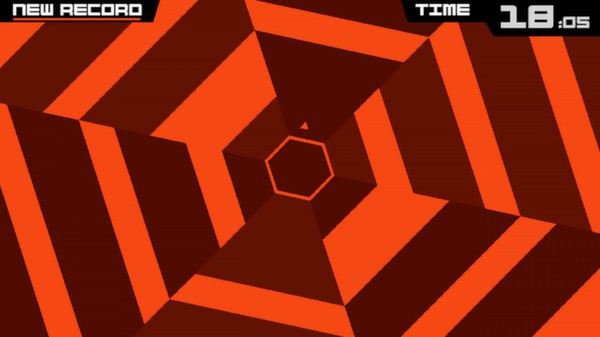 Super Hexagon (from the official Steam screenshots)
Background — going indie as his version of going to Australia
After college he worked as a market risk analyst. In a 2021 PC Gamer feature he explained going indie like this: "I was young. A lot of my friends were doing things like going off to Australia for a year. At the time, the whole indie developer thing was just starting to really kick off. I saved up some money and decided to give it a go. The decision was my version of going to Australia" (PC Gamer, 2021 ↗). The timing was bad; the reporter frames it as a career move his colleagues would, from a risk mitigation perspective, have advised against.
The programming came much earlier. He started making games on a Commodore 64 as a kid: "As soon as you turn a C64 on, it starts you right into BASIC, before you see anything else. It makes it pretty hard not to wonder about what's possible!" But the thing that made him serious was playing Final Fantasy VII as a teenager — "for whatever reason it astounded me so much that I knew I wanted to be a game designer" (Wireframe, issue 3 interview ↗). As a teenager he tried to make RPGs, "very unsuccessfully."
VVVVVV, his first paid game, arrived in 2010; Super Hexagon in 2012; Dicey Dungeons in 2019. Throughout, he kept giving away free games and the free music tool Bosca Ceoil.
Philosophy — take one verb and hone it
At his first GDC in 2010, asked why VVVVVV made such a splash, he answered with startling brevity: "It's fun. That's honestly it, really. It's a lot of fun to play. I like to think it's well-designed. It's interesting to play. I think that's basically what it comes down to" (The A.V. Club, 2010 ↗). In the same interview he refused the word "ambitious" for it — "It's definitely the biggest game I've ever made" — and added, "In a way it's less ambitious than some of the games I made last year. It wasn't as scary to make."
In 2021 he described the turn plainly. His pre-VVVVVV work had been more serious and arty; the reporter frames it as Cavanagh, faced with financial failure, rejecting avant garde storytelling and embracing throwaway fun instead. His own words: "It turns out that's really a better direction. My games got better when I started thinking of them that way" (PC Gamer, 2021 ↗).
Did he abandon story, then? No. Asked whether he considers his games narrative games, he said: "Not so much. When my games have a story they want to tell, I usually prefer to tell it through the mechanics" (Alphr, 2017 ↗). It reads less like giving up narrative than moving the vessel for it from text to rules.
Obsessions — tuned to his own reflexes
On Super Hexagon's tenth anniversary he wrote on his own blog: "It was a game that just sort of came along, while I was working on something else, a game I very much made for myself, tuned to my own reflexes. I didn't expect any kind of reaction to it, let alone the one it got" (distractionware, September 2022 ↗). He tunes to himself first. Whether an audience follows is a later question.
His stance on visuals has barely moved in a decade. "Most people don't think my games are very beautiful. I try to make things look interesting but I'm not really much of a visual artist. I keep things minimal for a reason... I settle on something very, very quickly" (Game Developer, 2012 ↗). In 2017: "My visuals have gotten a lot better since I made VVVVVV, but I still think of my style as 'programmer art', and I still think I probably have some weird ideas about what looks good" (Alphr, 2017 ↗). Back in 2010 a reporter had already noted that Cavanagh treats his self-described inability to draw as an asset rather than a hindrance.
But he is not only a subtracter. Dicey Dungeons pushes the other way. "The main thing I'm interested in doing with the game is taking this very simple set of core mechanics, and, then, with the different classes, explore those systems in lots of cool ways" (Wireframe, issue 3 ↗). For the Robot class he threw out the premise of two dice per turn: instead you get a target that rises as you level, and you may roll as many dice as you like — go over it and your turn ends. New games made not by adding foundations but by rereading the one that is there. That reads to me as continuous with the one-verb discipline of VVVVVV.
Failures — "This is not working out, I have to go and get a real job"
Going indie did not go well. The PC Gamer feature reports that after many failed starts and projects that didn't pan out, Cavanagh ran out of money, borrowed from the bank to keep going, and ran out of that too. In his words: "I'd come to the end of the whole thing, where I just had to say, 'This is not working out, I have to go and get a real job.' And I was working on one last project, which was this little gravity-flipping platformer" (PC Gamer, 2021 ↗). That last project was VVVVVV.
The fashionable game-a-month habit did not stick either. Asked in 2010 how it was going, he answered: "About shit. I did it for two months. I started a new project in January. I started a new project in February, and at the end of the month I laughed at what I'd done. The game for January I didn't like, and didn't think was very interesting. I think I will abandon the project" (The A.V. Club, 2010 ↗). For someone with a reputation for prolific output, he folded his own production plan without ceremony.
And one more line, which is a large part of why I trust what this man says. Having defended the design intent behind the lives system in the free Naya's Quest at some length, he added: "This is definitely the weakest thing about the game, though. Maybe there was a better solution I never thought of. Mea cupla" (Game Developer, 2013 ↗ — the typo is in the original). Not many designers put the defence and the confession in the same paragraph.
Dilemmas — is punishment guidance, or obstruction?
The place he articulates a dilemma most carefully is the 2013 Naya's Quest interview. Asked whether his games are intentionally being frustrating and evil to the player, he pushed back: "I think the main thing that makes Naya's Quest frustrating isn't actually anything about the puzzles - it's the lives system and the way it pushes you back a room when you fail." And: "This was a pretty scary thing to add to the game, and understandably a lot of people hate it - but I feel like the game is ultimately stronger with it, as it guides players towards playing it the way it's supposed to be played" (Game Developer, 2013 ↗).
Guides them towards what? "The single worst experience you can have with this game is to approach it as trial and error, which is exactly what happens when you don't have any real consequences to failure" (same). For him punishment is not cruelty but a device that forces thought. Yet he closes the very same topic by calling it the weakest thing about the game. He shipped it knowing that the guidance and the obstruction come out of the same mechanism.
The other tension is commercial. On why he gave it away: "I don't believe Naya's Quest would sell, if I tried to sell it, but that doesn't mean I shouldn't have worked on it, if I'm able." And: "If I didn't do that, I think commercial pressures would inevitably influence what I chose to spend my time working on. If everything I worked on had to be a thing that would make money, then I might work on other things. I might never have made this" (same). Six months on a game he knew wouldn't sell, then given away free — which he describes as doing the best work that he can.
Influences — FFVII, the C64, and Dream Quest
The influences he acknowledges are clear. Final Fantasy VII is why he wanted to be a designer; BASIC on the C64 is how he got in (The A.V. Club, 2010 ↗ / Wireframe, issue 3 ↗). But he does not spare the genre he loves: "RPGs have an awful lot of filler, to be honest. It's a genre I love, but I recognize that even a lot of the games I love, like the Final Fantasy series and Chrono Trigger, they're flawed in a lot of ways that could be better" (The A.V. Club, 2010) — immediately followed by "I didn't say that," and a laugh.
Dicey Dungeons' direct parent is Peter Whalen's Dream Quest. "Dream Quest is legit one of my favourite games ever. Dicey Dungeons essentially started as a Dream Quest fan game." He calls Slay the Spire "a super cool game" but says he stopped playing after about an hour because it was clear they were exploring the same design space, and looks forward to playing it properly once his own game is done (Wireframe, issue 3 ↗). The class system, he says outright, is hugely inspired by Dream Quest too.
More surprising is an influence running backwards in generations. PC Gamer notes that the pairing VVVVVV established — brutal challenge with player-friendly checkpointing and instant resets — is still visible in Maddy Thorson's Celeste, and records that Cavanagh had been "influenced pretty heavily" by Thorson's own early '00s projects (PC Gamer, 2021 ↗). The lineage of difficulty design does not run one way.
And one influence often attributed to him that he denies: on Mega Man 5's Gravity Man stage and Metal Storm, he says he went and played both only after people brought them up. "I want to say that it was inspired, but it's more just a coincidence. Even though it's the same mechanic, we're exploring it in very different ways" (The A.V. Club, 2010). Worth keeping on the record, so nobody invents an influence for him.
Kizuki's reading — "it won't sell" is not an excuse but a design constraint
From here on this is my reading, not something he said. I read Cavanagh as someone who frees his hands by pinning his expected return at zero. Start from the assumption that it won't sell, and the market never gets a vote on what to cut and what to keep. Tuning difficulty to his own reflexes, or shipping a lives system he knew many players would hate, would not have survived a commercial premise. That the one game which saw him through his worst money trouble was the last one he made after dropping the seriousness is probably not an accident: forecasting no sales is how he made the thing that sold most. And yet — in 2017 he said that as much as he would sometimes like to find the thread pulling all his work together, the truth is that all his games seem driven in their own different directions (Alphr, 2017 ↗). So if I claim here to have found the thread, he will deny it. Let me restate it, then: not a thread but a habit. What repeats in him is not an argument but a way of moving.
Closing — where to start
If you want to understand him, don't go straight down the commercial line of VVVVVV, Super Hexagon, Dicey Dungeons. Put a free game in between — I'd suggest Naya's Quest. It runs in a browser and takes about an hour, and you rarely get to play a game whose designer has publicly named its weakest part while also arguing for it. Then play Super Hexagon for ten minutes without trying to get good at it. You will feel, in your fingers, what "tuned to my own reflexes" meant.
Some neighbours worth reading next. On squaring brutal difficulty with generous relief, try our study of Maddy Thorson ↗ — the designer Cavanagh says influenced him "pretty heavily." For failure as the subject itself, Bennett Foddy ↗; and for another developer caught between seriousness and throwaway fun, Petri Purho ↗. Read together, they show what late-2000s indie threw away and what it picked up.
Sources
Primary sources used in this article (text verified for all):
・Cavanagh's own blog, distractionware, "Super Hexagon, 10 years on," September 2022 ↗
・Cavanagh's own blog, distractionware, "About Me" (his own account of his career and games) ↗
Reactions (no login)
Anonymous • one of each per visitor per day
Learn — Curriculum
LearnPart 9 Shipping — Make It, Then Deliver ItChapter 20 Market and Delivery8 / 11
Part of these series
The Designer's PhilosophyEpisode 35 of 63