RETRO-REVIEW · 2026-09-30
Lights Out (1995): Press a Button and Its Neighbours Flip. Linear Algebra Sat Under Those 25 Buttons
Rereading Tiger Electronics' handheld through its predecessors and its mathematics
Introduction: 25 buttons and one puzzle
This is a toy from 1995: the handheld electronic game Lights Out, sold by Tiger Electronics in the United States. Japanese Wikipedia says that Takara released it in Japan.
The board is a 5x5 grid of 25 buttons. Press one, and that button and its four neighbours (up, down, left, right) all flip. The goal is to turn every light off. That is the whole rule set.
Yet under this simple rule lies linear algebra. Not every layout can be solved. Of the 2^25 possible layouts, only one in four can be cleared.
This article reads the little box as a historian would. What came before it? When did mathematicians notice it? And what is still going on today? I write only what I could confirm.
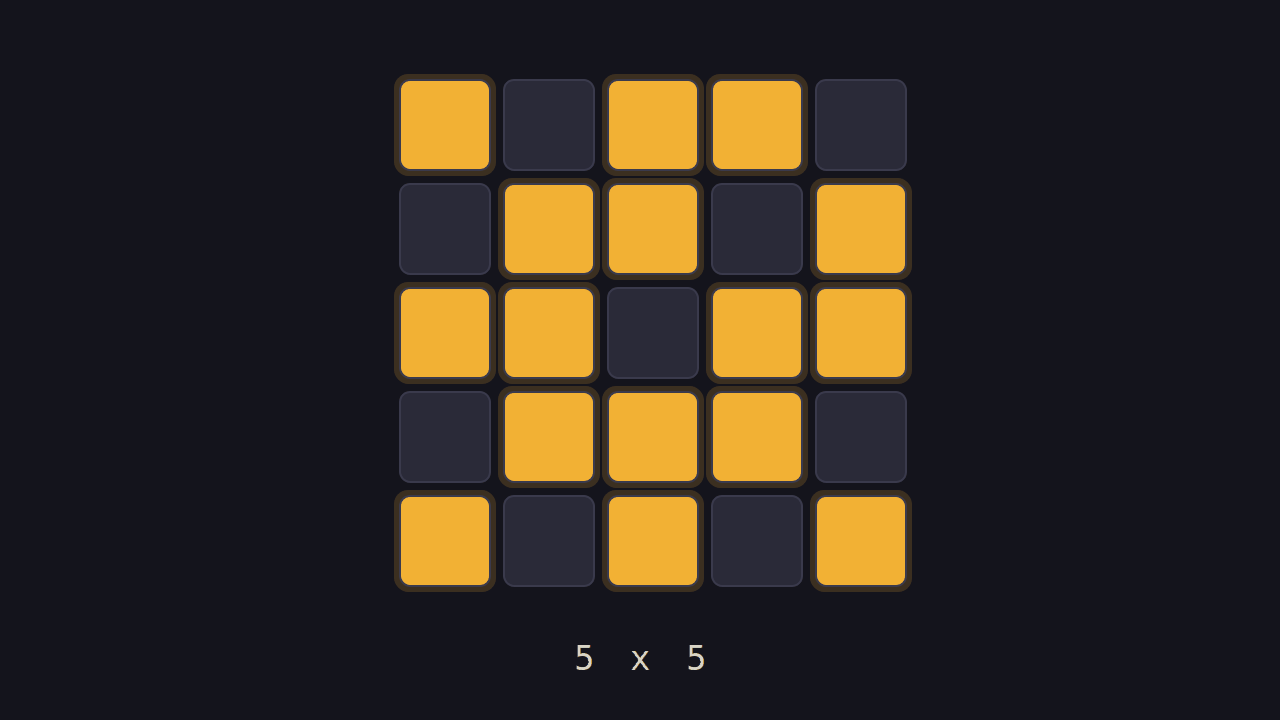 A board of 25 buttons (illustration, AI-generated)
Context: 1978, 1983 and 1995
Lights Out did not appear from nothing. Both English and Japanese Wikipedia name earlier games: Merlin from the 1970s and the XL-25 from 1983.
According to puzzle researcher Jaap Scherphuis, the "Magic Square" of Merlin (Parker Brothers, 1978) is probably the earliest game of this kind. But its board is 3x3, and its flipping pattern is not the same as in Lights Out.
The same page says the XL-25 was made by Vulcan Electronics, with patents filed in 1983, and credits its invention to Laszlo Mero. It is among the earliest electronic games close to today's Lights Out.
Then came 1995. The same page says Tiger Toys patented its version on May 23, 1995. English Wikipedia lists six designers: Avi Olti, Gyora Benedek, Zvi Herman, Revital Blumberg, Avi Weiner and Michael Ganor.
I found no statement from the developers saying whether Tiger drew on the XL-25 or similar games. So I do not claim that the XL-25 led to Tiger's version. The safe claim is only that earlier games existed.
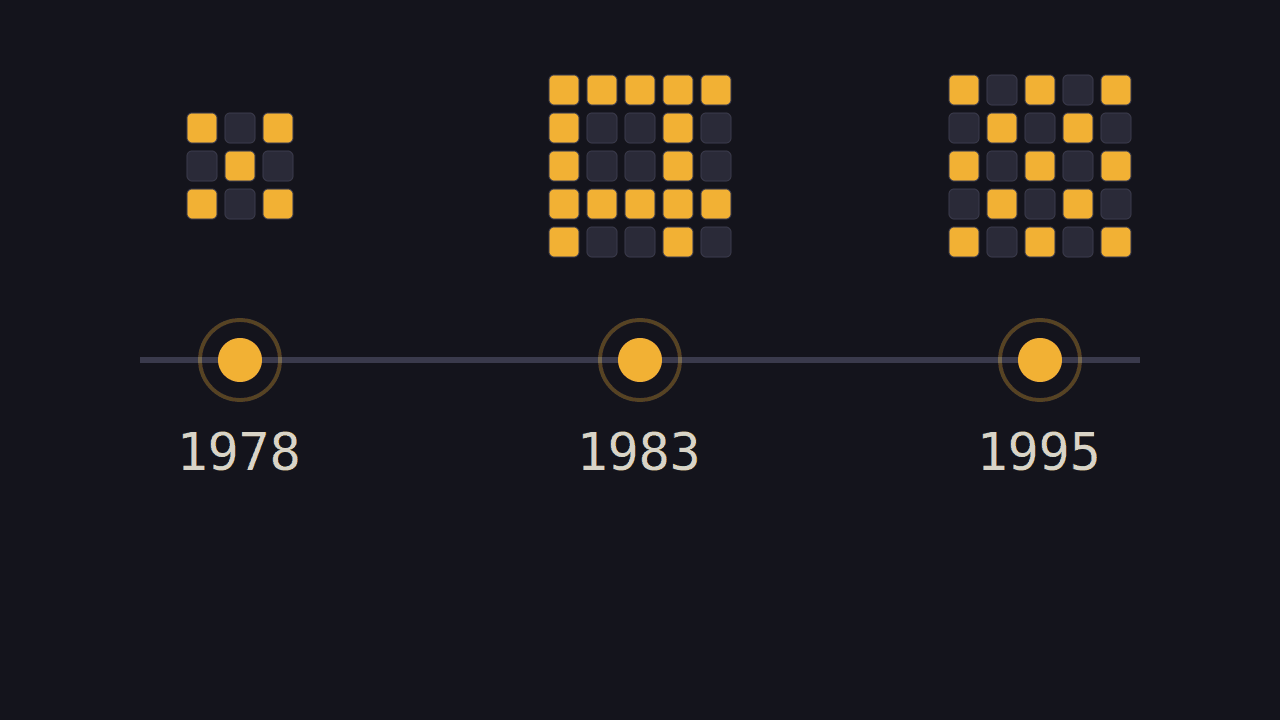 A timeline linking 1978, 1983 and 1995 (illustration, AI-generated)
Mechanics: the order of presses does not matter
The heart of the game is that pressing a button twice undoes it. So each button is a yes-or-no choice: press it or don't. The order of presses has no effect on the result.
Thanks to this, the 25 buttons become 25 zeros and ones. Japanese Wikipedia also notes that pressing the same spot more than once is wasted effort and that order does not matter. In mathematical terms, it is a system of equations over the field GF(2), where you add using only 0 and 1.
A firm result follows. The coefficient matrix of the 5x5 board has rank 23, and Scherphuis's page also gives 23. I brute-forced all 2^25 layouts on my own machine to check: exactly 2^23 layouts are solvable, one quarter.
There are four "quiet patterns", sets of presses that change nothing, counting the empty set. By hand, the standard method is "light chasing": work from the top row down, pressing buttons in the row below to clear each row above.
Even the worst solvable layout can be cleared in 15 presses at minimum. My brute force confirmed that 15 is the maximum; 7,350 layouts need that many. The all-lights-on board also needs 15.
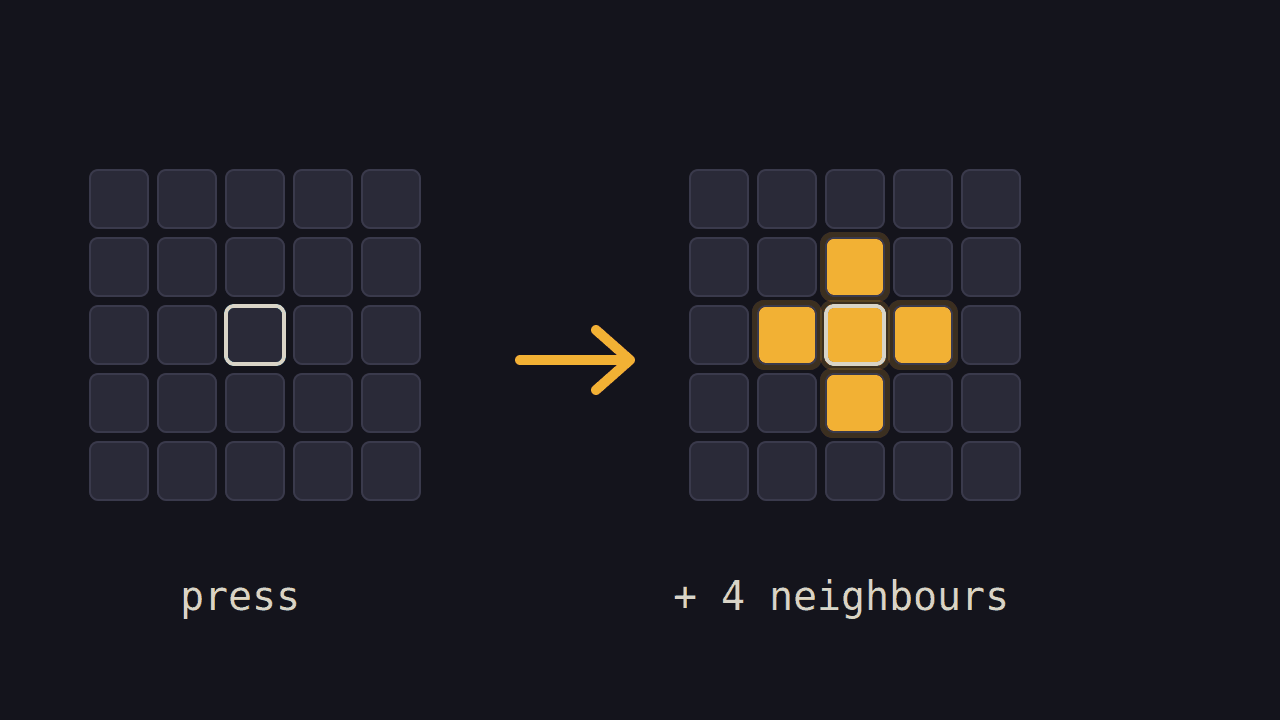 One press flips the button and its four neighbours (illustration, AI-generated)
Lineage: from a toy to graph mathematics
The game also became a subject for mathematicians. According to MathWorld, Klaus Sutner showed in 1989 that, on a square grid, it is always possible to go from all lights on to all lights off.
Sutner's paper, "Linear cellular automata and the Garden-of-Eden", appeared in The Mathematical Intelligencer. It predates the game, so the mathematics came first. But I found no evidence that it influenced Tiger's development.
In 1998, Marlow Anderson and Todd Feil published "Turning Lights Out with Linear Algebra" in Mathematics Magazine, reading the game as a lesson in linear algebra. In 2013 came a survey by Fleischer and Yu, "A Survey of the Game Lights Out!".
Research continues. A conjecture by Sutner about board size and the number of quiet patterns was addressed in "Resolution to Sutner's Conjecture", posted to arXiv in 2022. That paper says Sutner was one of the first to study such games mathematically.
Researchers have also extended the board from a grid to general graphs ("Lights Out on graphs"). The 5x5 box of 1995 is still a subject of academic papers. English Wikipedia lists spin-offs: Lights Out 2000, Lights Out Cube, Lights Out Deluxe, and a 1997 Game.com cartridge.
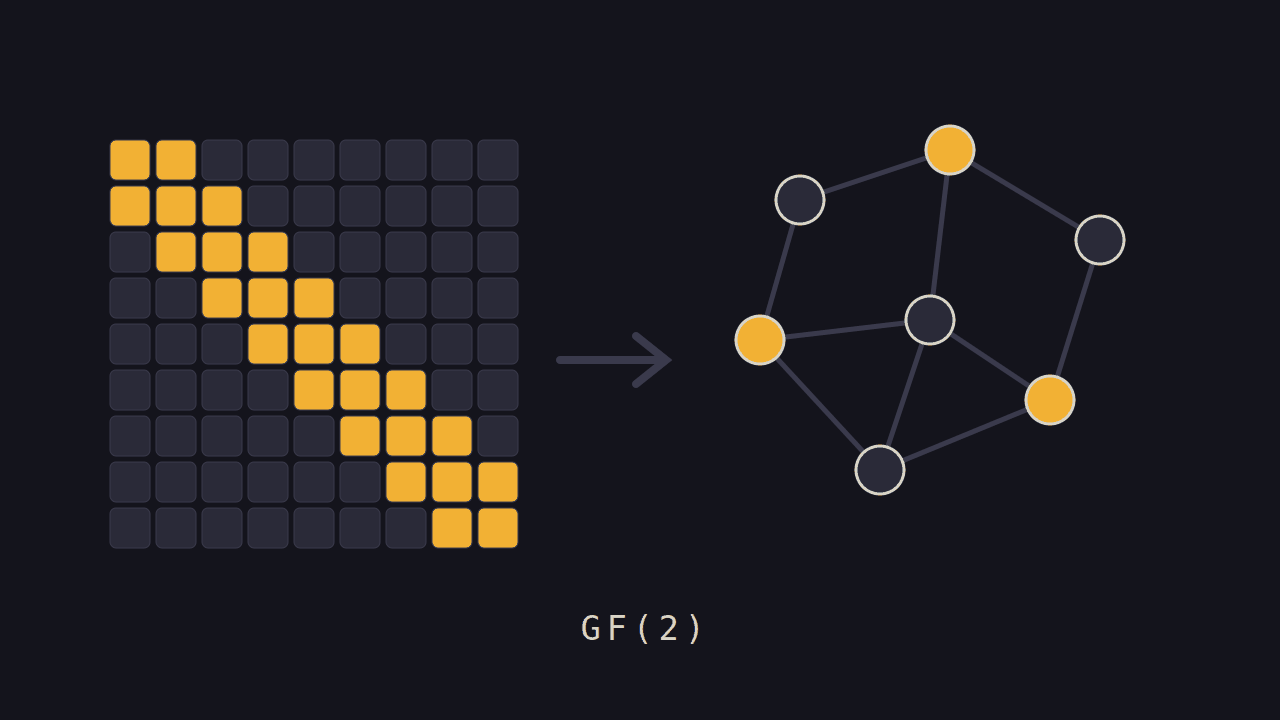 A matrix and a graph, linked (illustration, AI-generated)
References
Sources consulted for this article:
・Wikipedia (English): Lights Out (game)
・Jaap's Puzzle Page: Lights Out (Merlin, XL-25, Tiger patents)
・Jaap's Puzzle Page: Lights Out Mathematics
・Wolfram MathWorld: Lights Out Puzzle
・K. Sutner, Linear cellular automata and the Garden-of-Eden (The Mathematical Intelligencer, 1989)
・M. Anderson and T. Feil, Turning Lights Out with Linear Algebra (Mathematics Magazine, 1998)
・R. Fleischer and J. Yu, A Survey of the Game "Lights Out!" (2013)
・Resolution to Sutner's Conjecture (arXiv:2202.09878)
・Lights Out on graphs (arXiv:1903.06942)
The figures for rank 23, 2^23 solvable layouts, a maximum of 15 presses, and 7,350 layouts needing 15 were verified by the author by brute force over all 2^25 layouts.
Closing: what history shows in this box
What history shows through Lights Out is clear. A tiny rule can hide deep structure. Press a button and its neighbours change. From that alone come linear algebra, graph theory, and even open conjectures.
All I can say is the sequence of facts. Merlin in 1978, the XL-25 in 1983, Tiger's 5x5 in 1995, and Sutner's mathematical answer in 1989. I do not assert influence among them, because I have no evidence.
What modern puzzle games inherited from Lights Out, I cannot say with confidence. But games that rewrite a board by flipping are still being made, and the pleasure of thinking about the whole board before you press has not faded.
 A single light left in the dark (illustration, AI-generated)
Reactions (no login)
Anonymous • one of each per visitor per day
Part of these series
Retro RevisitedEpisode 45 of 45