STAGE-STUDY · 2026-10-03
Microban Level 1 — The box that is already home must leave first
Anatomy of a Level #2
Introduction — Episode 2 opens the “practice” collection of 2000
Hello, Toki here. Episode 2 of “Anatomy of a Level” reads Microban level 1. It teaches exactly one thing: a box that starts on a goal has to leave that goal before the level can be solved. Two boxes, fourteen floor cells. Into that little space the designer has packed three mistakes beginners make.
A warning first. This article contains the complete solution. The shortest sequence, the losing sequences, all of it. If you want to solve it yourself, come back afterwards.
Microban is a collection of 155 Sokoban levels that David W. Skinner released in 2000 (the year is from the itch.io edition's description, cited below). Sokoban itself dates from 1982, by Hiroyuki Imabayashi of Thinking Rabbit. Last time, in Sokoban level 1, we read a level with six boxes. This time there are two.
I confirmed the layout by comparing two level files published on GitHub: microban1.lvl in GerardMT/Sokoban-Editor and microban.txt in stahta01/sokoban-1. I also checked that the shortest solution found here matches the record kept on the online version at sokoban-game.com (33 moves, 8 pushes, as of 2026-10). From the thumbnail of “Sokoban Original & Extra (Microban 1-20)” (Heartburn Mode, YouTube). A ported version; its look differs from the diagrams in this article.
What does the starting position look like? — 14 floor cells, two boxes, two goals
Counting the outer walls, the board is 6 cells wide and 7 tall. There are only 14 floor cells. Two boxes, two goals. And one of the boxes (A in the diagram) starts on a goal.
In words: a tall room with a 2×2 alcove attached to its right side. The left column (column 1) is a narrow passage five cells long. At its top end, at the top of column 2, sits the one empty goal.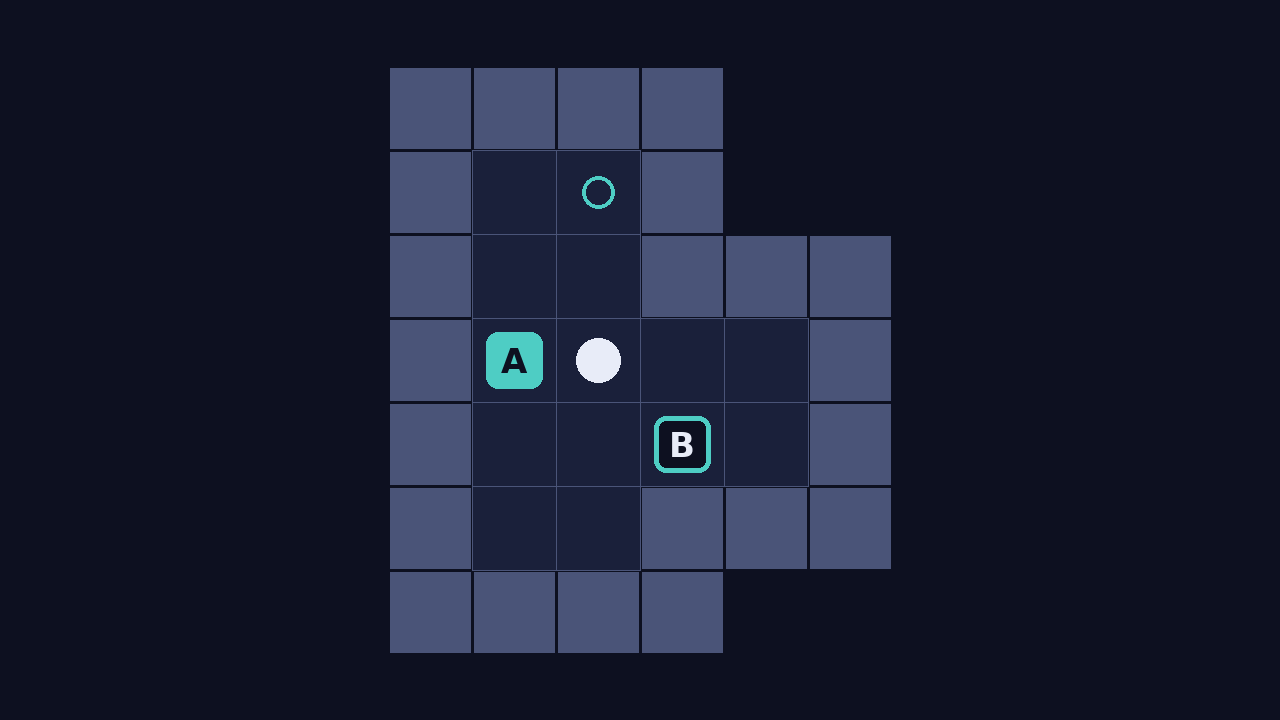 (Diagram) Starting position of Microban level 1. Filled squares = walls, rounded squares = boxes, filled rounded square = a box on a goal, hollow circle = goal, white circle = player. Layout taken from two level files on GitHub (microban1.lvl / microban.txt).
The player stands in row 3, column 2, just right of A. The other box, B, is at the mouth of the alcove, row 4 column 3. Walls sit above and below B, so it can only be pushed left or right. Push it right and it enters the alcove's corner and never comes out.
The feature to notice is the three cells in the lower left (row 4 column 1, row 5 column 1, row 5 column 2). They form a dead-end pocket with only two entrances: row 3 column 1, where A stands, and row 4 column 2, diagonally below it. This pocket is the key to the level.
What does this level teach? — A box on a goal is not finished
Three things are new here. “You can push but not pull” and “a box in a corner is dead,” both from Sokoban level 1 last time, are review.
First. A box on a goal is a goal and an obstacle at the same time. A is already where it belongs. But as long as A sits there, the player cannot use the left passage or enter the pocket. A must leave its goal and come back later. The level demands that round trip.
Second. Boxes are walls for the player, too. Push B one cell left and both entrances to the pocket are boxes. The player cannot get in. Pushing B upward requires standing inside the pocket, so at that moment there are no moves left.
Third. Parking a box. On the way to the goal, B is set aside in an unrelated cell (row 3 column 3), A is returned, and then B is picked up again. A detour, but the only road.
One number. From the starting position of this 14-cell, two-box level, 55 box arrangements are reachable. 14 of them are solvable; the other 41 are already lost (by my breadth-first search). Three quarters of the reachable arrangements are dead. That many traps, in a space this small.
Where do players get stuck? — Two of the four possible first pushes are instantly fatal
Four pushes are available on the first move: A up, A down, B left, B right. The two pushes of B are instantly fatal.
Push B right and it enters the alcove's corner (row 4 column 4), walled on two sides. That is review from last time.
Pushing B left is what most first-time players do. It moves B toward column 2, where the goal is. But at that instant A and B block both entrances to the pocket. The player cannot get in and cannot stand where B must be pushed up from. Both boxes can still move, yet there is no solution. This is a different kind of deadlock from last time's corridor: it is the player, not a box, who gets locked out.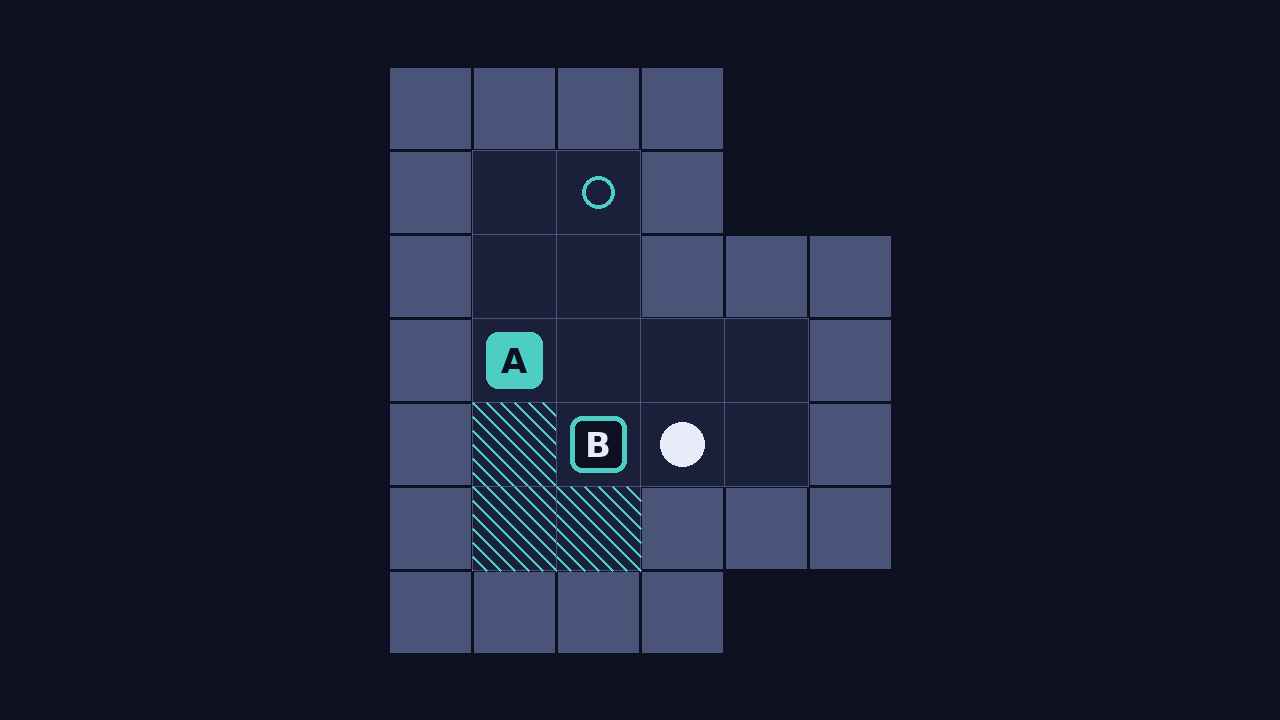 (Diagram) The deadlock the moment B is pushed left. The hatched cells are the lower-left pocket. Its only two entrances, row 3 column 1 (A) and row 4 column 2 (B), are both boxes. The player cannot get in, so cannot stand where B must be pushed up from. A search program confirmed no solution exists from here. Layout from the same level files.
Pushing A down does not lose, but it accomplishes nothing. With A in row 4 column 1 the pocket is closed just the same. You can push it back from below, so the only cost is two wasted pushes.
The correct first push is A up. A moves to row 2 column 1 and the left passage opens. But two more traps follow.
One is the “put it back too soon” trap. After pushing B left, the player can walk around the top to row 1 column 1. From there it is tempting to push A down onto its goal. The moment you do, you have exactly the position in diagram 2. The pocket closes, and that is the end.
The other is the “carry B straight through” trap. With A parked above, you enter the pocket and push B up, up, up, onto the goal at row 1 column 2. B is home. But returning A requires standing at row 1 column 1, and both B and A block the way there. No solution.
So this level has three kinds of deadlock. A box dies in a corner. The player gets locked out. You cannot reach the far side of the box you need to push. Fourteen cells, and all three classic Sokoban failure patterns appear.
How does the shortest solution go? — 33 moves, 8 pushes
The shortest solution is 33 moves, 8 of them pushes. I found it with a breadth-first search I wrote for this article and verified the sequence with a separate replay program. There is exactly one 8-push solution (confirmed by counting the paths that reach the goal in 8 pushes). The record kept at sokoban-game.com is also 33 moves and 8 pushes.
Here is the sequence, pushes only. ① A up (player pushing from row 4 column 1). A goes to row 2 column 1. ② B left (from row 4 column 4). B goes to row 4 column 2. ③ Walk down the left passage into the pocket and push B up. B goes to row 3 column 2. ④ Step around to row 3 column 1 and push B right. B is parked at row 3 column 3.
⑤ Walk around the top to row 1 column 1 and push A down. A returns to its goal (row 3 column 1). ⑥ Walk around the right to row 3 column 4 and push B left. B goes to row 3 column 2. ⑦⑧ Step to row 4 column 2 and push B up twice. B lands on the goal at row 1 column 2. Done.
In notation: dlUrrrdLullddrUluRuulDrddrruLdlUU (lowercase = move, uppercase = push; u/d/l/r = up/down/left/right).
There is almost no branching. Step ④, parking B at row 3 column 3, is the only cell that keeps B out of column 2 and away from the pocket entrances while A returns. One more push to the right would kill it in the corner, so this is the only parking spot. That single point is why the shortest solution is unique.
If you do not mind extra moves, detours are possible, such as pushing A down and back on the first move. But the route the boxes take has no alternative.
Where does it sit in the sequence? — In level 2, two of three boxes start on goals
This is Microban level 1, so there is no previous level. What comes before it is Sokoban itself. Where the roomy, six-box “Original” level 1 silently taught four rules, Microban level 1 narrows the lesson to one rule and cuts the boxes to two. It is the first page of a collection designed for practice.
In level 2 (6×7 with walls, three boxes), two of the three boxes start on goals and only one goal is empty. The same question, whether to move a box that is already home, is repeated with one more box. I confirmed that layout in the same two level files.
This is how Skinner's collection proceeds: one concept added per level. Where an ordinary collection is ordered by difficulty, Microban is ordered by what it teaches. In that sense, I read it as a close cousin of the LESSON levels in Chip's Challenge.
How did Skinner describe Microban?
Skinner's own note on the collection survives. Rather than paraphrase, I quote it.
“This is a good set for beginners and children. Most of the puzzles are small and illustrate a particular concept. More experienced players should also find them interesting, since they are as different from each other as I could make them given their size. Sokoholics could perhaps time themselves on completing the whole set. This set also contains puzzles which I thought were interesting but too easy to include in my regular sets.” (As reproduced on the Microban pages at sokoban-game.com and in the description of au voleur!'s itch.io edition.)
“Illustrate a particular concept.” Level 1's concept is getting a box off its goal. The level is exactly what its designer says it is.
Closing — The year, for the record, was 2000
Fourteen cells. Two boxes. Eight pushes. And three kinds of deadlock. The smaller the level, the clearer the designer's hand.
I never feel an article is finished until I have written the year. Microban was released in 2000, eighteen years after Sokoban was born. By then the rules of Sokoban had become something not just to play, but to teach. Tonight I will warm a bottle of sake to that.
Next time: either LESSON 1 of Chip's Challenge or Microban level 2. In Microban level 1, did you push B first, or A? Tell me, if you like.
Sources
How the layout was verified, and sources consulted:
・GerardMT/Sokoban-Editor: levels/microban/levels/microban1.lvl — Level data for Microban level 1. Primary source for the layout in this article.
・stahta01/sokoban-1: data/sokoban/levels/microban.txt — A separate file containing all 155 levels. Levels 1 and 2 match the file above.
・sokoban-game.com: Microban Level 1 — Online level page. Consulted for the best recorded solution (33 moves, 8 pushes, as of 2026-10) and for Skinner's description of the set.
・Microban I (by David W. Skinner) — au voleur!, itch.io — Browser-playable PuzzleScript Plus edition. Consulted for the 155-level count, the 2000 release year, and the reproduced description.
・ticalc.org: Microban (port for TI calculators, 2001) — Corroborates that the set circulated as 155 levels by 2001.
・Sokoban Original & Extra (Microban 1-20) (Heartburn Mode, YouTube) — Opening image. Footage of a ported version.
・The shortest solution (33 moves, 8 pushes), the count of reachable box arrangements (55, of which 14 solvable), and every deadlock judgment come from a breadth-first search program I wrote for this article. The sequence was verified with a separate replay program.
Reactions (no login)
Anonymous • one of each per visitor per day
Part of these series
Anatomy of a LevelEpisode 2 of 2

