STAGE-STUDY · 2026-09-19
Sokoban, Level 1 — A one-wide corridor carries one box at a time
Anatomy of a Level #1
Introduction — Starting with the most famous level of all
Hello, Toki here. This is the first episode of a new series, “Anatomy of a Level.” One level of a classic puzzle game per episode, redrawn as a diagram and read closely: what it teaches, where it makes you stall, and why it has that shape.
A warning first. This article contains the complete solution to the level. Every trap and the shortest route are all here. If you want to solve it yourself, come back afterwards.
Episode one is Sokoban, level 1. Sokoban is the box-pushing puzzle Hiroyuki Imabayashi of Thinking Rabbit released in 1982. For the game as a whole, see our earlier Sokoban (1982) and The philosophy of Hiroyuki Imabayashi. Today we look at a single level.
The level in question is level 1 of the 50-level set credited to Thinking Rabbit and shipped as “Original” in many ports and open-source versions. I confirmed the layout by comparing two sources: the level data of xsokoban, the UNIX port (screens/screen.1), and the level file of another open-source port. The 1982 PC-8801 release had 20 levels; whether its first level is this same layout is something I could not verify this time.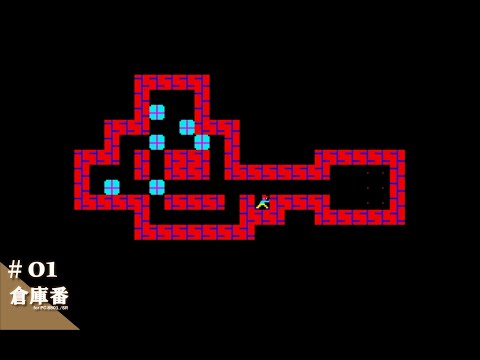 From the thumbnail of “【Play】PC-8801 倉庫番 #01 レトロゲーム” (名作レトロゲーム博物館, YouTube). PC-8801 footage; not necessarily the same layout as the “Original” set’s level 1 discussed here.
Starting position — a 19×11 board, six boxes, six goals
The board is 19 cells wide and 11 tall, with 56 walkable floor cells. Six boxes, six goals. The goals sit in the rightmost room as a 3-by-2 block.
The level is three rooms and one corridor. Top-left is the “upper room,” bottom-left the “left room,” bottom-right the “goal room.” A one-cell-wide corridor running along row 8 connects all three.
Count the boxes. Four in the upper room. One at the mouth of the left room (column 3). One at the left end of the corridor, right where a narrow passage comes down from the upper room (column 6).
Where is the player? In a one-cell notch below the corridor, toward the right. One step up puts you in the corridor; right leads to the goal room, left runs into the corridor box. The player's own starting cell, by the way, is a dead-end pocket — push a box in there and it never comes out.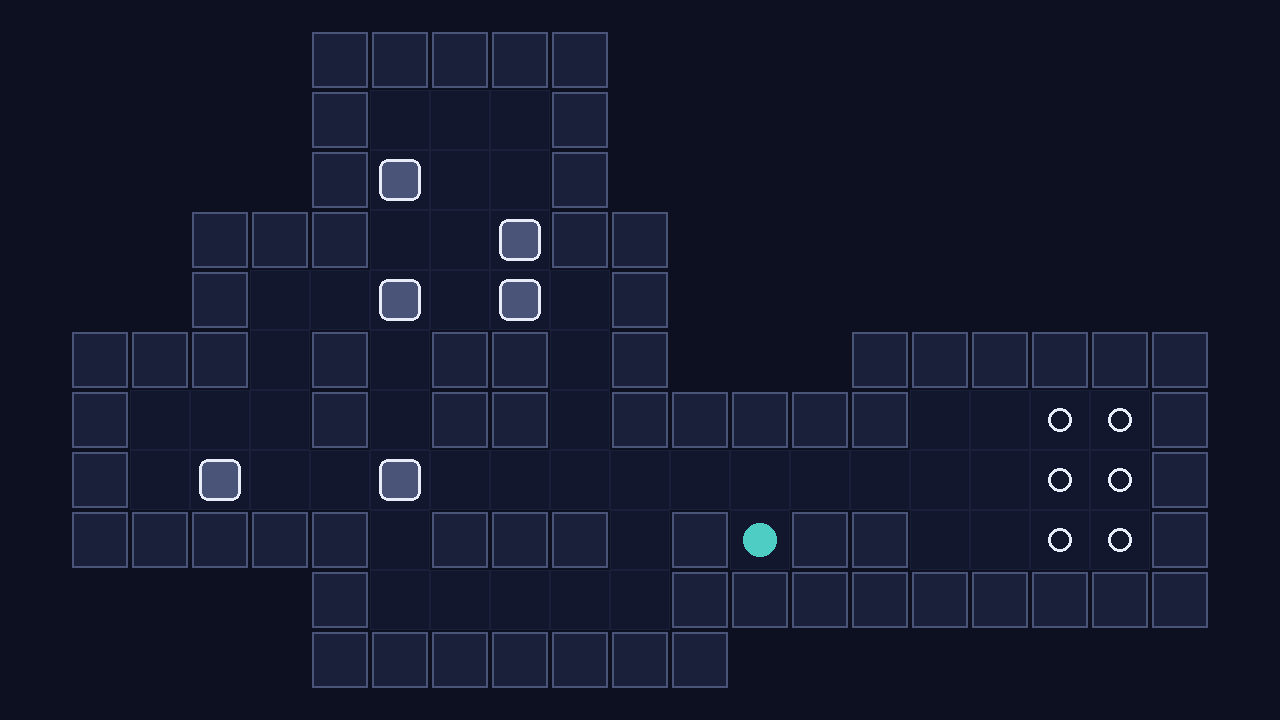 (Diagram) Starting position of Sokoban “Original” level 1. Filled squares = walls, rounded squares = boxes, hollow circles = goals, teal disc = player. Layout taken from the xsokoban level data (screens/screen.1).
Three things stand out. First, the corridor is long: boxes must be pushed more than ten cells in a straight line to reach the goal room. Second, two passages lead down from the upper room (columns 6 and 9), both one cell wide. Third, the goal room is 3 rows by 4 columns, and the top and bottom corners of its entrance column are not goals.
What this level teaches — four facts, no tutorial text
Since this is level 1, every rule it uses appears here for the first time. Yet there is no tutorial text anywhere. The shape of the level does the teaching. I count four lessons.
One. You can push, but you cannot pull. To bring a box back you have to get around to its far side. A box pushed somewhere you cannot get behind is stuck for good.
Two. A box in a corner never leaves. Push a box into a corner with no goal, and the level is unsolvable from that instant. Of the 56 floor cells, 15 are cells where placing a box kills the level (I counted them by working backwards from the goals). The three cells along the upper room's ceiling, the five in the bottom dead end, the player's own starting cell, and so on.
Three. Boxes side by side cannot be pushed. You push one box at a time. Two boxes in a line, with a wall running along that line, and neither will ever move again.
Four. A one-wide corridor carries one box at a time. The player can only stand behind a box, so in a corridor the pushing direction is fixed. Put two boxes in the corridor and rule three freezes them. That is where this article's title comes from.
All four rules come up in every one of the remaining 49 levels. Level 1's job is to teach them without writing them on the wall. For the mechanic in general, see our Sokoban-style pushing entry.
Where you stall — the very first push is already a trap
From the starting position the player can reach only two boxes: the lower-right box of the upper room (just left of the top of the column-9 passage) and the box at the left end of the corridor. There are exactly three possible first pushes.
(a) Push the upper room's lower-right box to the left. (b) Push the corridor box left, into the left room. (c) Walk around through the bottom dead end and push the corridor box up.
(c) kills the level the moment you do it. Push the corridor box up into the narrow column-6 passage and it sits two cells below the upper room's lower-left box. To bring it back down, the player would have to stand between the two boxes, and there is no way in. It is “push but never pull,” taught on move one. I confirmed with a search program that no solution exists from that state.
(b) is fine once. Push it twice, though, and it lines up beside the left room's box with a wall beneath both. Frozen. A live demonstration of “boxes side by side cannot be pushed.”
(a) is safe. More than safe: it is the opening of the standard solution. To get into the upper room via the column-9 passage, pushing this box left is the only way.
The mid-game trap is the corridor. You push the corridor box partway, then go back for the next box. Now the second box sits right behind the first. Walls above and below; the player can get behind neither. This is, I suspect, the most common way to die on this level.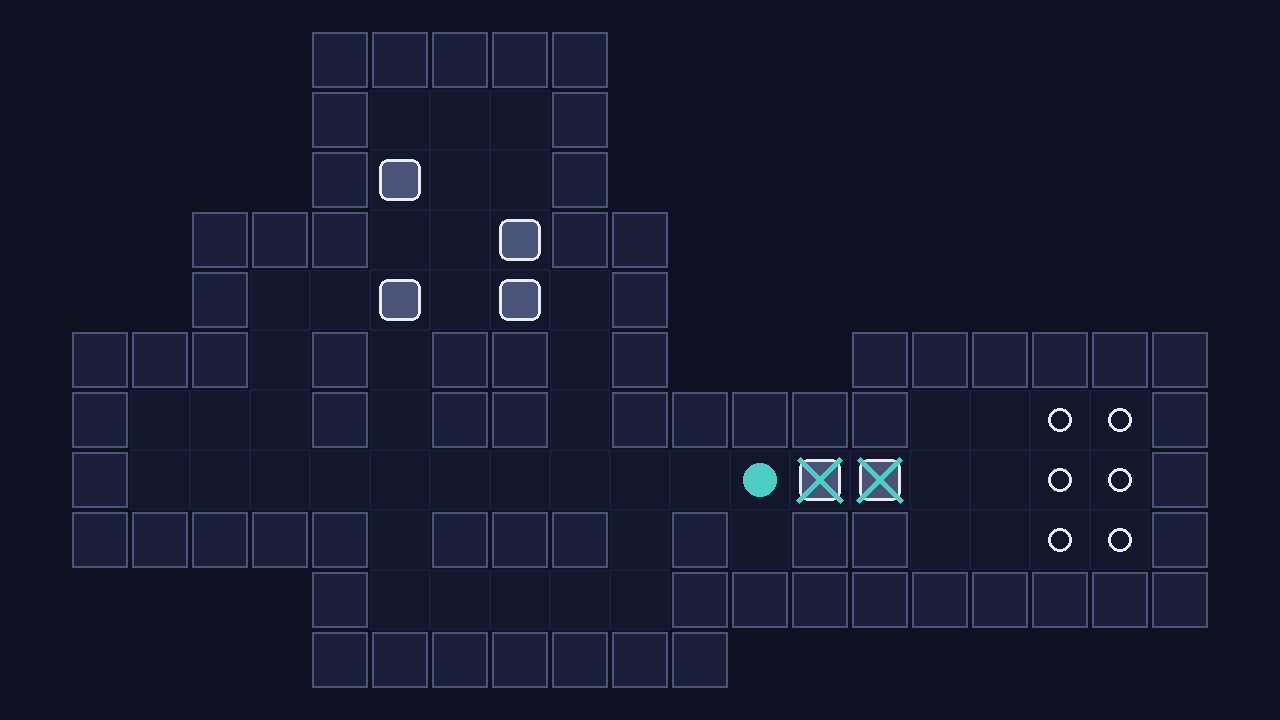 (Diagram) The deadlock the moment two boxes line up in the corridor. Neither X-marked box can ever move again. A search program confirmed there is no solution from this state. Layout from the xsokoban level data (screens/screen.1).
One more: the upper room's ceiling. Push any upper-room box upward and it ends up against the ceiling on row 2. Even without walls to either side, a box against a wall can only slide along that wall, and there is no goal on that row. “Against a wall means finished, unless a goal lies along that wall.” Three ceiling cells here are exactly that.
Solution and branches — 230 moves, 97 pushes at minimum
I counted the shortest solution. Counting each step of the player as one move: 230 moves, of which 97 are pushes. This comes from a breadth-first search I wrote for the article; it examined about 43.66 million states before finding the solution. Minimizing pushes alone also gives 97. I then replayed the resulting move string in a separate checker and confirmed all six boxes end on goals.
The skeleton of the solution goes like this. Three opening pushes. (1) The upper room's lower-right box, one cell left. (2) The box above it, one cell up — a temporary parking move to clear a path; it comes back down later. (3) The upper room's lower-left box, one cell down into the column-6 passage. Now the player can pass from the upper room into the left room.
Next, push the corridor box right 12 times from the left-room side, all the way to the far end of the goal room's middle row. Then the left room's box, 14 pushes right, to the cell just short of it. The middle row is done.
The remaining four come down from the upper room through the column-6 passage into the corridor and travel right. Push each to the second cell inside the goal room, shift it up or down by one, then push right. Far column first, near column second. The goals fill in this order: middle row, then far-top, far-bottom, near-top, near-bottom.
On branches: besides (a), the opening (b) — pushing the corridor box left once — also leads to a 230-move solution (with 99 pushes instead of 97). So the shortest solution is not unique. The number of solutions starting with opening (c), however, is zero.
On the size of the state space: distinguishing states by box positions and the player's reachable region, and excluding dead cells, there are 1,531,717 of them. No human looks at all of these. Once you have learned the corridor rule, very few branches need looking at. Level 1 is solved by understanding the rules, not by the volume of search.
Before and after — level 2 raises the count to ten boxes
Nothing comes before level 1. So this level carries the whole load of teaching “push, never pull; corners kill; side by side freezes; one box per corridor” all at once.
Level 2 (screen.2 of the same set) is a slightly smaller 14×10 board with ten boxes, and its goals form a 5-by-2 block at the far left. Instead of one long corridor, the space is partitioned into narrow rooms and the boxes sit much closer together. It takes the “side by side freezes” lesson from level 1 and makes you manage it with ten boxes. Level 2 will get its own dissection in this series eventually.
Six boxes in level 1, ten in level 2. The count grows; the rules do not. The set, as I read it, spends all its rules on the first level and then raises difficulty through layout alone. For a 1980s single-room puzzle designed on a very different principle, compare Eggerland (1985).
Closing — for the record, 1982
1982. I never feel an article is finished until I have written the year down. This level has been the front door to a game born that year for a very long time.
What drawing the board taught me: the first move is a three-way choice, one option dies instantly, one dies on its second push. As a tutorial with no text, that is harsh. But harsh is how it sticks. That is the design.
Next time: either LESSON 1 of Chip's Challenge or level 1 of Microban. Which Sokoban level was the first one to stop you cold? Tell me, if you like.
Sources
How the layout was verified, and what was consulted:
・xsokoban (Andrew Myers) — level data screens/screen.1 (level 1) and screens/screen.2 (level 2). Primary source for the layout in this article.
・lieberkind/sokoban: original-levels.txt — a separate file of the same 50-level set; level 1 matches xsokoban exactly.
・Wikipedia: Sokoban — the 1982 PC-8801 release (20 levels), Sokoban 2 in 1984 (50 levels), the 1988 Spectrum HoloByte port, and so on.
・【Play】PC-8801 倉庫番 #01 レトロゲーム (名作レトロゲーム博物館, YouTube) — the opening image. PC-8801 footage; not necessarily the same layout as the level discussed here.
・Shortest solution (230 moves / 97 pushes), state counts and deadlock verdicts come from a breadth-first search program written for this article; the move string was validated with a separate replay checker.
Reactions (no login)
Anonymous • one of each per visitor per day
Part of these series
Anatomy of a LevelEpisode 1 of 1