REVIEW · 2018-02-20
Cypher
An exhibition of cryptography that assumes paper and pencil
First Impressions
Cypher sits at 89.7% positive on Steam: 851 of 949 reviews, labelled Very Positive (snapshot 2026-09-07). The number looks safe. Reading the pool in helpful order does not feel safe at all.
Both camps describe the same scene. A notebook, a pencil, a person motionless in front of a screen. The top positive review calls it what working at Bletchley Park must have felt like. The top negative calls it possibly the hardest Steam game to finish unassisted.
They also share a number. Top positive reviewers post 1.6 and 3.1 hours on record, then add that they spent twenty to thirty hours thinking off-screen. Negative reviewers cite the same ratio and draw the opposite conclusion: then the game is not in the game.
So the split here is not taste. It is one design decision, and whether you accept it. The solving surface was placed outside the software.
 Cypher in play — Steam store screenshot, first in the store gallery
The World
The noun the review pool reaches for is not game. It is museum. One positive review sums the whole thing up as a small simulated museum about cryptography, six main rooms plus challenge puzzles.
The negative side keeps the metaphor and swaps the adjectives: hollow, bleak, white. The same rooms read as calm to one camp and as unfinished to the other.
In our vocabulary this is a question of where observational resolution is demanded. The walls are not there to be observed. Only the strings hung on them are. Unlike The Witness, where the landscape is itself the puzzle text, here the space is a container for text.
That is why the complaint about the first-person frame has force. Walking does no work beyond moving you to the next exhibit.
 Cypher in play — Steam store screenshot, second in the store gallery
Putting the Mechanics into Words
Count the verbs the player is given and you get three. Walk. Read. Type.
The verb that matters, decipher, has no operation inside the game. Nearly every concrete negative complaint reduces to that. No copy function, so ciphertext gets transcribed by hand. No notepad. No tool for counting letter frequencies. One reviewer lists what they actually used: a spreadsheet, a search engine, and code they wrote themselves.
The positive side does not count any of this as missing. Open your notebook and enjoy thinking at a blank wall, one of them writes. For them the absence of tools is proof that the work belongs to the player.
This is subtraction pushed unusually far, but it runs the other way from Hexcells Infinite. That game subtracted luck from the board and left pure logic behind. This one subtracted the workbench.
 Cypher in play — Steam store screenshot, third in the store gallery
Teaching
The most reproducible negative claim is this: learn cryptography first, then come and play. Several writers name the Bacon cipher in particular, set as a puzzle with no in-game explanation of what it is.
Another negative review reports the experience collapsing somewhere past the monoalphabetic stage into googling the decrypted text and typing it in. No learning happens; only answer procurement remains.
Positives answer in two registers. Some defend it as a decent introduction to the basics. Others go further. One reviewer with more than a hundred hours writes that the game made them genuinely curious about cipher systems. That learning finishes outside the game rather than inside it.
As design, this is an exhibition rather than a curriculum. The rooms are ordered, but no room teaches its own solution. Chants of Sennaar settles unknown words against a table the game itself holds; Cypher keeps that table in the outside world.
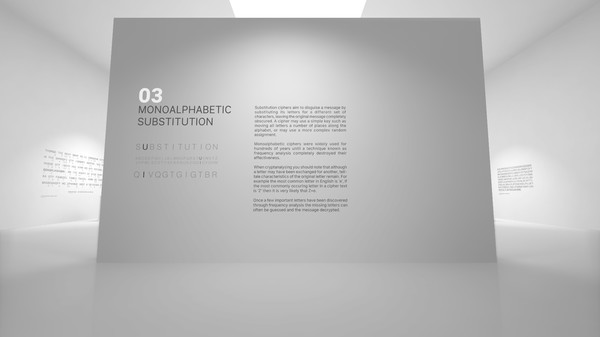 Cypher in play — Steam store screenshot, fourth in the store gallery
The Texture of Difficulty
On difficulty the review pool converges on a single metaphor: a cliff. A cliff face, a giant cliff. Positive and negative writers put it in the same place.
They agree on where that place is. Everyone clears the monoalphabetic rooms. People stop at polyalphabetic substitution and at the Enigma-grade machine material. I found no review arguing that the step there is gentle.
From what I read, the difficulty splits three ways. Knowledge: you cannot begin without knowing the method. Labour: transcription and counting demand patience. And judgement: when the clues run out, nothing tells you whether you are wrong about the method or wrong about the arithmetic. The third is the heaviest.
Each puzzle carries exactly one hint, and even positive reviewers call their quality uneven. A single rope of variable strength does very little against the third kind. So it is not enough to say the experience varies by player. What varies is how much you can bring in from outside.
 Cypher in play — Steam store screenshot, fifth in the store gallery
Reviews Consulted
This piece was written from the Steam store page's user reviews as of 2026-09-07. No review text is quoted directly; recurring claims are reconstructed instead.
・Steam: Cypher (Very Positive, 851 of 949 reviews positive = 89.7%)
・Read via WebFetch: the top 10 helpful positive reviews, the top 10 helpful negative reviews, and the 10 most recent reviews (30 in total)
・PC Gamer: Cypher is a neat, head-scratching puzzle game that'll teach you cryptography (Joe Donnelly, 2018-02-21). The professional piece ends on the pleasure of the early rooms and an admission of being stuck, and never reaches the cliff the user reviews testify to.
・Product facts (developed and published by Matthew Brown, released 2018-02-20) come from Steam's public data.
・The environment this piece was written in could not reach Steam's image CDN directly, so the images could not be opened and inspected. Their URLs were confirmed to exist through Steam's official API, and the captions deliberately do not claim what any particular frame shows.
Closing
Steam reads 89.7% positive. I put it at 7.4, well below that, and the gap is not preference. It is a different axis.
On player satisfaction the game works. For about five dollars it lays out the main historical methods and pushes curiosity outward, past its own walls. The positive reviews do not read as inflated.
On design self-sufficiency the cost of moving the solving surface outside is real. The combinatorial explosion is dissolved by outside knowledge rather than held down by in-board constraint, so whether a puzzle is solvable depends on what the player already knew. The work does not control the difficulty of its own questions.
I still would not call it a failure. Its author built the Hexcells trilogy, where everything resolves on screen, and then chose to walk outside the board. Read next to a self-contained extreme like Tametsi, that choice looks stranger and more deliberate. For the right reader it is an eight-year-old exhibit with no substitute. For everyone else, turning back at the first room is a reasonable move.
 Cypher in play — Steam store screenshot, sixth in the store gallery
Where are you with this game?
Press one and the game goes on your shelf. You can see it on your account page.
Reactions (no login)
Anonymous • one of each per visitor per day
Read next
Related reviews
Hexcells Infinite
A Minesweeper-lineage logic puzzle: find the hidden blue cells on a hex grid using only adjacency counts, line hints and consecutive/non-consecutive markers — pure deduction, no guessing. Matthew Brown's third entry layers an endless puzzle generator over 36 hand-made boards.
Into the Breach
A top-down tactical puzzle: three mechs on an 8×8 grid, every enemy attack for the coming turn shown to you in advance, and a city to keep standing. Subset Games, makers of FTL, stripped almost all randomness out of the combat itself.
SquareCells
A tiny logic puzzle that crosses Picross with Minesweeper: fill or break each square in a hidden grid using only the surrounding clues, where a number in a cell tells you how many cells it connects to. No guessing — every solution is reachable by pure deduction. By Matthew Brown, creator of Hexcells.


