REVIEW · 2022-05-19
Jelly Is Sticky
Reading the Steam reviews of a sokoban 'front door' built on few verbs
First Impressions
I write this from the Steam review pool for Jelly Is Sticky. Across the helpful positive reviews the recurring words line up: few simple rules, variety, no filler, and chill. Many reviewers list Snakebird, Stephen's Sausage Roll, DROD and Baba Is You, and half-joke that we are living in a golden age of sokoban-likes. The talk starts from that sense of lineage.
The numbers first: the label is Very Positive — 97% of 122 English reviews, roughly 95% of about 139 across all languages (snapshot 2026-07-25). Released 19 May 2022, developed by Lunarch Studios (David Rhee) and published with WhisperGames. A small pool, but a dense one.
The reserved positives and the few negatives keep returning to the same points: too easy early on, bloat across 300 levels, an unpolished UI, and a 'best ending' left unimplemented. Often praise and complaint point at the same trait — one reader's 'clean' is another's 'thin.' My job is not to stir that up but to name where the split comes from in the design.
 Header art for Jelly Is Sticky — Steam store key art
Putting the Mechanics into Words
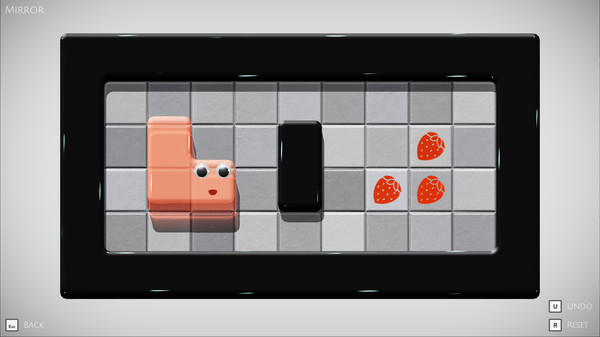
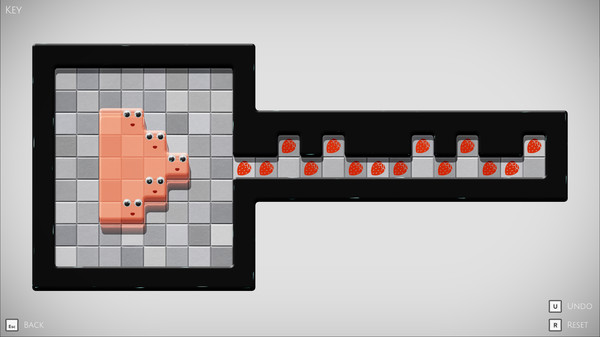
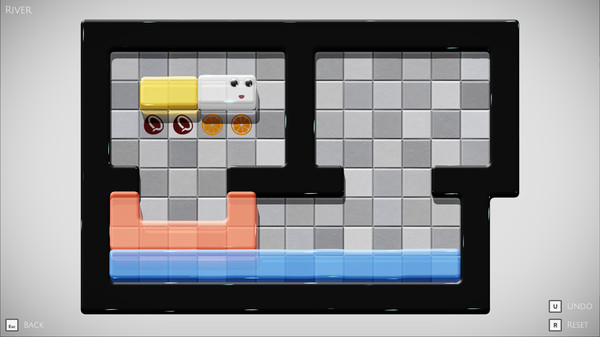
When reviewers explain the mechanics they reach the same skeleton: four jelly types with different properties — sticky, rigid, deformable — that you push, stick together, and reshape into footholds or tools. No story, no tutorial; each new jelly arrives with a few soft-ball puzzles that teach its property. As one review puts it, 'only four blob types, each with its own unique and meaningful mechanism.'
This is what Puzzlebyrinth calls subtraction of verbs. The player's verbs are pared to a handful — push, stick, deform, undo. The praise reviewers repeat, 'the restraint of not layering new mechanics onto the hard levels,' is exactly that subtraction. Few verbs make one legible grammar, and the boards speak only in it — the same way Sokobond or Baba Is You lean on a small toolkit for readability.
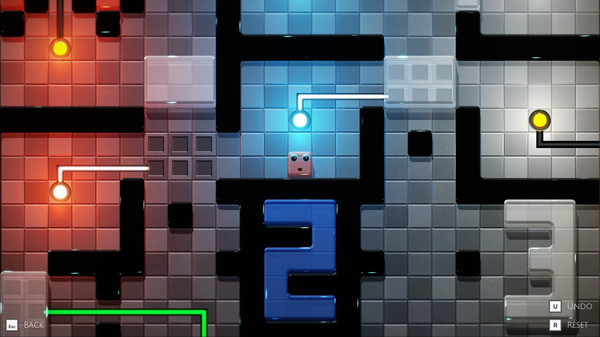
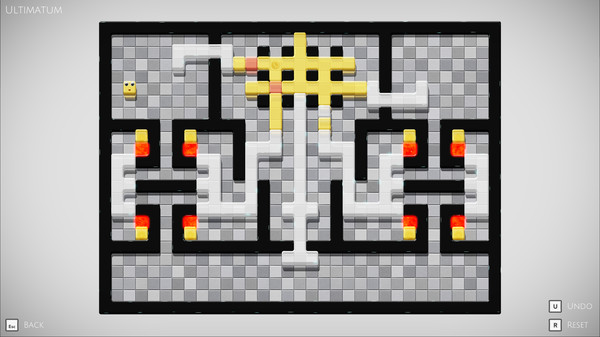
From that grammar the late game becomes a combinatorial explosion. 'Just as you learn strawberry jelly, grape jelly shows up, and soon you're juggling combos of several in one board,' one writes; another says some puzzles feel like picking a lock or a claw machine. Four elements, but their interactions multiply — more states to watch is the difficulty itself.
 Main store capsule for Jelly Is Sticky — Steam store key art
The Texture of Difficulty
Opinions on difficulty split cleanly. Most say it ranges from 'too easy' to 'quite difficult' but leans easy; 'the first stretch is too easy, then it picks up,' 'the late game has some real head-scratchers.' A few groan, 'why are sokobans this hard?' The same game can be told as easy and as hard — and that range is the clue.
In design terms this is a game where the learning curve is foregrounded. Reviewers note again and again that each area only needs a fraction of its puzzles solved to advance. That escape hatch, plus the gentle opening, deliberately lowers the wall of failure. When several call it 'a taste of what makes Baba Is You great, with the barrier drastically reduced,' they are naming its reach. Its intended audience differs from the mercilessness of Snakebird.
So 'too easy' versus 'just right' is not a ranking but a question of reach. Players who want sharp difficulty from the first minute will find it thin; those who enjoy a rule settling into the hands, or who want a way into the genre, are well served. The author aimed at the latter — and the way the reviews split makes that aim clearer, not muddier.
 Store hero capsule for Jelly Is Sticky — Steam store key art
Place in the Lineage
Reviewers measure Jelly Is Sticky on two axes. One is the difficulty lineage — Stephen's Sausage Roll, Snakebird, DROD, Patrick's Parabox, the modern sokobans that dive deep on few rules. The other is volume and progression: 'more puzzles than a Professor Layton game,' 'areas open as you solve enough, like Mario 64.'
As positioning, this is a design that deliberately takes the entry-point role within a lineage known for sharp difficulty. The praise '300 levels with no filler' and the complaint '300 levels, so some bloat and gimmicks' are two sides of the same volume decision. A wealth of handmade boards can read as rich variation or as padding — which one depends on how much a player savors variation.
Press coverage is thin, so the verdict rests on user reviews. The wound they keep naming is the 'best ending' achievement left unimplemented (later removed by the developer, several reviews report) and a rough menu whose labels overrun their boxes. The better the design, the more such unkept promises show. The review pool records that debt honestly too.
 Library hero banner for Jelly Is Sticky — Steam store key art
Sources
This piece was written by reading the Steam store and community user reviews as of 2026-07-25. No review text is quoted directly; typical claims are reconstructed.
・Steam: Jelly Is Sticky (Very Positive; 97% of 122 English reviews, ~95% of about 139 across all languages; snapshot 2026-07-25)
・Read via WebFetch: roughly the top 10 helpful positives (All Time), the representative negatives, and several recent reviews
・Developer, release date, genre tags and asset data cross-checked against the Steam store page and SteamDB (app/1492620)
Closing
Jelly Is Sticky is a game whose verdict splits quietly but coherently. If you love few verbs and 300 handmade boards, it is a calm, un-tiring way in. If you want sharp difficulty or a polished finish, the gentle opening, the rough menus and the unkept promise will catch. Both reactions follow from one design choice, faithful to subtraction and accessibility.
Steam's overall sits near 95%, but from a design view I give it 7.5. The restraint of not stacking new mechanics, and the craft of sustaining 300 levels on variation, are real. Yet the late-game padding, the unfinished menus and the missing best ending are genuine weaknesses, and I discount for them. Not sharpness but the settling-in of a rule — as an entry point to the sokoban, this one truly works.
 Library vertical capsule for Jelly Is Sticky — Steam store key art
Where are you with this game?
Press one and the game goes on your shelf. You can see it on your account page.
Reactions (no login)
Anonymous • one of each per visitor per day
Read next
Related reviews
Return to Monkey Island
A point-and-click adventure in which series creator Ron Gilbert returns, three decades on, to the pirate comedy he left unfinished. It replaces the old verb menu with a single context-sensitive interaction, adds an in-world hint book that opens solutions in stages, and sends Guybrush Threepwood after the Secret of Monkey Island once more.
Hyperbolica
A first-person non-Euclidean adventure set in towns built from hyperbolic space, where parallel lines refuse to stay parallel, and spherical space, where distant objects look larger; you talk to residents and play races, skiing and snowball fights to build an intuition for the place. Made by CodeParade, who wrote the rendering pipeline from scratch.
Dorfromantik
A hand-painted tile-placement puzzler: draw one hexagonal tile at a time and rotate it so its forests, fields, houses, rivers and rails line up with their neighbours. Complete quests to win tiles back and keep the village landscape growing, in Berlin studio Toukana Interactive's debut.


