REVIEW · 2012-11-19
Little Inferno
A fireplace with one verb — where the verdict splits
First Impressions
The review pool agrees on its first impression to a striking degree. "Buy things, burn them, get more money to buy more" — most of the helpful positives open by explaining their own confusion in exactly those terms. Several admit their first thought was: they made a whole game out of this?
What is notable is that they do not file that confusion as a complaint. Most continue with some version of "the game wants you to feel that way." The critical side starts from the same spot and arrives somewhere else: it is a toy, not a game; it is not worth the price. One first impression becomes an entrance for one camp and a refund request for the other.
The numbers first. On Steam, 13,034 of 13,731 all-language reviews are positive — about 95%, labelled "Overwhelmingly Positive" (snapshot 2026-07-29); 95% of 5,549 in English, 98% of 84 in the last 30 days. Metacritic, meanwhile, sits at a metascore of 68 and a user score of 7.5. A gap that wide between user warmth and critical temperature is unusual, and it is what I want to read in design terms.
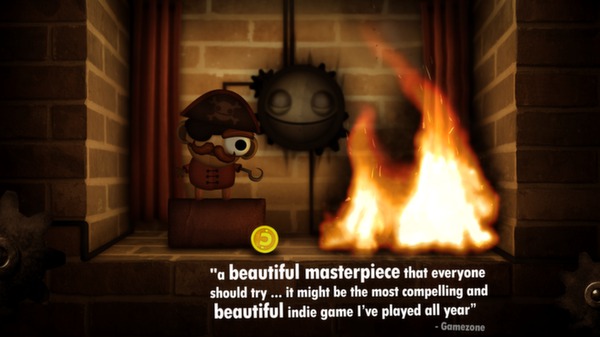 Little Inferno store header image — Steam store key art
Putting the Mechanics into Words
Put into words, the verb set contains effectively one entry: burn. Order an item from the catalogue, drop it in the fireplace, click to light it. It burns, you earn coins, you buy the next thing. In our vocabulary this is subtraction of verbs taken to its limit — the same instinct that let Human Resource Machine strip the instruction set down to thought, applied here to the act of playing itself.
So what becomes the object of thought? The pool agrees: the 99 "combos." You get a short phrase like "Someone Else's" and must pair two or three catalogue items by wordplay. One positive reviewer called it a kind of puzzle they had never encountered before. With the verbs cut to one, the thinking moves off the board and onto a vocabulary list. The thing to be solved is language, not physics.
The critical side counts exactly this as the weakness: a gimmick of combining bad puns, almost no difficulty, burned out within an hour. Both camps, I would say, describe the same design correctly. The combos do not produce combinatorial explosion — the set is finite at 99, each answer is unique, and failure costs nothing. The puzzle layer is thin. Whether thinness is a flaw belongs to the next section.
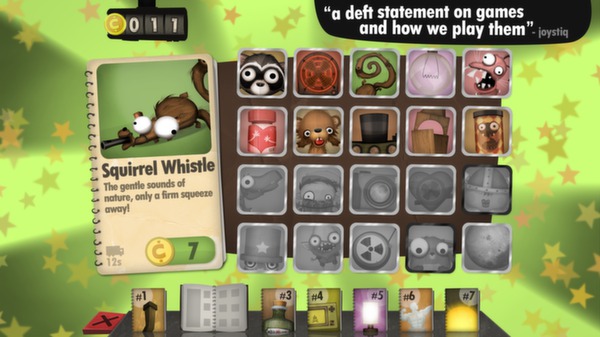 The store's main capsule image — Steam store key art
Pacing
The most repeated concrete complaint in the pool is not difficulty but waiting. Ordered items take between thirty seconds and several minutes to arrive. "I didn't mind the 30-second or one-minute timers, but some ran near three minutes, and at that point it felt like padding." "I opened another game while I waited." Both the negatives and the qualified positives say versions of this.
The positives read the same waiting as the subject matter. It makes you wait on purpose, so your hands go idle and you start thinking. One review advises believing that every seemingly monotonous task will be worth it at the end; another says the long, painful waits exist because the game wants you to feel them. The store page, meanwhile, advertises "IAP Free — no spam, upselling, ads, of any sort" and "Zero Waste." Yet the metaphor the critics reach for is a free social game with paid timer skips. Developer self-description and reader experience are pointing in opposite directions.
Restated as design: this game draws a patience curve rather than a learning curve. Waiting raises no skill and deepens no understanding of the board. It does, however, work as an apparatus for demonstrating the theme — dependence on time-killing — in the body. Spending the player's own time as the vehicle for the theme is the bet, and whether you take it is one of the forks in the verdict. Completion times cited in reviews cluster between three and six hours, with a median near four.
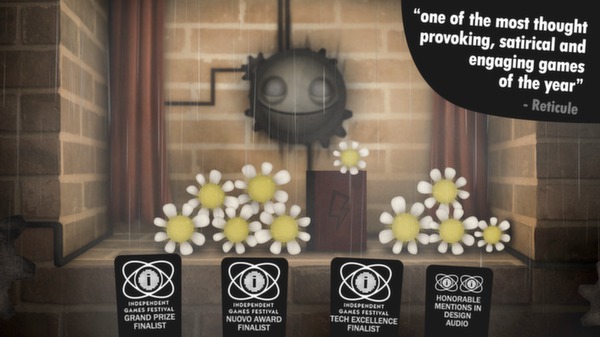 The official artwork used as the store page background — Steam store art
The Feel of the Story
Read only the positives and the subject shifts, always, to the letters and the ending: the mail from next door, the world outside getting colder, and the chimney going up up up. One long review describes dismissing the game at eighteen, deleting it from their library, and coming back at twenty-five on the verge of tears. Another says three hours of busywork all paid off at the end.
The critical vocabulary is just as consistent: vague, lazy, explains nothing, cinematic cues for something profound with nothing behind them. On Metacritic's user reviews, this whiff of an ending is the single most common deduction, and the critical metascore of 68 seems largely to come from the same place.
The difference, I think, is not effort of interpretation but shape of expectation. This story does not plant and pay off in order to fix a meaning. It offers the time the player has already spent as evidence and hands interpretation back. It is the same structure that splits opinion on the ending of INSIDE: a whiff to readers who want closure, sufficient to readers who want materials. One writer also quit partway over the sheer number of animals you are asked to burn (a GameGrin feature) — there are people who reliably fall outside this game's reach.
 The wide key art used in the Steam library — Steam store key art
Sources
This piece was written by reading the Steam user review pool and its surrounding material as of 2026-07-29. It is a reading of reviews, not a play diary.
· Steam: Little Inferno (13,034 of 13,731 all-language reviews positive, about 95%; "Overwhelmingly Positive"; 95% of 5,549 in English, 98% of 84 in the last 30 days)
· Read: the top 10 helpful positives (All Time) and three July 2026 reviews surfaced on the app hub
· The critical side was assembled from roughly 15 low and mixed scores on Metacritic's PC user reviews (58%% positive / 33%% mixed / 9%% negative; metascore 68, user score 7.5) and the Steam thread "This product is not a game, but rather it is like a toy." The negative-sorted Steam review page could not be retrieved from this environment, which I note for the record.
· Press: GameGrin, "Why I Hate Little Inferno Despite Loving It"
· The figures in this piece are official Steam store assets (header, capsule, library key art, store background). Image files could not be downloaded and inspected in this environment, so the captions state only the asset type and make no claim about depicted content.
Closing
In closing: Little Inferno cuts the verb set to one and pours wordplay, waiting and letters into the space that opens up. Come looking for puzzle depth and it is reliably thin. But on the single point of making the structure of time-killing itself the thing you play, its design was remarkably precise for 2012.
My score departs a little from Steam's ~95%: 7.8. The deduction sits with the combos, not the timers. Ninety-nine pairings, finite and unique, with no cost to failure — a platform for the theme, but never quite a place to think. The theme is strong; the puzzle bones are thin. I label the difficulty "easy," which is not a selling point so much as a note that resistance was never the aim.
For: readers who welcome short works that look back at the act of playing, in the way Unpacking does. Not for: those who put the snap of a solution at the centre. The line the critics keep repeating — "buy it on sale" — looks like a price argument but reads to me as a statement of reach: how much is a theme delivered in three or four hours worth? That one is for the reader, not the design, to settle.
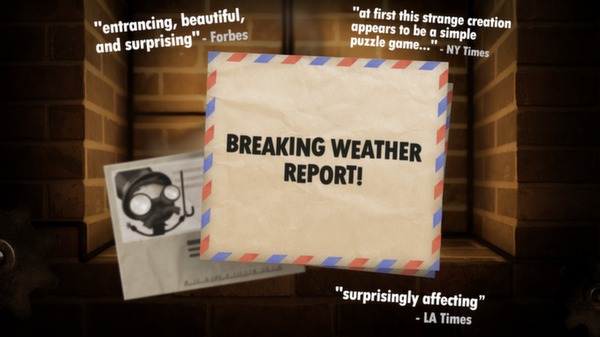 The store's hero capsule image — Steam store key art
Where are you with this game?
Press one and the game goes on your shelf. You can see it on your account page.
Reactions (no login)
Anonymous • one of each per visitor per day
Read next
Related reviews
Scribblenauts Unlimited
Type a noun and the thing appears: a jetpack, a dinosaur, a scalpel. You use whatever you summoned to help the people around you and collect Starites across a hand-drawn 2D world. Adjectives change what you make, and an editor lets you build objects of your own. From 5th Cell.
Primordia
A 2D point-and-click adventure in which a robot called Horatio and his small companion Crispin lose their power core and descend into the city of Metropol. You combine salvaged parts to restart broken machines, and read the ruins for traces of who built you. Made by Wormwood Studios and published by Wadjet Eye Games.
Thomas Was Alone
A 2D puzzle-platformer in which you switch between coloured rectangles, each given exactly one ability, and combine them into stepping stones across 120 levels. A narrator reads out what the shapes are thinking as you go. Released in 2012 by Mike Bithell's Bithell Games.


