REVIEW · 2012-11-19
Scribblenauts Unlimited
One side grades the word they typed, the other grades the answer key — reading 5,347 reviews
First Impressions
Line up the most helpful positive reviews and the first surprise is what they are about. Almost all of them report what the writer typed. A shotgun solves ninety percent of problems. A katana performed the surgery. A cat with a jetpack cleared the cliff. Each of these carries hundreds of votes.
What is missing is the board. Not one of them describes a layout, or how it was read, or what the intended shape of the solution was. What gets written down is a single word pulled out of the writer's own vocabulary, and the absurdity that followed.
Meanwhile the single most-voted review on either side is a negative one. Too simple for an adult, it says. The errands repeat. Creativity is the selling point, yet creative solutions are not rewarded.
So in this review pool the positive side is grading the input box and the negative side is grading the answer key. They read like two different products shipped in one box. That mismatch is what I want to follow.
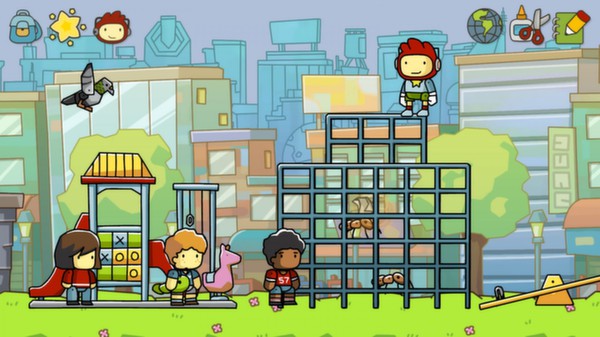 Scribblenauts Unlimited — Steam store screenshot #1
Putting the Mechanics into Words
The system is plain enough. Open the notebook, type a noun, and the thing appears in front of you. Add an adjective and it turns red, or huge, or on fire. Then you pick it up and carry it to whoever needs it.
What is worth noticing is that only the nouns grow. The verbs stay at roughly three: summon, attach, hand over. The dictionary is enormous, and yet what any given object can do is startlingly small.
On this site we have called the practice of cutting verbs to gain depth subtractive design. This game runs the operation backwards. The verbs hold still while the nouns explode.
The combinatorial explosion therefore happens only at the entrance. At the exit, the check is reading a handful of properties: does it fly, does it cut, does it burn. A wide door in, a narrow door out. The positive reviews are standing at the first door and the negative ones at the second.
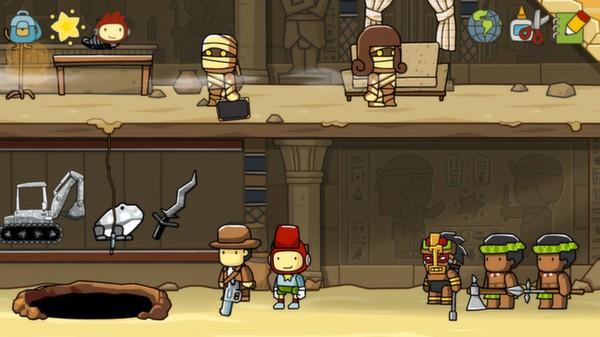 Scribblenauts Unlimited — Steam store screenshot #2
The Texture of Difficulty
The most-voted Japanese negative review says the answers have no give in them. The same writer adds that it has become a game of guessing the riddle's answer. The English negative side says the same thing differently: it calls itself unlimited, and then accepts about three things.
What is striking is how that narrowness turns into a different kind of value in the Japanese pool. It is good English practice. It is fun with a dictionary open. It teaches spelling. The difficulty has moved off the board and onto the player's vocabulary.
The autocomplete comes up too. It is clever enough that you cannot type loosely, which means there is a dictionary standing at the entrance as well. One Japanese reviewer admits that by the back half they had run dry and kept reaching for the same few words.
As difficulty design this is an unusual shape. The board stays easy on purpose, and getting stuck has been outsourced to something outside the game entirely — your language and your dictionary. That is how "far too easy" and "the English is hard" can live in the same review pool.
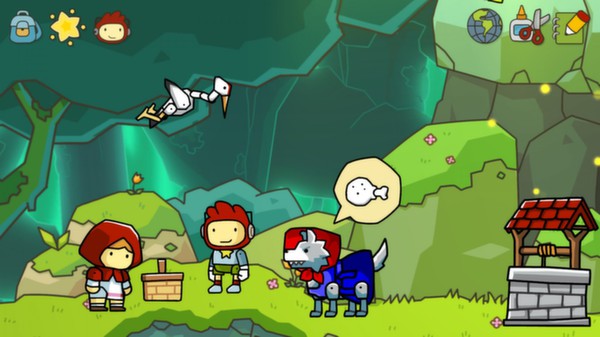 Scribblenauts Unlimited — Steam store screenshot #3
Design Craft
So were the designers simply careless? The opposite, I think. The game is full of devices that pull the answer back toward one.
One is the notebook and the merit board. They record what you have tried, what is still missing, and nudge you along. One negative reviewer says this turns the puzzles into data entry. A hint dissolves the blockage and shortens the search at the same time.
The other is that every request arrives as a sentence. I am hungry. I want to get up there. Because the demand is written in words, the answer can be given back in words, and the board never has to be read.
The published record indicates that this entry dropped the budget meter and allows up to sixty objects at once. Several reviewers also mourn the action stages that the handheld games had. What was subtracted here was not a verb. It was the room to fail.
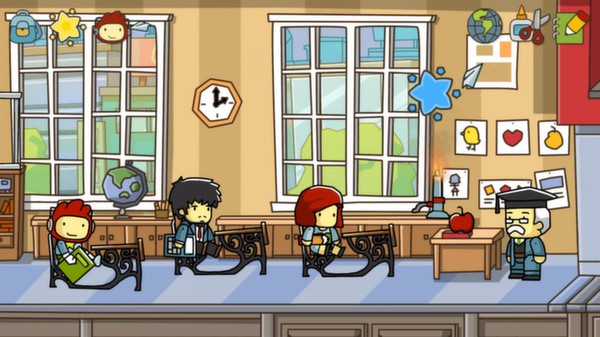 Scribblenauts Unlimited — Steam store screenshot #4
Sources
This piece was written from the Steam store page and the Steam Community review pool as they stood on 26 August 2026.
・Steam: Scribblenauts Unlimited (Very Positive; 93% of 5,347 reviews, 92% of 27 in the last thirty days)
・SteamDB (roughly 12,000 reviews across all languages, 91.4% positive) and Metacritic (PC: 75 from 14 critics; user score 7.7 from 149 ratings)
・Read in full: the ten most helpful positive reviews, the ten most helpful negative ones, the ten most recent, and the ten top-rated Japanese-language reviews. Background facts were checked against the Wikipedia article.
・The images are screenshots published on the Steam store page. This session could not reach the image CDN directly, so their contents could not be inspected; the captions therefore give only the store ordering rather than describing what is shown.
Closing
The tallies, for the record. As of 26 August 2026 Steam's label is Very Positive: 93% of 5,347 reviews, and 92% of 27 in the last thirty days. Across all languages SteamDB has roughly 12,000 reviews at 91.4%. Critics sit at Metacritic 75 from 14 reviews, with a user score of 7.7 from 149 ratings.
I give it 6.8. That is a gap against 93%, and the reason is simple: I am grading the exit. The pleasure at the entrance — type anything and something happens — is real, and on that point the 93% is right and I am not.
Other games sell the width of their solution space. Mosa Lina takes responsibility for that width by announcing up front that some boards cannot be solved. This one makes no such announcement, and joins a wide entrance to a narrow exit with a very short corridor.
Who it suits is clear enough. People who enjoy the act of thinking of a word, people building English vocabulary, people playing beside a child. Who it does not suit is anyone buying the hours spent reading a board for its one available move. That is not a failure of design. It is a question of range.
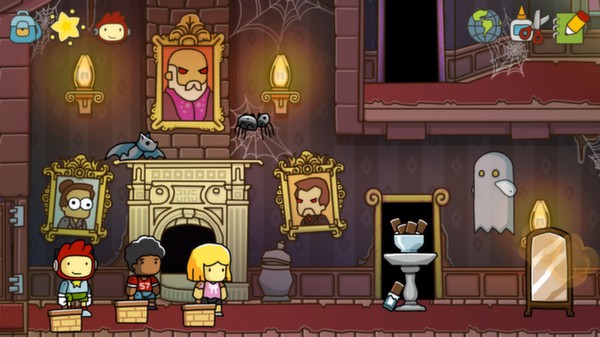 Scribblenauts Unlimited — Steam store screenshot #5
Where are you with this game?
Press one and the game goes on your shelf. You can see it on your account page.
Reactions (no login)
Anonymous • one of each per visitor per day
Read next
Related reviews
Botanicula
A hand-drawn point-and-click adventure from Amanita Design in which five small tree creatures carry the last seed out of their home tree, now infested by parasites. There is no dialogue: you poke at more than 150 locations and pick your way forward by the sounds and movements that come back. Music by the Czech band DVA.
Little Inferno
A 2D point-and-click that plays out entirely in front of a fireplace: order toys from a catalogue, burn them, watch how each one goes, and pair two or three of them by wordplay to find 99 "combos." Released in 2012 by Tomorrow Corporation, the studio behind World of Goo.
Unmechanical
A 2.5D puzzle adventure in which you guide a small creature through a mechanical world, reading its contraptions to get out. A game by Talawa Games.


