REVIEW · 2023-03-28
Terra Nil
The Order-of-Operations Puzzle They Called a City Builder: Reading the Gap Between 86% and 6.9
First Impressions
Terra Nil has you turn wasteland back into living land. The store calls it a reverse city builder: scrub the soil, run water, plant forest, bring the animals back. It was made by Free Lives and Clockwork Acorn in South Africa, published by Devolver Digital, and released on PC on 28 March 2023. It began as a Ludum Dare 45 entry in 2019.
I am writing this from the Steam review pool, not from notes of my own play. The numbers first: 4,877 reviews at 86% positive, labelled Very Positive; the last 30 days sit at 85% of 64 (snapshot 2026-08-22).
Change the vessel and the number moves. OpenCritic collects 52 critics and reports 82. The Metacritic user column shows 6.9 from 57 ratings, marked Mixed. One game, three scoreboards: 86%, 82, 6.9.
What splits the pool is not whether the game is good. It is what to call it. The store says reverse city builder; the reviews keep correcting that to puzzle. The gap between those two words is the gap between the numbers.
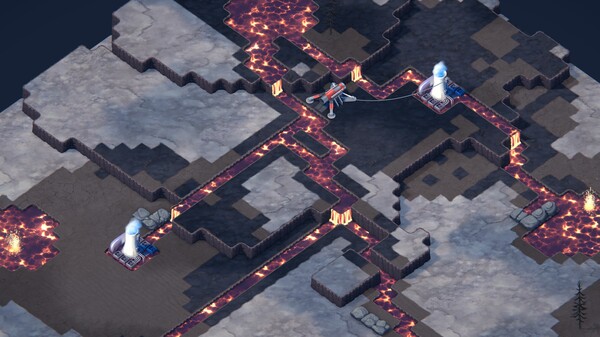 A gameplay view of Terra Nil — Steam store screenshot
Putting the Mechanics into Words
Pull the verbs out of the pool and there are very few. Place, and at the very end, remove. You cannot put a machine anywhere you like either: some only sit on dry rock, others only beside water.
So the question is not placement but order. PC Gamer calls it an order-of-operations puzzle and says it owes more to solitaire than to city building. Terrain made by one move is the ground for the next. In our terms, the grammar reduces to a single word: adjacency.
How a reviewer names that structure is how they vote. A low Metacritic score calls it terraforming tetris and finds it dull. A forum post insists it is closer to Portal than to Tetris. Opposite labels, the same object: few verbs, one narrow line of correct order.
There is no combinatorial explosion here. Options do not multiply as you play; the places you may build shrink. Where Dorfromantik narrows your choices with the tile it deals you, this game narrows them with your own previous move. Under the soft art runs a dry optimisation problem.
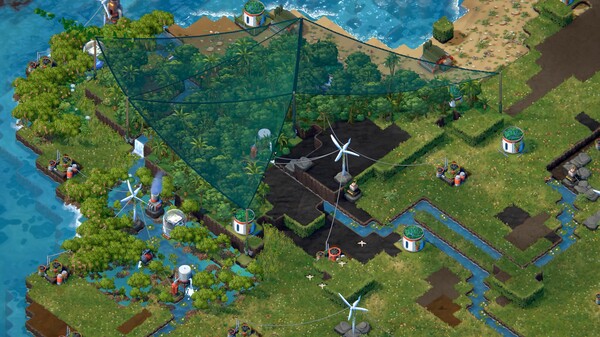 A gameplay view of Terra Nil — Steam store screenshot
Subtraction
The single most praised move in this game is its last one. Once the land is green you recycle every machine you built, load it onto an airship and leave without a trace. When reviewers say they love the idea, this is almost always the idea they mean.
Building games normally end in addition. Here your own structures are the final thing costing you points. Subtraction is not an epilogue for atmosphere; it is scored. That is a rare arrangement.
The negative side presses on the same spot. Forum posts complain that recycled sites leave patches of wasteland behind. Others note that machines cannot be removed until the endgame, so placement has to anticipate the clean-up. Tidying is not a free finale; it is a constraint acting from the first move.
A four-out-of-ten on Metacritic says the ecology is finally just abstract numbers. That reading is correct. But it is precisely because the traces are numbers that they can be scored, and the closing subtraction can mean anything at all. The game trades ecological realism for design consistency.
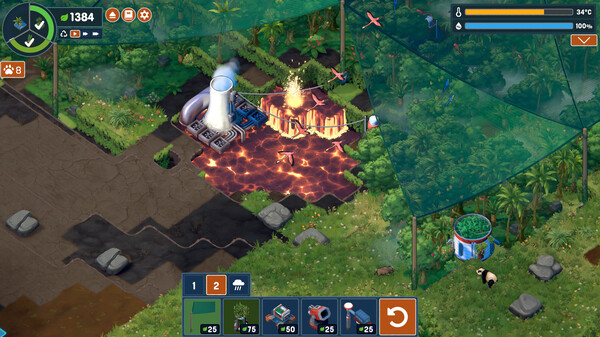 A gameplay view of Terra Nil — Steam store screenshot
The Texture of Difficulty
Relaxing and infuriating sit side by side in the same pool. A twenty-hour positive calls it a game for chilling at home alone. A thirty-one-hour positive calls it challenging and calming at once. And yet the pool keeps repeating that perfectionists will suffer.
Read enough of it and the difficulty separates into three kinds. First, simply finishing a map is easy; PC Gamer says as much. Second, chasing a perfect score turns hard fast, and because the maps are procedural, some layouts cannot produce one at all.
The third kind is not difficulty. No save-and-quit mid-map, menus that lock the interface, animal pathing that jams late on: that is most of what a thirty-five-hour negative actually lists. Those are procedural frictions, not puzzles. Arguments stall because all three get called the same thing.
In kind, this is not a game you fail to solve; it is one you cannot take back. The unit of retry is a whole map, and the map is different every time. A position with luck in it is presented to an optimising eye. That, I suspect, is the real fault line in the reviews.
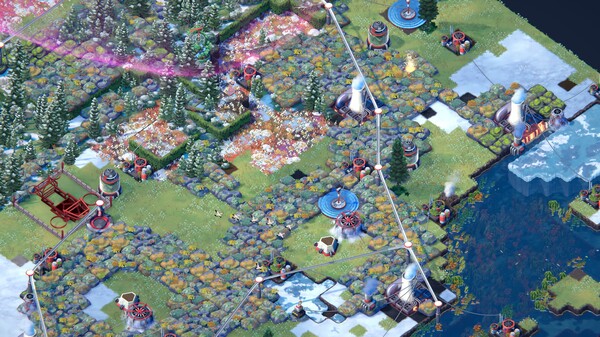 A gameplay view of Terra Nil — Steam store screenshot
Pacing
The loudest complaint is length. The base campaign is four maps, roughly four to six hours end to end. A three-out-of-ten on Metacritic counts eight puzzles of which four are reworks, and calls it overpriced at full price. Among critics, IGN Italy says it lasts a little too little.
But this pool spans three years. The free Vita Nova update of 25 June 2024 added five missions and changed animals from something you place to something that migrates in when the habitat can hold it. The free Heatwave update of 7 August 2025 added three arid maps, thirteen animals and a photo mode.
And still the last 30 days read 85% of 64, essentially the same as the lifetime 86%. The additions have not removed the complaint so much as left it where it was. People saying it is short are talking about the shape of one run, not the amount of content.
That also explains the spread in the numbers. Steam is a two-way thumb. Someone who thinks good, but short clicks Recommended on Steam and types a 6 or 7 on Metacritic. 86% and 6.9 are not in conflict; they are the same opinion poured into vessels with different markings. The argument around Unpacking had the same shape.
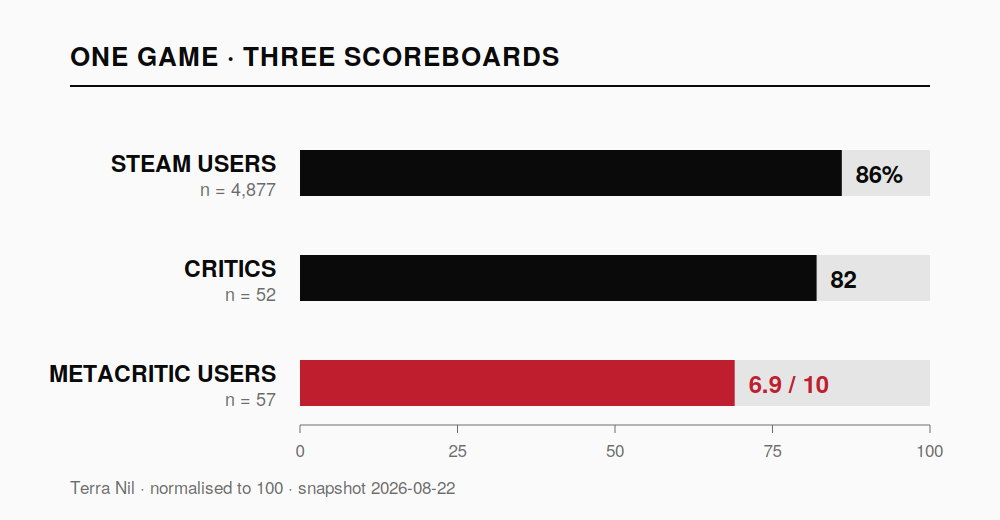 Three scoreboards for one game: Steam users 86% (n=4,877), critics 82 (n=52), Metacritic users 6.9/10 (n=57), normalised to 100 — diagram, snapshot 2026-08-22
Sources
Written from the Steam user review pool and the surrounding aggregates as of 2026-08-22. No review text is quoted directly; typical claims are reconstructed.
- Steam: Terra Nil (Very Positive — 86% of 4,877 reviews; 85% of 64 in the last 30 days)
- Read in full: the 7 reviews served by the Steam Community top-rated list — 6 Recommended, 1 Not Recommended, 2.9 to 35.5 hours played. The separate helpful-sorted positive and negative pages could not be retrieved this time, so the 20–25 target was not met.
- Supplemented with 12 individual Metacritic user reviews (6.9 from 57 ratings: 28 positive, 20 mixed, 9 negative) and one Steam discussion thread.
- Critics: OpenCritic (82 from 52 reviews), PC Gamer (80), IGN Italy and Game Informer (7.5 each), Steam Deck HQ, and the reception section of Wikipedia.
- On images: Steam's image CDN was unreachable from this run, so the screenshots could not be inspected. Four official screenshots whose URLs were confirmed on the store page are used, with generic captions naming only the game and the asset type. The one comparison chart is my own.
Closing
I settled on 7.8 — below Steam's 86%, above the 6.9 from Metacritic users. The reason for the upper half is clear: the closing move, erasing yourself from the map, is scored rather than staged. Few games this small in verbs hold together this consistently.
The reason for the lower half sits in the same place. That move surprises you exactly once. The skeleton of the order is the same from map to map; only the terrain deal changes. The free updates added maps without changing the shape of a run, so the complaint about length is fair.
Who it suits is unusually clear-cut. If you want to assemble an order of operations inside quiet art and sound, it suits you very well. If you want the feel of expanding and commanding a board, it does not. Anyone thinking of the pleasure of drawing a line in Mini Metro is closer to it than anyone thinking of city building.
The split in the pool is less a flaw in the game than a problem with its sign. Reverse city builder catches the eye, but what you are handed is an order-of-operations puzzle. Had that one word been swapped before purchase, I suspect the 6.9 would sit a little higher.
Where are you with this game?
Press one and the game goes on your shelf. You can see it on your account page.
Reactions (no login)
Anonymous • one of each per visitor per day
Read next
Related reviews
The Tartarus Key
A first-person puzzle adventure with no combat: a woman wakes in a mansion full of traps and puzzles and tries to escape while rescuing other captives. By Vertical Reach.
Planet of Lana
A cinematic side-scrolling puzzle adventure in which a girl named Lana and her small companion Mui cross a machine-invaded planet in search of her sister. Its verbs are few — walk, climb, push, and point the companion somewhere — and the story is carried by hand-painted backdrops and an invented spoken language.
Underground Blossom
A point-and-click escape puzzle that rides down seven metro stations through the life of a woman named Laura. You buy a ticket, search each room, and reassemble the pieces of her memory. A 2023 release from Rusty Lake, the studio behind the Cube Escape series.


