REVIEW · 2019-04-02
The 7th Guest: 25th Anniversary Edition
The house survived, the puzzles did not — reading a pool where neither side defends them
First Impressions
The Steam page reads Mostly Positive: 77% of 263 reviews (2026-09-18 snapshot). Counted across all languages without the purchase filter it is 216 of 280 — the same 77%. For a reissue of a 1993 landmark, that looks unremarkable.
Read the two sides next to each other, though, and they do not meet. What the positive side praises and what the negative side attacks are not the same object.
The top negative review, 277 votes, reports that this is the mobile build of a few years ago dropped onto PC with little changed: stretches at 15fps, coarse upscaled actors, crashes when loading a save. Every line of it is about the 2019 package.
The top positive reviews are about the 1993 mansion instead — the pioneering FMV horror, the score, the first CD-ROM someone ever owned. And neither side defends the puzzles. That is where this review starts.
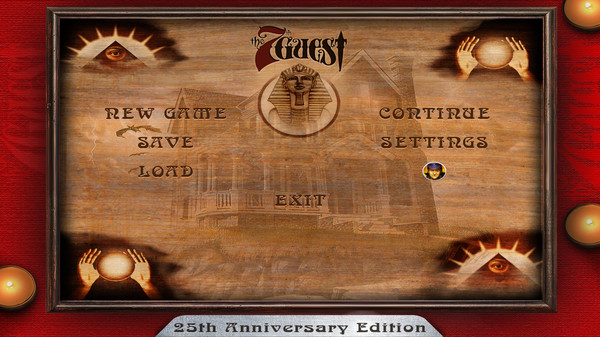 The 7th Guest in play — screenshot 1 as listed on the Steam store page (Steam store screenshot)
Putting the Mechanics into Words
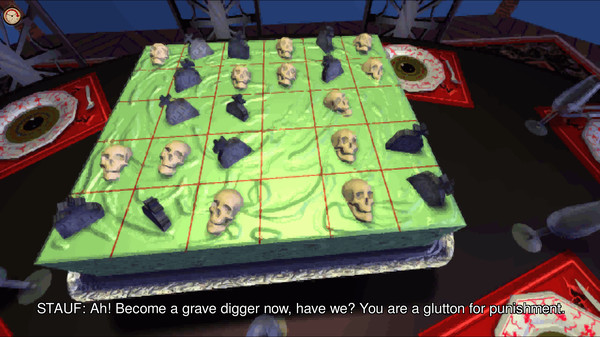
There is no verb running through this game. You walk the house, enter a room, and solve whatever has been installed there. The contents are an Ataxx board on a microscope slide, a chess problem, a cake to divide, mazes, letters picked out through a telescope. Abstract puzzles that already existed, placed one per room.
So the puzzles are guests too. They were invited in and seated; they did not grow out of the house's grammar. In the escape room and puzzle box lineage, the fiction of a room and the logic of its device usually continue into each other. Here that join is cut.
The learning curve therefore resets at every door. Nothing you worked out in the last room applies in the next. The line from the positive side — "part Clue, part Myst" — is a compliment and an accurate structural description at the same time.
In Puzzlebyrinth's terms this is collection, not subtraction. Rather than cutting the verb list down and digging deeper, the game gathers ready-made puzzles and lines them up. Twenty-one contraptions here are closer to twenty-one separate small games.
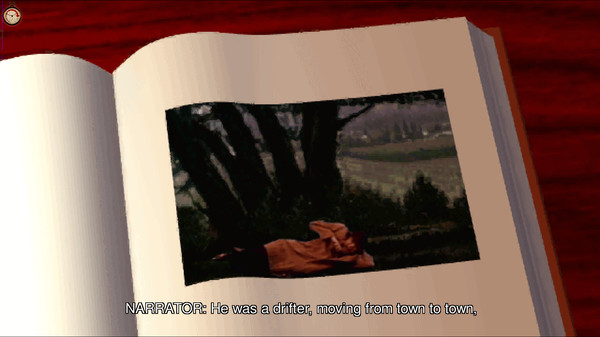 The 7th Guest in play — screenshot 2 as listed on the Steam store page (Steam store screenshot)
The Texture of Difficulty
The pool names its walls, and they cluster. The microscope board reviewers call Reversi. A chess problem that assumes you know chess. The knife and the cake. Reports of stopping there appear on both sides.
The telling part is how the positive side phrases it: funny and clever, right up until the hard puzzles — and then a thumbs up anyway. The amount of difficulty is not in dispute. The quality of being stuck is.
The negative side puts words to that. This is trial and error, not deduction. One review calls the late puzzles high-difficulty and low-effort at once. The old complaint that a randomised picture puzzle can deal an unsolvable layout is still being written down.
The house does offer a bypass. The book in the library answers three times per puzzle, and past that it simply solves the thing for you. Difficulty is not tuned here; a side door is installed instead. Crude, but not hidden.
 The 7th Guest in play — screenshot 3 as listed on the Steam store page (Steam store screenshot)
The World
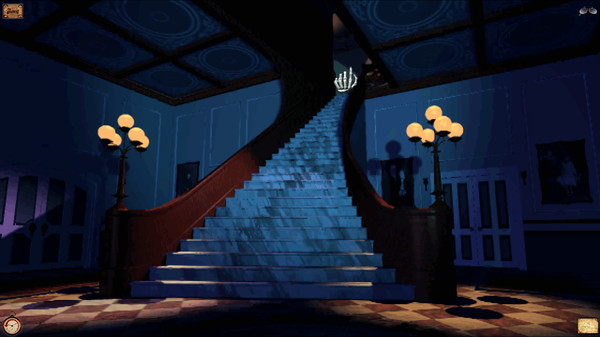
So what is the positive side buying? The mansion. Live actors composited into pre-rendered rooms, the six guests' pasts replaying in fragments. In 1993 nobody had seen this.
The positive vocabulary is remarkably uniform: atmosphere, the music, a relic of the '90s, memory. Recorded playtimes bunch around 400 to 650 minutes, so most of these people walked the house to the end while complaining about it.
The negative vocabulary is just as uniform, and points somewhere else: 15fps, an upscale filter like a strange oil painting, interlacing left in the actors, the map removed, clicks that miss. Every one is a complaint about the playback machine, not about the house.
This is not one feature read two ways. The two sides are appraising two different objects. The 77% is less a ratio of approval than a ratio of which object people came for.
 The 7th Guest in play — screenshot 4 as listed on the Steam store page (Steam store screenshot)
Reviews Consulted
This review was written from the Steam store page and the Steam review API as of 2026-09-18.
・Steam: The 7th Guest: 25th Anniversary Edition (store view: 77% of 263 reviews, Mostly Positive; all languages without the purchase filter, 216 of 280 = 77%)
・45 reviews read in full: the top 20 positive and top 15 negative by helpfulness, plus the 10 most recent. Recent reviews stop in spring 2024, so the pool is no longer moving.
・The 1993 credits, sales figures and the library hint system (three consultations per puzzle, then an automatic solve) were checked against Wikipedia.
・The store page for The 7th Guest Remake (Vertigo Games / Exkee, 3 June 2026) was also consulted (86% of 241 reviews).
・The images are screenshot URLs returned by Steam's appdetails API, used verbatim. This environment could not download the image files, so their contents could not be inspected; the captions deliberately do not claim what is depicted.
Closing
I give it 6.5, below Steam's 77%. The deduction is not about the port. It is that the puzzles do not grow out of the house. The rooms are wonderful; the rooms and the devices having nothing to do with each other is the design weakness.
Recorded playtimes scatter from 6 to 11 hours, with completions bunching at 7 to 8. I put difficulty at Hard, because the walls are few and concentrated and the library book will carry you past them.
One recent development belongs here. On 3 June 2026 a ground-up remake from Vertigo Games and Exkee arrived on Steam. Its store page says the performances were captured volumetrically in 3D and that every puzzle was rebuilt from scratch. It sits at 86% of 241 reviews.
What the rebuilders preserved was the house and its guests; what they threw away was the puzzles. That is a verdict about where the work lives. It points the opposite way from Myst's 2021 edition, which carried the island and its puzzles across together.
If you want to see what happened in 1993, this edition is still worth an evening. If you are playing it as a design lesson, there is exactly one thing to take away: providing rooms does not by itself produce a grammar. That is not a cheap lesson.
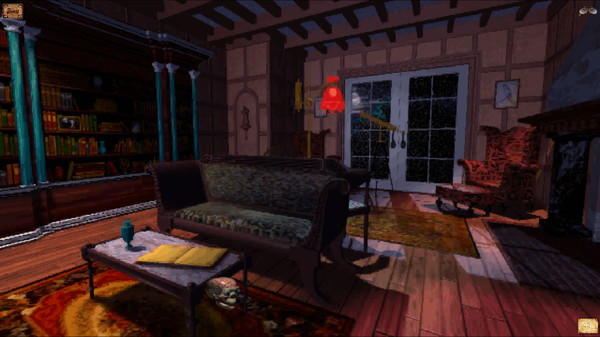 The 7th Guest in play — screenshot 5 as listed on the Steam store page (Steam store screenshot)
Where are you with this game?
Press one and the game goes on your shelf. You can see it on your account page.
Reactions (no login)
Anonymous • one of each per visitor per day
Read next

Related reviews
Trüberbrook
A point-and-click adventure in which Hans Tannhauser, an American physicist who has won a trip to a remote West German village in 1967, chases a stolen physics paper and walks into a story about another dimension. Made by the German studio btf, with sets built as real miniatures and photographed.
The House of Da Vinci
A first-person escape puzzler set in Florence, 1506: in the workshop of a vanished Leonardo you use a lens that sees inside objects and a device that replays the past, opening one wood-and-brass contraption after another. Built around nesting — every solved mechanism opens into a further one — by Slovakia's Blue Brain Games, 2017.
Moncage
A wordless optical-illusion puzzle adventure. Each face of a glass cube holds a different world, and rotating your view until two silhouettes line up locks them into a single mechanism. You move between a factory, a lighthouse, an amusement park and a church, picking up scattered photographs that assemble the story of a father and a son. From Optillusion.


