REVIEW · 2019-03-12
Trüberbrook
The hand-built village is adored; the puzzles are hit for being both too easy and unfair — reading the inside of a 73.0%
First Impressions
I did not play this one. I am reading how its verdicts stacked up. Numbers first: 2,343 Steam reviews, 1,711 positive against 632 negative — 73.0% positive, sitting in the 'Mostly Positive' band (snapshot 2026-08-27). For a game whose village was built by hand, that is lower than I expected.
The critics are harsher still. Metacritic's PC page holds a 66 from 25 reviews, filed under 'mixed or average', and its user score is 5.7 from 44 ratings. The three aggregates step downward in order: Steam, then critics, then Metacritic users.
The shape of the complaints is the odd part. 'The puzzles are too easy' and 'the solutions are unguessable and I needed a walkthrough' sit side by side in the same review feed. The twist resembles the one I followed in Deponia, except that here one reviewer will often write both lines. That contradiction is my way in.
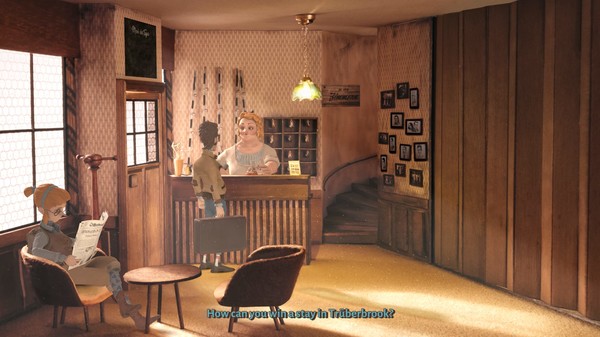 Trüberbrook — Steam store screenshot
The World
The praise converges on one thing: the sets were built by hand. Real miniatures were photographed, then characters were laid over them. The positive vocabulary clusters on 'gorgeous', 'stunning', 'painstaking', 'hand-built', and the negative side does not contest it. Even the outlet that scored it three out of five had no complaint about the look.
The sound runs the same way. Many reviews reach for 1960s jazz, and the music of David Lynch's films comes up again and again. The setting is a cold, remote West German village in 1967, and Twin Peaks is named from both sides of the split.
In design terms this is a world built at very high observational resolution. There is a great deal on screen and it is a pleasure to look at. As we will see, though, almost none of that resolution is spent telling you which part of it you are meant to touch.
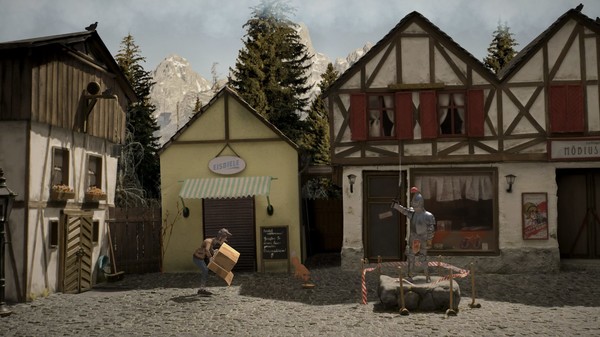 Trüberbrook — Steam store screenshot
Putting the Mechanics into Words
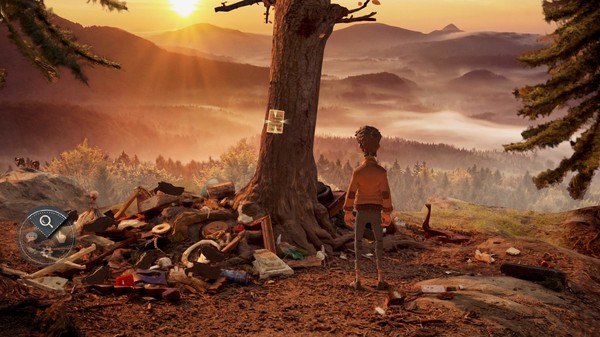
The interaction is classic point-and-click with two pieces of tidying. Click a thing and a ring of actions opens, with anything unusable here greyed out. Inventory combinations are chosen for you when a combination applies. Press space and every touchable spot lights up.
The positive side calls this 'no more rubbing every item against every item'. The negative side says the thinking step itself was taken away. In Puzzlebyrinth terms, this is not subtraction of verbs but outsourcing of search: the verbs remain, and the machine takes over the labour of trying combinations.
It is a strong decision, and it cuts both ways. Remove the combinatorial explosion and you remove the place where an insight would have landed. One reviewer wrote that if you hold the right item and click the right spot, the game will show you the use as well. Asking whether that is still a puzzle is fair. Thimbleweed Park chose the opposite at the same fork, putting the verb list back on screen and keeping the labour in the player's hands.
 Trüberbrook — Steam store screenshot
The Texture of Difficulty
So is it easy? The review pool answers: easy, and you still get stuck. Sort the accounts of getting stuck and they fall into three kinds.
First, unstated objectives — the inventory chain advances while you have no idea what you are advancing towards. Second, leaps in the solution: the cat in the tree, and calling birds down to interfere with a television signal, are the examples the negative reviews name. Third, plain back and forth — walking is slow and the later chapters send you through the same screens repeatedly.
Only the second of those is difficulty in the puzzle sense. The other two are notification and traversal. As I argued in Is Difficulty Unkind? The Philosophy of Fairness, fairness is decided by how a game notifies, not by how much difficulty it holds. That is why 'too easy' and 'unfair' can both be true here: the solution space has been folded down small, and the signpost has been taken off the exit.
 Trüberbrook — Steam store screenshot
The Feel of the Story
The story is where the aggregate sinks. Early impressions are strong. From the middle onward the reviews converge on 'it starts rushing' and 'something feels cut', and the complaint that the antagonist's motive is never explained comes from recommenders too.
The last stretch adds fetch errands and an unskippable live-music scene, a fixture of the negative reviews. Hey Poor Player, scoring it three out of five, names the imbalance directly: the story flashes past while the player walks laborious circles. Against the official blurb's claim of about ten hours, the times in the reviews cluster at five to nine.
The other recurring objection is the referencing. A Twin Peaks style habit of dictating notes, turns of phrase that recall Monkey Island, myth and history salted into the place names. Plenty is pointed at; little is cashed in. As design this is a question of allocation — the labour went to the sets. Syberia is a game whose atmosphere is strong enough to swallow a rough story; here the atmosphere was strong enough, but the running time was too short to swallow with it.
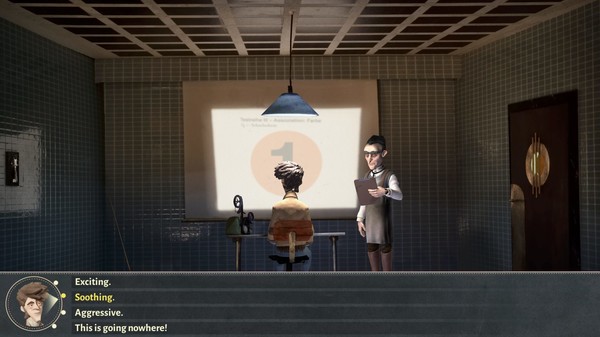 Trüberbrook — Steam store screenshot
Reviews Consulted
This piece was written from the Steam user reviews and related coverage available on 2026-08-27. No review text is quoted directly; recurring claims have been reconstructed instead.
· Steam: Trüberbrook (1,711 positive of 2,343 reviews, 73.0% positive, 'Mostly Positive' label, snapshot 2026-08-27)
· The ten most helpful positive reviews, the ten most helpful negative reviews and the eight most recent — 28 in total — read in full via Steam's review API.
· Metacritic: Trüberbrook (PC metascore 66 from 25 reviews; user score 5.7 from 44 ratings)
· Press: the Hey Poor Player review (3/5)
· Note: every image here is an official screenshot served by the Steam store. The writing environment for this piece could not open the image files themselves, so the captions stay generic rather than naming what is depicted.
Closing
I read the recent end too. The eight newest reviews I could pull were all recommendations, and all posted around December 2024. The tone assumes a discount: for the art and the sound, this is enough. It is the kind of game whose standing rises as its price falls, which lines up neatly with the launch-era reviews complaining about the price.
From a design standpoint I put it at 6.5, a little harsher than Steam's 73.0%. The deduction is not for the easiness of the puzzles but for outsourcing the search while omitting the signposts. I found no reason to discount the praise for the sets and the score.
Completion times in the reviews run roughly five to nine hours, with a median near seven. It suits players willing to spend those hours on a hand-built screen and a good soundtrack; it does not suit players who want to assemble the solution themselves. By the line drawn in Narrative Puzzles and Storyless Puzzles, this one stands well over on the story side. Go down into the village knowing that, and the village is well made.
 Trüberbrook — Steam store screenshot
Where are you with this game?
Press one and the game goes on your shelf. You can see it on your account page.
Reactions (no login)
Anonymous • one of each per visitor per day
Read next

Related reviews
Röki
A point-and-click adventure through a snowbound forest drawn from Nordic folklore, following Tove as she gathers and combines objects to search for her sister. Polygon Treehouse's game has no combat and no fail state, carried instead by hand-drawn landscapes and a story about loss.
Tangle Tower
A hand-drawn, fully voiced detective adventure: a painter's murder in a strange mansion, solved by interrogating suspects, pairing the clues you gather, and cracking the puzzles hidden through the tower. SFB Games' 2019 follow-up to Detective Grimoire.
Phoenix Wright: Ace Attorney Trilogy
A courtroom adventure in which you play defense attorney Phoenix Wright, matching one line of testimony against one piece of evidence to break a lie. Capcom's collection gathers all fourteen episodes of the three games first released between 2001 and 2004, with the art redrawn frame by frame.


