ANALOG · 2026-10-01
Oink Games and Deep Sea Adventure (2014) — A Small Box Where Everyone Breathes the Same Air
Two costs hung on one number / the air is counted by the whole table / nothing in the box enforces "turn around only once"
Today's texture: small, and everyone breathes from the same box
Today's texture: small. And everyone breathes from the same box.
Today's subject is Oink Games and its best-known title, Deep Sea Adventure (2014).
Both start from smallness: a small box that leaves almost no room for hesitation. That approach carries straight over to people who build digital puzzles.
I'll take it apart in two steps: how the company works, then how one game works.
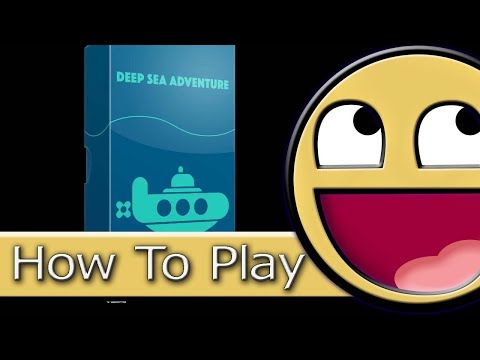 Thumbnail from "How to Play Deep Sea Adventure" (FailroadExpress, YouTube)
The object: a small-box company incorporated in 2010
Oink Games was established on May 26, 2010, with Jun Sasaki as representative (company overview).
Sasaki started as a designer. In an interview he says he began making games after applying to Game Market in 2010.
He had to print 1,000 copies of the first title, Stray Thief, and incorporated to handle barcodes and Amazon sales. The company began as a print run.
An English-language feature gives the box size as 11 x 6.5 x 3.5 cm (Tabletop Gaming). That is one outlet's figure, so I mark it "reportedly".
The same feature says small boxes fit crowded shelves and ease warehousing and shipping. In the interview, Sasaki says an overseas publisher told him the box looked too small and therefore too expensive, and he held his ground.
When I get a new box, I weigh it first. I have no copy in hand this time, so I could not weigh it. I'll write dimensions instead of grams.
Deep Sea Adventure is co-designed by Jun Sasaki and Goro Sasaki (Tabletop Gaming, Board Game Wire). It plays 2–6 in about 30 minutes.
Per the rulebook, the contents are: 2 dice (faces 1–3), 6 diver pieces, 1 air marker, 1 submarine board, 32 treasure chips (4 levels x 8), and 12 blank chips.
As of August 2024, more than 300,000 copies were reported printed (Board Game Wire). The same article announces a new edition.
Why it works on paper: the air is in front of everyone
The core rule is shared air. The air marker starts at 25.
At the start of your turn you move the marker toward 0 by the number of treasure chips you carry. Carry three, and the air drops by three.
The air is one pool for everyone, so one greedy diver eats everybody's remaining time.
Next, movement. Roll two dice, subtract the number of chips you carry from the total, and move that far. The more you carry, the slower you go.
A turn has four steps: breathe (reduce air), declare a turn-around (once, only if carrying treasure), swim, and handle treasure (pick up, drop, or pass).
 (Diagram) The more you carry, the more air one turn uses. From the rulebook's "breathe" step
Now, texture. This works on paper because the shrinking air sits where everyone can see it.
Every time someone's haul grows, the whole table counts "how many turns are left" at once. The rules don't leave that counting to each player; they put it in the middle of the table.
There is one more thing. The turn-around declaration can only be made once. Within the rulebook summary I read, no dedicated component is listed to mark that a diver has turned around.
This is where I get strict. Nothing in the box enforces "only once". What enforces it is the memory and conscience of the people at the table.
Of course, in a 30-minute small game this rarely breaks. A gap is still a gap. In a digital version it closes in one line. I'll return to that next.
One more modest detail. When treasure is dropped, blank chips fill the gap and are removed at round end, closing up the line. Every drop shortens the path.
The road to the submarine gets shorter as you play. That, too, is just rearranging parts.
Moving it to digital: what vanishes, what stays, what can be added
What vanishes is the time of counting together. The whole table silently watching the air fall — that silence thins out when the number drops automatically.
And the faces. The look on everyone's face when someone picks up one more chip. On a screen, you can't see it.
What stays: one shared number and two costs that grow with what you carry. Driving both air and movement from the same "number carried" moves straight onto a screen.
The spec is simple, so little breaks in porting. This is an easy design to move.
What you can add is the repair of that gap. A screen can hold the turn-around as state. Nobody has to remember "only once".
Another possible addition is undo. Letting players rewind a turn weakens the push. That may be one to leave out.
"The more you carry, the slower you go and the more air you burn" appears outside puzzles too. Games where carrying more dulls movement are close cousins of organization games.
In the encyclopedia the nearest entry is Organization. Organization lists works that deal with carry limits. There is no entry yet for push-your-luck (continue or bail), so I'm recording it as a candidate.
On the deduction side, games of reading others' greed sit next to Deduction.
My earlier pieces covered how to make hidden information. Hanabi hides your own hand; Love Letter removes one card unseen. Deep Sea Adventure does the opposite: it hides nothing and shows everything.
For makers: hang two costs on the same number
One takeaway. When you need two costs, hang both on the same single number.
In Deep Sea Adventure, air loss and slower movement are both decided by the number of chips you carry. What players must learn is effectively one thing.
Players remember one line: carrying makes you heavy. The numbers produce the rest.
The small-box company teaches the same thing: give one constraint several meanings. Parts and rulebook both shrink.
Digital has no box-size limit. That is exactly why you should decide your own "small box".
Closing
A small box is a size that ends in your hand. Deep Sea Adventure fits thirty minutes of greed into it whole.
Finally, a question. In your game, will you leave the "only once" promise to human hands?
If you do, you design for the moments it gets broken. If you don't, it can't be broken, but the credit of having kept it also disappears from the screen.
Decide first, then build. It's probably faster.
Sources
Oink Games official "About" — established May 26, 2010, representative Jun Sasaki ↗
BROAD interview with Jun Sasaki (Japanese) — founding story, small-box commitment ↗
Tabletop Gaming, "The Iconic Oink" — box size, co-designer, why small ↗
Deep Sea Adventure rulebook PDF (English) — components, air 25, turn steps, three dives ↗
Board Game Wire (2024-08-20) — 300,000+ copies, new edition teaser ↗
Reactions (no login)
Anonymous • one of each per visitor per day
関連シリーズ
Solved by Hand第10回 / 全10回