HISTORY · 2026-09-18
Nine Linked Rings (Baguenaudier) (1872) — The Year an Origin-Unknown Ring Puzzle Turned Out to Use Binary Math 81 Years Before a Telegraph Engineer Patented the Same Idea
From a Chinese legend, to a Lyon clerk's theory, to two patents, to a shelf at today's puzzle shops
Introduction — An Invention With No Name, Invented Twice
Nine Linked Rings, also known as Baguenaudier, is a puzzle in which you remove rings from a bar one at a time until a single ring slides free. Its origin is unknown. But in 1872, a mathematics enthusiast in Lyon, France, wrote down the correct order of moves as a table of binary digits.
That table turned out to be mathematically almost identical to the "Gray code," patented 81 years later, in 1953, by telegraph engineer Frank Gray. The same idea, it seems, was invented twice, on two different continents, eight decades apart.
In this piece I dig through what happened between those two inventions: a Chinese legend, a mathematician in France, and a product still sold on puzzle-shop shelves today. One ring connects all of it.
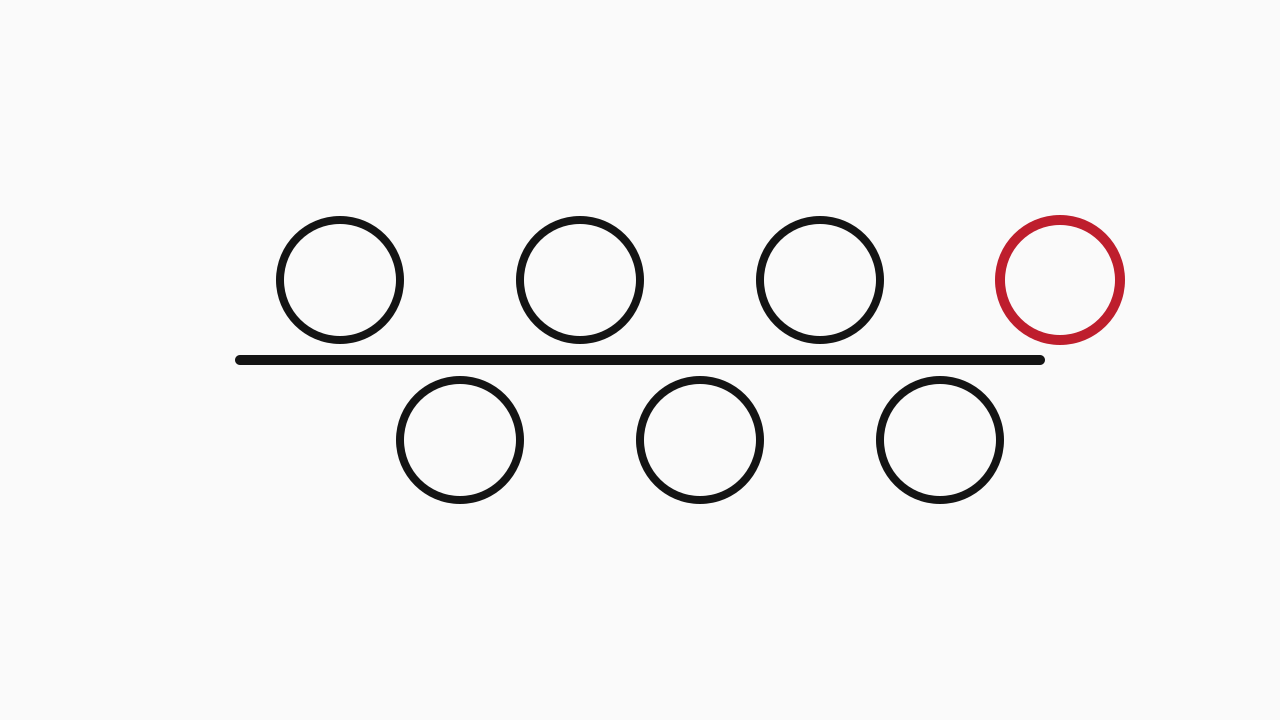 Impression of rings on a bar (illustration, AI-generated)
Historical Context — From a Legendary General to Renaissance Mathematicians
In China, this puzzle is called jiulianhuan, "nine linked rings." Legend credits it to the Three Kingdoms-era strategist Zhuge Liang (2nd–3rd century CE), but that story rests on later oral tradition with no documentary support.
The earliest confirmed record is a mention of a "nine linked rings" toy in Sheng'an ji, a work by the 16th-century Chinese scholar Yang Shen. Around the same period, the puzzle was already known in Europe: problem 107 of Luca Pacioli's De Viribus Quantitatis, compiled around 1500, describes it.
Girolamo Cardano in the 16th century and John Wallis in the 17th century each wrote about the puzzle too. In France, the same mechanism reportedly saw use among peasants as a makeshift lock — a scholar's toy that quietly became a household tool.
 Impression of an old book and a ring (illustration, AI-generated)
Mechanics — The Rule That Only One Ring Moves at a Time
The rule is simple to state. Rings sit on a bar, each linked to its neighbor's position by a loop. Only the ring at one end can move freely; every other ring can only be toggled when its neighbor sits in exactly the right state.
Because each ring can only see its immediate neighbor, the move count explodes as rings are added: roughly doubling for every additional ring. That growth follows the same shape as the move count in Tower of Hanoi (1883), which this site has covered before.
Treat each ring's state as a single binary digit, either 0 or 1, and solving the puzzle becomes the same procedure as counting through binary numbers one step at a time. Whatever rule tells you which digit to flip next also tells you which ring to move next.
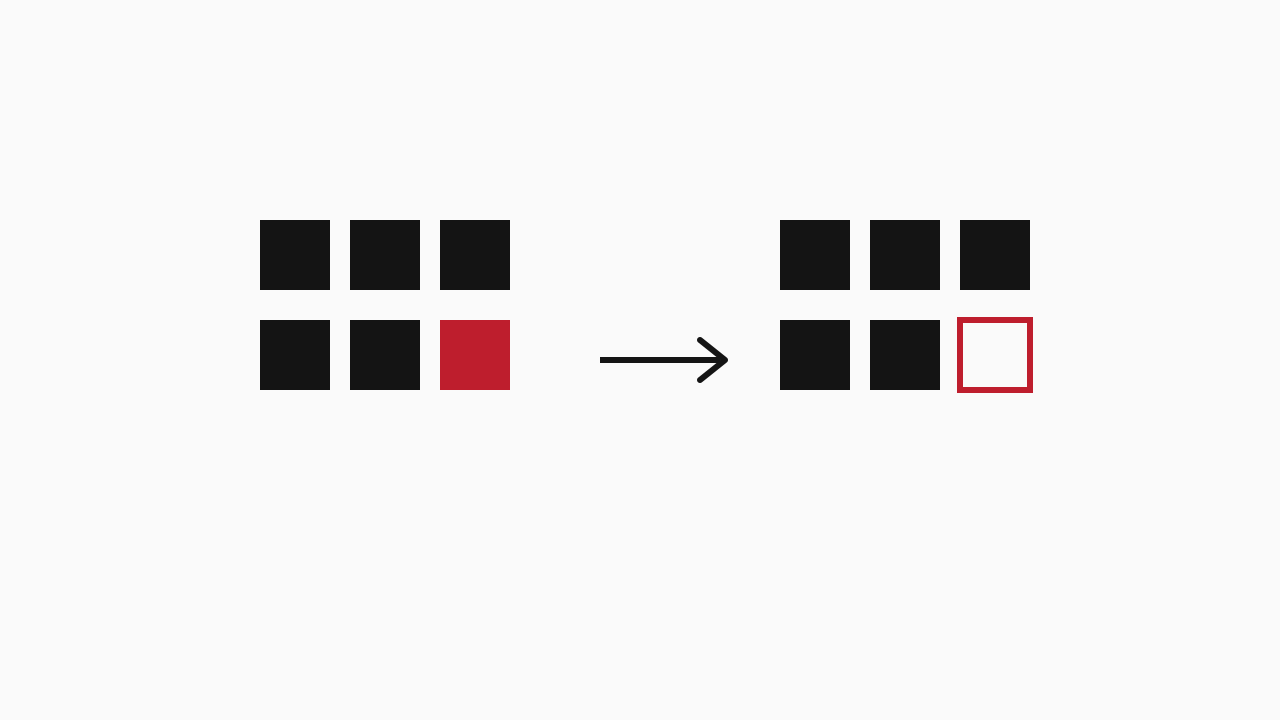 Impression of a single changing binary digit (illustration, AI-generated)
Legacy — A Theory Forgotten, Then Invented Again
In 1872, Luc-Agathon-Louis Gros, who worked at a notary's office in Lyon, published a short book titled Théorie du Baguenaudier. It represented each ring's state as a 0 or 1 and, for the first time, laid out which ring to move next as a systematic binary table.
Ten years later, in 1882, the mathematician Édouard Lucas discussed the puzzle in the "Seventh Recreation" chapter of the first volume of his Récréations Mathématiques. Lucas is the same mathematician who devised Tower of Hanoi (1883) — the two puzzles came from one person's hands.
The same mathematics Gros had described resurfaced, for an entirely different purpose, in 1953: telegraph engineer Frank Gray patented what we now call the "Gray code," a way of encoding numbers so that communication errors are less likely to corrupt them. There is no record that Gray knew Gros's name. The same mechanism had, in effect, been invented again 81 years later.
In 1970, the American William Keister filed a patent for a toy that swapped rings for interlocking rotating discs; it was granted in 1972. That design became one of the first products from Binary Arts, founded in 1985 (renamed ThinkFun in 2003), sold as "Spin-Out" — a puzzle the company still sells today. Gray codes remain foundational to real technology: rotary encoders that read a machine's rotation, and error-correcting codes used in communication. A table one person in Lyon wrote in 1872 to count rings shares its mathematics with code running inside digital devices today.
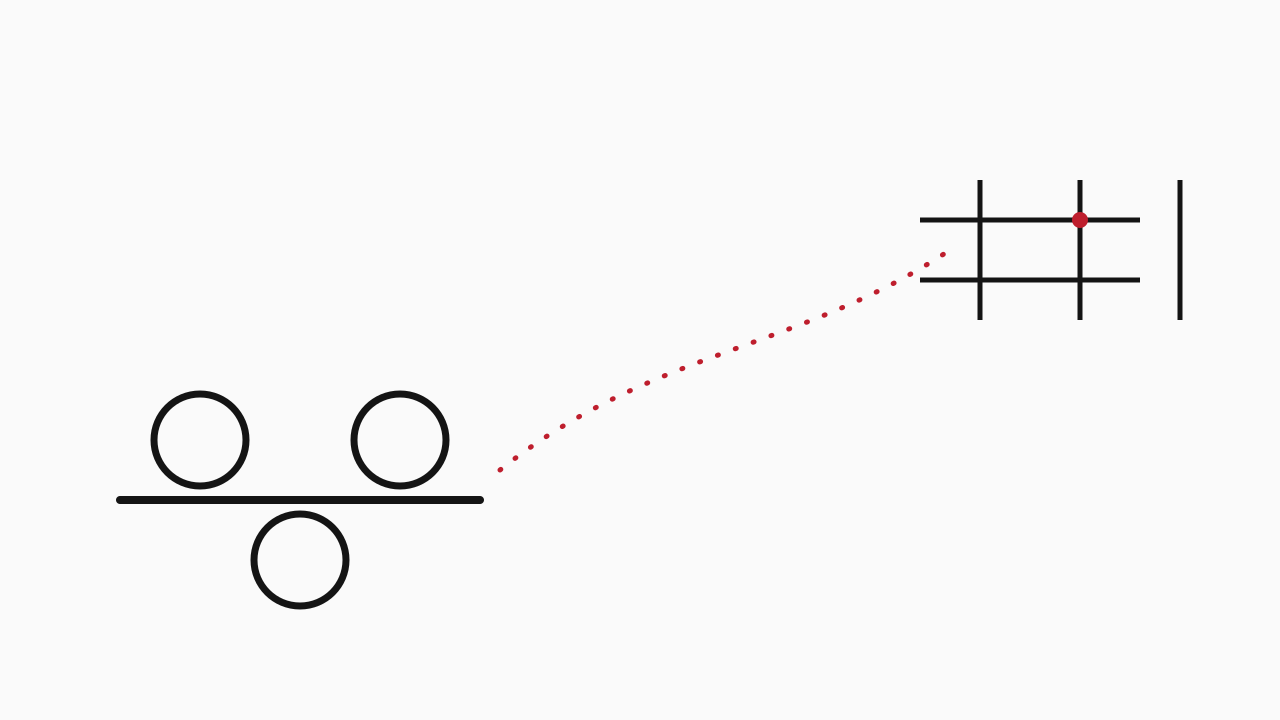 Impression of rings leading to a circuit (illustration, AI-generated)
Sources
Sources consulted for this article:
・Wikipedia (French): Jeu du baguenaudier
・Wikipedia (Japanese): Chie no Wa
・Wolfram MathWorld: Baguenaudier
・Jaap's Puzzle Page: Spinout / The Brain / Chinese Rings puzzle
・Google Patents: US3637215A "Locking Disc Puzzle" (William Keister)
Closing — The Name Fades, the Mechanism Remains
Louis Gros's name never made it onto a puzzle box. And whether the Chinese legend of Zhuge Liang is any more reliable than that, we still don't know.
And yet the rule — remove rings one at a time, following a binary logic to solve it — has survived for more than 150 years, changing shape as it went: from a clerk's book, to a telegraph engineer's patent, to the shelf of a modern metal puzzle like Hanayama Cast Puzzle (1983).
An inventor's name can be forgotten while the mechanism itself keeps getting rediscovered. I like to think that every hand solving a puzzle today may be retracing, without knowing it, the same table someone wrote out a century and a half ago.
 Impression of a quiet ring (illustration, AI-generated)
Reactions (no login)
Anonymous • one of each per visitor per day
関連シリーズ
Puzzle Incident History第40回 / 全40回