HISTORY · 2026-09-22
Eternity Puzzle (1999) — The Year a £1 Million "Unsolvable" Fell in Seven Months
209 plastic pieces, an inventor's bet that it would take at least three years to solve, and the two mathematicians and two home PCs that proved him wrong
Introduction — Why Did a £1 Million "Unsolvable" Fall in Seven Months?
The answer first. Eternity, a flat tiling puzzle sold in the UK in 1999, was expected by its own inventor to go unsolved for at least three years. Instead, a solution arrived just seven months after launch.
The solvers were two Cambridge mathematicians, Alex Selby and Oliver Riordan. The box held nothing more than 209 plastic pieces, and the rule was simple: tile a given twelve-sided board with them, leaving no gaps.
That "no gaps" turned out to be brutally hard. Inventor Christopher Monckton staked a one-million-pound prize on that difficulty. Why did a puzzle built to be unsolvable fall in seven months? The answer lies in the shape of the pieces, and in the design of the prize itself. From the thumbnail of "He Solved a Jigsaw Puzzle Designed to be Unsolvable" (Cardboard Mountain, YouTube)
The Era — Why Did a British Toy Company Bet £1 Million?
Eternity was released by the Ertl Company, known for model toys, in the UK in June 1999. Britain's puzzle-toy market of the time had an appetite for prize puzzles as Christmas-season centerpieces, and Monckton had estimated beforehand that no one would solve it for at least three years.
Each piece was a shape called a 12-polydrafter: twelve right triangles with side ratio 1:√3:2 joined together. There were 209 such pieces, to be fitted without gaps into a slightly irregular twelve-sided board. Contemporary accounts put the number of theoretically possible arrangements at 10^500.
Monckton had also built six "clue" pieces into the board, meant to guide solvers toward his intended answer. Half of the one-million-pound prize was his own money; the other half was underwritten by the London insurance market, a device meant to head off doubts about whether the prize would really be paid. Impression of the board and piece layout (illustration, AI-generated)
Mechanics — How Did Selby and Riordan Solve It?
The first thing the two mathematicians did was ignore Monckton's six clue pieces. Selby later said the puzzle was "actually significantly easier to solve without enforcing any fixed hint pieces." The solvers discarded the designer's intended path to the "one true answer" on their own.
Their method combined probabilistic reasoning with brute-force backtracking search: statistically estimating how close a given arrangement was to completion, and pruning unpromising branches early. Running on two home PCs, they reached a complete solution on May 15, 2000 — seven months after starting.
What's striking is that their solution matched none of Monckton's six clues. A month and a half later, on July 1 of the same year, Germany's Guenter Stertenbrink independently found a different solution. The one-million-pound prize was paid out that October.
This exposes a trap in puzzle design. Designers tend to picture a single, intended solution when they lay out a board, but a board whose combinatorics explode can hide countless other valid solutions the designer never knew about. A clue can point the way to the intended answer, and just as easily wall off a shortcut nobody planned for.
Legacy — Where Is Eternity's "Hardness" Studied Today?
In 2007 Monckton unveiled a sequel, Eternity II: 256 square tiles to be arranged on a 16×16 board, with the prize raised to two million dollars. No correct solution was ever submitted by the December 2010 deadline. The closest anyone got, as of 2026-09, is a partial solution by the Netherlands' Louis Verhaard matching 467 of the 480 edges.
Eternity II also became a subject of study in theoretical computer science. Carlos Ansótegui and colleagues at the University of Lleida, Spain, showed that commercial SAT/CSP solvers could reliably handle boards only up to 8×8, and found that Eternity II's own parameters — a 16×16 grid with 17 colors — sit almost exactly at the "phase transition" complexity theory identifies as the hardest point for this class of problem. Whether by intent or not, a toy company had landed on nearly the hardest design theory allows.
This line of research — measuring the mathematical hardness of a commercial puzzle — continues today. In 2022, Jonathan Geller proved that determining whether a board is solvable in Baba Is You (Hempuli, 2019), a rule-rewriting puzzle game, isn't merely NP-hard but undecidable — a question no algorithm can settle in principle. The question Eternity first posed, "can this board be solved?", has carried more than twenty years down to the puzzle games people play on Steam today.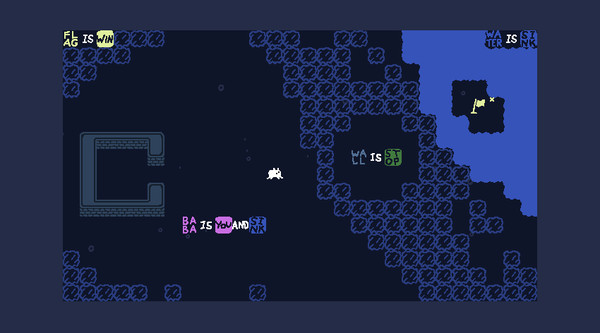 From a screenshot of Baba Is You (Hempuli, 2019)
Sources
Sources referenced in this article:
・Wikipedia: Eternity II puzzle
・AMS Grad Student Blog: The Eternity II Puzzle: Still Unsolved!!
・University of Oxford Podcasts: The Eternity Puzzle (Oliver Riordan, St Edmund Hall)
・Ansótegui, Béjar, Fernández, Mateu: How Hard is a Commercial Puzzle: the Eternity II Challenge
・Geller: Baba is You is Undecidable (arXiv:2205.00127)
・Cardboard Mountain: He Solved a Jigsaw Puzzle Designed to be Unsolvable (YouTube)
Closing
In 2006 Monckton admitted that his own claim — that he'd sell a 67-room mansion to cover the million-pound prize — had been "a PR stunt to boost sales over Christmas." His estimate that no one would solve it for three years, though, was probably not a stunt. He likely believed it.
Believing and proving are different things. What Eternity left to history isn't the million-pound prize itself, but the record of a designer's certainty that a puzzle couldn't be solved, overturned in seven months by two mathematicians and two home computers. As of 2026-09, the only two solutions to the original Eternity puzzle ever published are the ones found in 2000 — Monckton's own "intended" solution has still never been made public.
Reactions (no login)
Anonymous • one of each per visitor per day
関連シリーズ
Puzzle Incident History第43回 / 全47回