HISTORY · 2026-09-25
Instant Insanity (1967) — One Right Answer Among 41,472
A color-matching toy marketed to make you go "instantly insane" turned a puzzle into a problem for mathematical proof
はじめに — 四つの立方体と、一つの脅し文句のような名前
In 1967, the American toy company Parker Brothers released a box containing nothing more than four cubes. Each face was painted one of four colors — red, blue, green, or white. The rule: stack the four cubes in a column, and make sure all four sides of that tower — front, back, left, right — each show every one of the four colors exactly once.
Its name was Instant Insanity. I have a soft spot for toys with names that goad the player before they've even opened the box — the confidence of the makers shows through.
And this toy lived up to that confidence. There are 41,472 possible ways to stack the cubes. Of those, essentially only one arrangement satisfies the condition. Turning the cubes at random, for as long as you like, will almost never get you there.
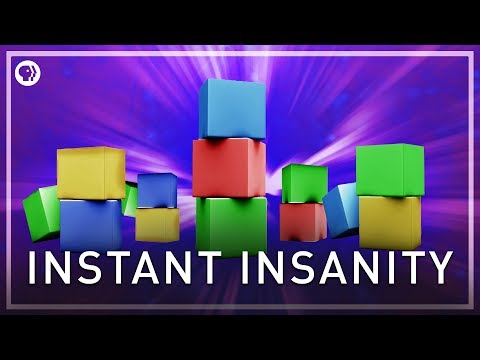 From "Instant Insanity Puzzle" (PBS Infinite Series, YouTube)
その時代の文脈 — 特許玩具から「タンタライザー」、そして量産される色の悪夢へ
This toy's roots go back further still. According to Wikipedia, the first patented version was devised in 1900 by Frederick Alvin Schossow as the "Katzenjammer puzzle." By the 1940s, a variant form was circulating widely under the name "The Great Tantalizer." Parker Brothers' 1967 release stands at the end of that lineage — a reinvention, in effect.
That year, Frank Armbruster reworked the coloring scheme of the cubes, and Parker Brothers and Pressman each commercialized it independently. The backdrop matters: plastic injection molding had spread widely enough that many identical pieces could be reproduced cheaply and precisely. Unlike the one-off wood or metal puzzles of 1900, a 1960s toy factory could stamp out as many identically precise cubes as it liked.
The numbers speak for themselves. Parker Brothers alone sold more than 12 million units, and the toy became a store-shelf staple. Selling what looked like simple color-matching, while it was secretly a puzzle with a vanishingly low chance of being solved by luck, reads almost like a dress rehearsal for another cube's global hit seven years later, out of Hungary — the Rubik's Cube.
I keep being struck by how many products of this kind — toys on the surface, mathematics underneath — were mass-produced across America and Europe in the second half of the twentieth century. The more industrialized the era, the more play was mass-produced too, and real hard problems slipped in among the merchandise.
メカニクス — 41,472通りを、色の地図に変える
Let me restate the rule. Four cubes, each with its six faces colored one of four colors. Stack them into a tower, and you win if each of the four sides — front, back, left, right — shows all four colors exactly once. Each cube can be oriented 24 ways, so the raw combinatorics balloon quickly. Counting only genuinely distinct stackings, there are 41,472 of them.
That's not too many for brute force to be physically possible — but it's far too many for a human to patiently work through. Which is why the real protagonists of this toy turned out to be mathematicians. In 1947, a group of Cambridge students, writing under the joint pseudonym "F. De Carteblanche," published a solution to the ancestor puzzle, the Tantalizer, in the journal Eureka (issue 9, published by the Archimedeans society).
Their idea: treat the four colors as four vertices, and for each cube, draw an edge between the two colors that sit on opposite faces. Four cubes give four edges each, so the result is a single diagram with four vertices and sixteen edges. All that remains is to find two edge-disjoint subgraphs within it, each of which passes through every color exactly twice — one for the front/back pair of sides, one for the left/right pair.
The moment you reframe the problem this way, the brute-force search through 41,472 stackings collapses into the far smaller task of picking a few lines on a map of colors. A year after Parker Brothers commercialized the toy, in 1968, T.A. Brown solved the same Instant Insanity puzzle again, this time from the angle of combinatorial number theory.
 Colors as vertices, opposite-face pairs as edges (illustration, AI-generated)
現代への系譜 — 玩具を「解けるか」で測る伝統は、いまSteamの3Dゲームに届いている
What Instant Insanity really left behind was not the answer to the color puzzle itself, but an attitude: translate the question "can this toy be solved at all?" into the abstract tool of a graph, and answer it there. Both the Cambridge students of 1947 and Brown in 1968 were nominally up against a toy company's color puzzle, but what they were actually wrestling with was a combinatorial structure.
That attitude has survived, in changed forms, ever since. In 2018, MIT's Erik Demaine, Joshua Lockhart, and Jayson Lynch published a paper using Valve's Portal (2007) and its sequel as material, classifying individual in-game mechanics — placing a portal, carrying an object, and so on — as NP-hard, PSPACE-complete, or solvable in polynomial time.
What their paper showed is that much of what makes a puzzle feel like it demands real thought can, in fact, be proven hard in the vocabulary of computational complexity. The half-century-old picture of a toy company selling color-matching cubes and mathematicians redrawing them as a graph turns out to be strikingly similar in shape to today's picture of a studio building a 3D space and researchers redrawing it as a theory of state transitions.
I spend most of my time digging up old toys, but tracing a lineage like this reminds me that the urge to measure play by whether it "can be solved" has run, unbroken, for nearly eighty years now. The colors on the toy have changed. The shape of the question hardly has.
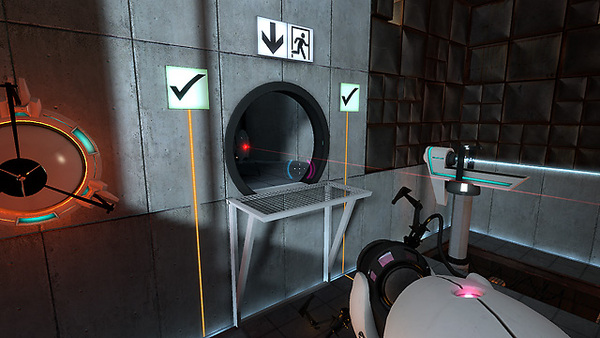 From a screenshot of Portal (Valve, 2007)
参考文献
Sources referenced in this article:
・Ivars Peterson, "The Mathematical Tourist: Averting Instant Insanity" (2019)
・Érika Roldán Roa, "The Mutando of Insanity" (arXiv:1610.09371, 2016)
・Eureka, issue 9 (The Archimedeans, University of Cambridge, 1947) — Internet Archive
おわりに — 色は変わっても、問いの形は変わらない
Four cubes, four colors, and a rule simple enough to state in one sentence. Yet hidden behind it was a laughably low probability: one arrangement out of 41,472. A patented toy from 1900, the Tantalizer of the 1940s, Instant Insanity in 1967, and Portal research half a century later — four points, different in name and appearance, connected by a single unbroken line.
I'm the kind of writer who doesn't feel a piece is finished until at least one year number has been underlined. This time I got to watch four of them — 1947, 1967, 1968, 2018 — line up neatly along a single map of colors, and I enjoyed that plainly. Which cube's colors that line picks out next is something I'll wait for, watching the board as always.
Reactions (no login)
Anonymous • one of each per visitor per day
関連シリーズ
Puzzle Incident History第46回 / 全47回
