SOUNDTRACK · 2026-09-12
Soundtrack: Thomas Was Alone — one melody that changes clothes every time a rectangle joins
David Housden
Introduction — one rectangle, one melody
Start up Thomas Was Alone and a red rectangle stands alone on a dark screen. As Komugi's review put it, only rectangles ever move, yet the narration gives every one of them a personality — this is a puzzle-platformer built on that trick.
The first track is Where Are You? The tempo sits around 70, by ear, a slowness that feels hesitant to start walking. A piano lays down one note at a time, and chiptune grains and strings quietly gather around it.
The composer is David Housden. In an interview, he recalled that the job came with "a very simple brief, checking in occasionally with the Flash build."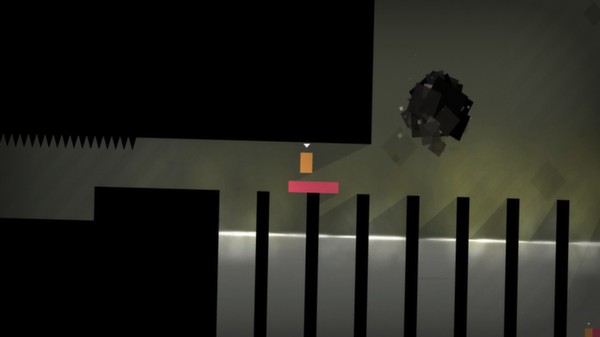 Thomas Was Alone (official Steam screenshot)
A puzzle-native trait — as many layers of sound as rectangles
The puzzles in Thomas Was Alone have you switch between rectangles with different personalities, lending each other's jump height and buoyancy to get through. Red can't jump high, yellow can — and roles keep stacking one at a time like that.
Housden's music traces the same addition. As the review site VGMOnline points out, the whole album is built on nothing but one short motif and its harmony, changing instrumentation and key from track to track to keep producing "similar but subtly different atmospheres." Each time a new rectangle joins the cast and the board's possibilities go up one notch, the layers of sound go up one notch too.
In his own words, his natural tendency as a minimalist composer "worked well" for this game. The restraint of a screen where nothing but rectangles ever appears lines up exactly with the restraint of music that keeps reusing one melody.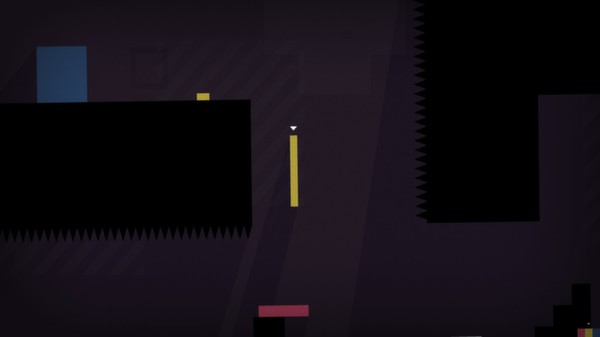 Thomas Was Alone (official Steam screenshot)
The puzzle analogy — the same leap, seen at a different height each time
The procedure in this game never changes. Switch rectangles, make one jump, stand another on top. Yet it never gets old, and I think that's because the same leap carries a slightly different meaning each time.
The music is built with the same hand. A melody I just heard returns in the next track wearing a different instrument, a different key, a different speed. My ear knows it's a continuation, yet what's actually sounding is genuinely different.
This double structure — an unchanging core in ever-changing clothes — lines up with the structure of Thomas Was Alone itself. Listen closely enough, and the same click of understanding you get from solving a puzzle happens in your ears too.
Tracks worth hearing
Start with the official trailer. It's published on developer Mike Bithell's own channel, and it's the clearest way to hear the music's mood alongside the narration.
If you want the whole thing, the expanded edition is officially available on composer David Housden's own Bandcamp. Thomas Was Alone - Original Soundtrack (Deluxe Edition) — official David Housden Bandcamp ↗.
If I had to pick one, it's Freedom. Housden himself has called it "the favorite track I've ever written," and it's where all the restraint that came before it finally lets go. Freedom ↗.
Closing — if I'm stealing something, it's the nerve to reuse a melody
If I were writing a score myself, this is what I'd steal: the nerve to build an entire album on one short melody, changing only the instrument, the key, and the speed each time. Earning more tracks by re-delivering the same material, rather than adding new material, feels like exactly the right instinct for puzzle-game music.
If I open this board again over black coffee, I'll listen to Where Are You? from its very first note. I want to confirm, in my own ears, that the melody changes clothes once for every rectangle that joins.
Sources
・Steam: Thomas Was Alone official page
・David Housden official Bandcamp — Thomas Was Alone Original Soundtrack (Deluxe Edition)
Reactions (no login)
Anonymous • one of each per visitor per day
関連シリーズ
Puzzle Soundtracks第95回 / 全100回
Read next

Related reviews
Thomas Was Alone
Un puzzle-platformer 2D où l'on bascule entre des rectangles de couleurs et de tailles différentes, en combinant les capacités données une à une à chacun pour construire des appuis et franchir 120 niveaux. Pendant la progression, une narration hors champ ne cesse de commenter l'état d'esprit des rectangles. Une œuvre de Bithell Games, le studio de Mike Bithell, parue en 2012.
Trine 2: Complete Story
Un jeu de puzzle-action à défilement horizontal dans lequel on alterne entre un chevalier, une voleuse et un mage pour empiler des caisses et des planches soumises à la physique et franchir les obstacles. Deuxième volet de la série des Finlandais de Frozenbyte, l'édition Complete Story réunit la campagne principale, l'extension « Goblin Menace » et un niveau supplémentaire.
Tetris Effect: Connected
Le jeu de blocs qui tombent que tout le monde connaît, avec des règles laissées strictement intactes. Sur plus de trente niveaux, la musique et la lumière réagissent au moindre geste. Deux ajouts seulement : une « Zone » qui fige le temps et permet d'effacer plus de quatre lignes d'un coup, et un mode coopératif à trois où les plateaux se rejoignent. Signé Enhance, le studio de Tetsuya Mizuguchi.


