PAPER-DIGEST · 2026-09-16
Hendijani and Steel: Letting people choose moved nothing; a number in the corner of the screen did — Fukai Reads
Experimental psychology of motivation — separating choice, reward and gaze across 270 people
In short — letting them choose did nothing; the number on screen did
There are two classic ways to get someone moving. One is to let them choose. The other is to pay them for what they achieve. Today's paper puts both into a single experiment and compares them head to head.
270 people took a memory test in which words appeared on screen one after another. The groups paid per correct word recalled about seven more words than the group that was not. Meanwhile, the group allowed to pick between Test A and Test B did essentially the same as the group given no choice at all.
Here is where it gets interesting. The authors used an eye tracker to record how much each person looked at the reward readout sitting in a corner of the screen. That gaze mediated the effect of the reward. So this is a paper about motivation and, at the same time, a paper about what you keep displayed, and where.
Who wrote this, and what kind of study is it?
There are two authors: Rosa Hendijani (Faculty of Management, University of Tehran, Iran) and Piers Steel (Haskayne School of Business, University of Calgary, Canada). It appeared in Frontiers in Psychology on 13 August 2026.
It is a peer-reviewed paper (reviewed by researchers in the same field before publication), not a preprint of the kind posted to arXiv. The full text is free to read.
I picked it today because it addresses a question that sits one step before most of the research I cover here. How you tune difficulty, what you charge for a hint — all of that assumes the player is still sitting in front of the screen. This paper experiments on that assumption itself.
One more reason. In game design circles, "give the player a choice and motivation goes up" circulates almost as common sense. This study shows, with numbers, that there are situations where that does not hold.
How true is "choice creates motivation"?
The field holds roughly three positions. One is the classical behavioural view: rewards move people. Another is self-determination theory (a framework holding that people draw strength from the sense that they are deciding for themselves), which has long warned that performance-contingent rewards eat into motivation that comes from within.
The authors stand with a third: motivational congruence theory (which treats internal motivation and external reward as equals, and holds that whichever fits the situation is the one that works). The question is not which is nobler, but which matches the context.
What was missing? Earlier work measured behavioural outcomes — the group given a choice scored higher, and so on — but rarely measured what happens in the head just before that. This paper brings in gaze as a ruler for exactly that.
One more thing matters: the authors classify their setting as a controlling context (a situation bound by rules and time, where personal discretion is small).
The word order is fixed. You cannot go back. The time limit is one hour, after which the test closes on its own. That property does real work in the interpretation later.
Sorting 270 people into nine boxes
There were 270 participants: 31.48% male, mean age 22.75 (SD 4.07), students and graduates recruited from Iranian universities. Everyone was randomly assigned to one of nine conditions, 30 people per condition.
The task was a memory test. The paper states that "the test consisted of seven trials and each trial consisted of 12 words that appeared one by one on the screen." You press a Next button to advance word by word, then type whatever you can recall at the end of each trial. The overall time limit was one hour.
The design has two axes. One is whether you get to choose. (1) A group that picks Test A or Test B; (2) a group told they get no choice — and told, in bold and underlined text, that other groups do; (3) a control group simply asked to take the test with no explanation. Note that the two selectable tests are nearly identical, differing only in the word order of the final set.
The other axis is how the reward is displayed. Everyone received a fixed participation fee of 500,000 IRR (about 1 US dollar). On top of that: (1) no performance bonus; (2) a "non-salient" group paid 10,000 IRR (about 20 US cents) per correct word, with numerical test progress shown in a brown box at the bottom of the screen; (3) a "salient" group paid the same amount, shown a large photo of money with the line that they could earn a large amount if they performed well, and a brown box showing cumulative potential earnings, updated for every word.
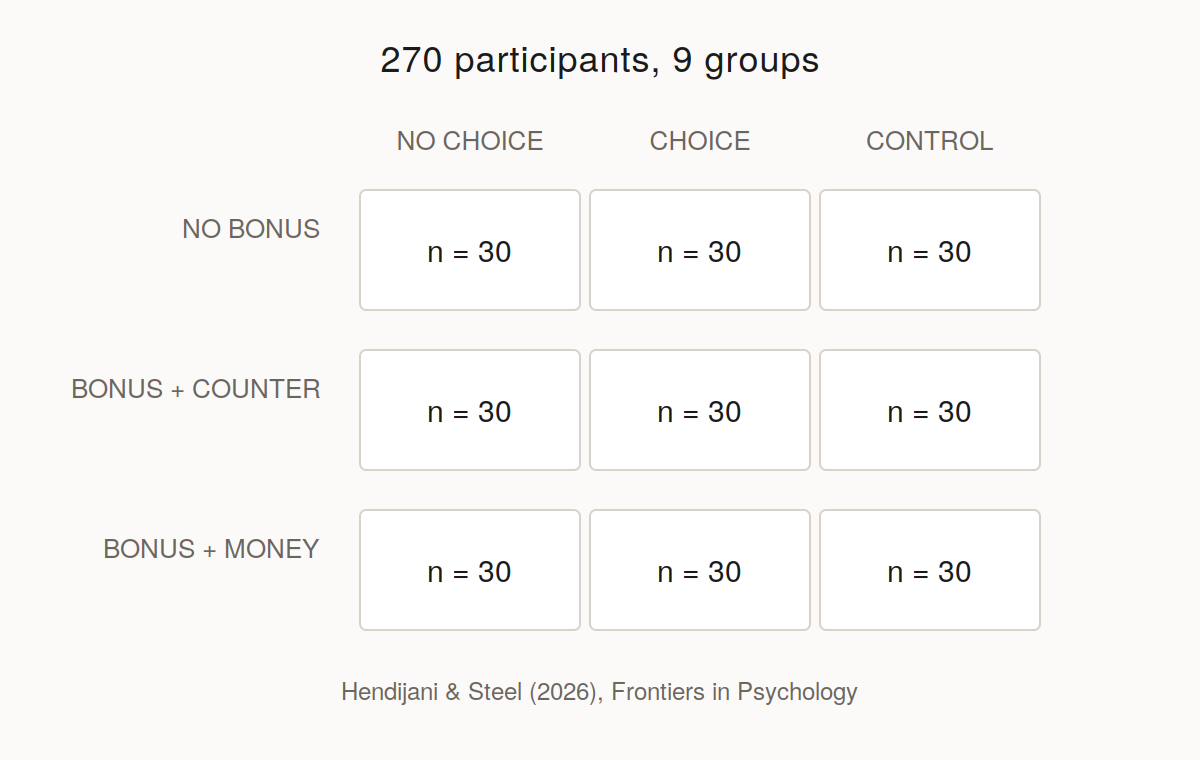 (Diagram) Three choice conditions by three reward conditions: nine groups of 30, 270 people in total
Gaze was recorded with a Tobii X2-60, mounted beneath a 23-inch monitor with the participant seated 50 cm away. The only region of interest was that brown box. For it, the authors logged three things: time to the first fixation, total fixation duration, and the number of fixations.
Two outcomes were measured. One was time spent on the test, standing in for motivation (mean 18.06 minutes). The other was performance — the number of words correctly recalled (mean 44.73 words, SD 12.98).
What came out of the nine groups
First, the manipulation checks. The choice group reported a higher sense of deciding for themselves than the no-choice group (B = 1.68, p < 0.001). The salient-reward group reported that the reward was more emphasised (B = 0.78, p < 0.001). Both manipulations landed as intended.
The results split with surprising cleanliness. Reward worked; choice did not. For time spent on the test, the salient reward gave B = 4.265 (p < 0.001) and the non-salient reward B = 4.078 (p = 0.001) — roughly four extra minutes of persistence. Choice gave B = 2.244 at p = 0.056, and the paper writes that choice "has no significant effect on overall motivation compared to the no-choice condition."
Performance is even clearer. B = 7.714 for the non-salient reward and B = 7.299 for the salient one (both p < 0.001) — about seven more words recalled. Choice gave B = 1.376, p = 0.457. In numerical terms, it barely moved.
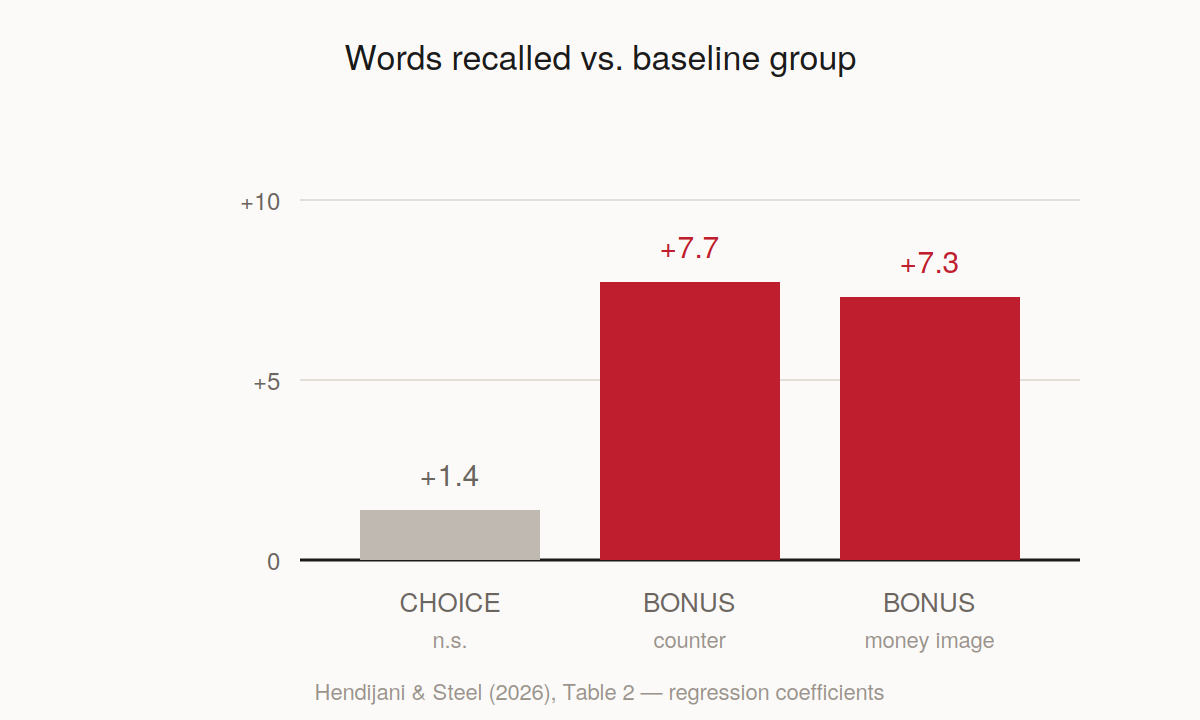 (Diagram) Effect on words recalled, from the coefficients in Table 2 of the paper
What stands out is that the salient reward did not beat the non-salient one. The large photo of money and the ticking earnings figure added nothing over a plain progress number. Part of the earlier theory predicted that making a reward too prominent would depress motivation from within; that did not happen here either.
Then there is gaze. Looking at the reward display statistically mediated the reward's effect. Using total fixation duration, more looking went with more time spent (B = 11.329, p < 0.001), and 1.087 of the salient reward's effect (95% CI 1.096 excluded — the interval was 0.395 to 1.956) ran through gaze.
In the analysis using time to first fixation as the mediator, essentially the whole effect of the salient reward ran through gaze: an indirect effect of 2.622 (95% CI 1.096 to 4.160), with no statistically confirmed direct effect outside it. The paper calls this full mediation — the state in which the effect travels entirely along the intermediate path.
How someone making a game can use this
1. Move the readout from the results screen onto the board. If you are making a daily puzzle, it is worth trying to stop showing score or streak only after the clear, and instead put it at the edge of play and update it every move. What worked in this experiment was less the reward itself than the fact that the reward stayed visible.
2. Do not spend the budget on spectacle. The display with the big money photo did not beat the plain number (7.3 versus 7.7). Before building an elaborate coin shower, check whether a small number reliably falls inside the player's field of view. This experiment, at least, does not support paying for flash.
3. Do not use "choices with identical contents" as a motivation device. The choice in this study was between two nearly identical tests differing only in word order. Nothing happened. If you are making a Sokoban-like and your level select offers "Stage 3-A / Stage 3-B", ask whether those two differ in a way the player can feel.
4. Read the context before picking the lever. The authors classify their setting as controlling: time-pressured, no going back, fixed order. Daily challenges and time attacks resemble it. A relaxed sandbox mode, by contrast, is something this paper says nothing about. There is no guarantee the same lever works there.
5. Add "did they look at it" to your playtest instruments. The point of this study is that the reward display's effect travelled through gaze. Turned around: a display nobody looks at does nothing. Even without an eye tracker you can build substitutes — ship two builds with the readout in different places and compare clear rates, or log where the cursor rests.
6. Put the in-house maxim that "freedom of choice raises satisfaction" under review, once. The effect of choice on performance was B = 1.376 and was not statistically confirmed. There are certainly situations where choice has power. What this paper shows is that choice is not automatically converted into motivation.
What this study does not tell us
The authors list four limitations themselves. First, this setting is a controlling one, and whether the same holds in autonomy-supportive settings is left to future work. Second, the task is confined to an attention-demanding memory test.
Third, they examine only gaze as the cognitive mechanism and suggest other measures such as brain signals. Fourth, overall motivation is measured by the single ruler of time spent on the task, which is directly linked to performance, so other measures are needed to validate and generalise the results.
What I want to point out is that three further things go unlisted. First, the presence of the reward and the presence of the on-screen box move together. The group with no performance bonus presumably had no continuously updating number either. If so, this design cannot separate "the money worked" from "a number stayed on screen."
The authors themselves propose a future no-reward group with identical display timing, which reads as though they see the same hole.
Second, choice failing here is not the same as the idea of choice failing. The options offered were two near-identical tests differing only in the word order of the final set. That a choice with no difference in content had no effect has been shown. About choices whose contents differ, this experiment says nothing. The choices a game offers a player are usually the latter kind.
Third, nobody looked at what happens after the reward is withdrawn. The classic worry from self-determination theory is that the moment you stop paying, enthusiasm falls below where it started. This was a single session; it measured neither post-reward behaviour nor any direct question about motivation from within.
And the choice effect sat at p = 0.056, just short of the conventional line, in the positive direction, worth about two minutes. Reading it as "it did not work" is fair; reading it as "it could never work" goes too far.
How Fukai reads it
From here on this is my own reading. I would rather take this study as a study of the field of view than a study of motivation. What worked was not the amount — two groups paid the same differed only in presentation and showed no gap — and what failed was not freedom as such. What moved the numbers was whether a figure tied to performance sat where the eye fell throughout play. In the vocabulary of design criticism, this is less about reward design than about HUD placement — the information a game keeps permanently on screen. And the authors' motivational congruence framework fits that reading well: if what works is decided by what suits the context, then the most practical dial a designer actually holds is neither the size of the reward nor the amount of freedom, but what stays in view.
What to read next to see the map
A long argument sits behind this paper. On the reward side, the 1999 meta-analysis by Deci, Koestner and Ryan (a method that pools results across many studies) is the classic, mapping the conditions under which performance-contingent rewards lower motivation from within. On the choice side, the 2008 meta-analysis by Patall, Cooper and Robinson separates out when the effect of choice appears and when it vanishes. Today's paper can be read as putting those two lineages side by side in one laboratory.
On this site it sits next to Lu et al. on whether difficulty or invested effort produces flow, McCaughey et al. on how people respond to the price of a hint, and Ghasemi et al. on the power of the option that is already selected. All are different angles on the same question: what you put in front of the player, and how.
References
Papers and related material referenced in this article:
Reactions (no login)
Anonymous • one of each per visitor per day
関連シリーズ
Paper Digest第86回 / 全89回