REVIEW · 2024-05-14
Braid, Anniversary Edition
Lire comment les avis Steam se divisent sur le remaster d'un classique indé
Introduction
You rewind, pause and bend the rules of time, world by world, gathering 2D footing and jigsaw pieces while chasing something lost — a figure called the Princess — through strange time-warped worlds. The original is 2008's Braid, the game Jonathan Blow released as one of the seeds of the indie wave. This Anniversary Edition is Thekla, Inc.'s remaster of that classic, fully repainted and packed with long developer commentary, put out in May 2024.
I write this not from my own playthrough but from the Steam review pool. Overall it reads 'Very Positive,' 93% of 1,669 reviews; the last 30 days read 'Mostly Positive,' 72% (both snapshot 2026-06-20). That gap between all-time and recent is the first thread I'll pull.
What's striking is that the reviews fork not over the game itself but over the remaster as a container. Almost no one doubts that 2008's Braid is a classic. The split is about one thing: what the added layer — repaint, commentary, new stages — gives back to that classic. This game begins not from comparison but from re-appraisal, and I'll read it from the reviews' side.
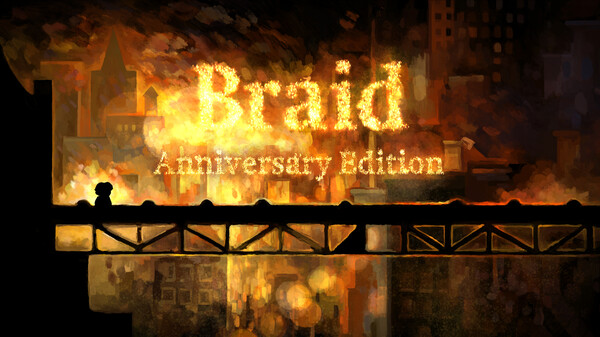 Braid, Anniversary Edition key art — Steam store
First Impressions
Line up the helpful positive reviews and the vocabulary falls into two directions. One is praise for the original — 'started the indie revolution,' 'one of the most important games ever,' 'it is art.' The other rates the remaster's craft: 'this is how you do a remaster,' 'switching between old and new graphics blows your mind.'
The negative side and the qualified positives keep to a cooler set: 'if you played the original there's almost nothing new here,' 'advertised as 40 new levels but the actual new puzzles number around a dozen-plus,' 'fifteen hours of commentary wears thin.' The recurring half-joke reviews thanking Soulja Boy for the original are a sight unique to this game.
What interests me, as with ChromaGun, is how the same element reads two ways. One reviewer's 'careful re-recording' of the commentary is another's 'a podcast cut and pasted in.' My job isn't to stage that as a fight, but to translate where the opinions fork into design terms.
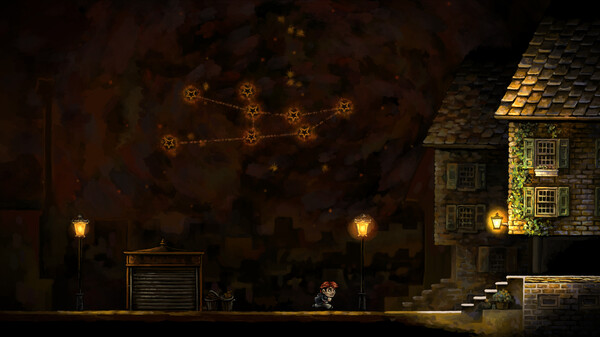 A 2D world steered by rewinding and time control — Steam store
Putting the Mechanics into Words
What the positive reviews praise almost unanimously is a design that draws a different grammar from a single verb — time — in each world. The base verb is 'rewind.' You can rewind out of death, so many reviews of the original write 'there is no death here.' From there, every new world swaps one rule: in one, certain objects defy the rewind; in another, time is tied to your movement; in another, your shadow replays your past actions. In Puzzlebyrinth terms, the verb is narrowed to 'rewind,' and the per-world grammar table becomes the object of thought.
When a reviewer writes that they 'respect not just thinking up each world's time gimmick but integrating it into clever puzzles,' that one-verb, many-grammars structure is what they mean. The curve rises not by adding inputs but by layering interpretation onto the same rewind. I read it as continuous with The Witness, where observation itself becomes the verb — the same Thekla/Blow hand.
Yet the same reviewers turn cold on the Anniversary Edition's new puzzles: 'the new ones aren't Blow's best,' 'more timing than puzzling.' That mirrors what I read in ChromaGun — a difficulty of a different kind grafted on late.
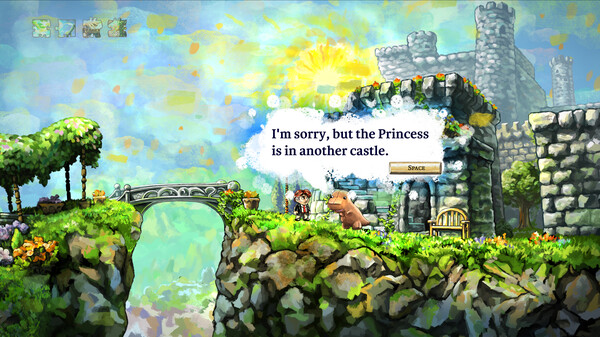 Each world swaps one rule of time — Steam store
The Feel of the Story
Reviews of Braid often stop talking about puzzles partway and turn to story. The recurring line in the long helpful reviews is the chill of the final stage, where the act of rewinding time lines up exactly with the meaning of the story. Rewind as redo as regret: system and story say the same thing. In one reviewer's words, it is 'a model of marrying narrative themes to game mechanics.' In Puzzlebyrinth terms, the verb itself tells the story.
But a second axis always surfaces: the maker, Jonathan Blow. 'The plot is deliberately vague and pretentious,' 'you could read it as what if Mario was an incel' — that irony shows up in praise and pans alike. One reviewer prefaces a 10/10 by insisting the work be judged apart from its author. The non-single reading of the story clearly amplifies the split.
To me what forks here is less the story's quality than a stance toward ambiguity: some take joining the unstated fragments yourself as richness, others as unfriendliness. That's the author's choice — a question of reach. On designing-with-story, Daniel Benmergui's Storyteller shows another answer; he himself left a warm review of this edition.
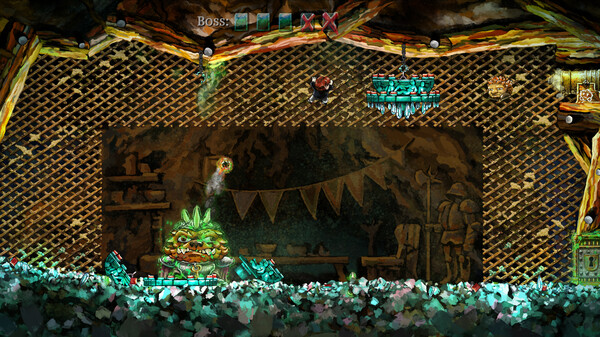 Rewind-as-regret folds the story into the system — Steam store
The Remaster as a Container
Opinion splits hardest over the value of what the Anniversary Edition adds. Sort the pool and three topics fall out: the repaint, the developer commentary, and the '40 new levels' tagline. On the repaint the reviews mostly agree — 'switch to the old graphics and you see how much memory had flattered it' — and grant it careful work.
The other two fork. On the 15-plus hours of commentary, the positive call it 'the most detailed commentary ever, worth buying for,' while the negative hear 'a podcast cut and pasted in' and note you must trigger the next clip every few minutes, so you can't listen in the background. And '40 new levels' turns out to be mostly a display of in-development iterations; the truly new puzzles number in the teens — the gap between the developer's framing and reviewers' experience recurs as 'it feels oversold.'
As lineage, this edition asks how to restage a classic. Where contemporaries like FEZ held their standing through ports and re-releases, Braid chose the heavy addition of 'showing its own workings.' The recent 72% isn't the original's shine fading; it's that buyers paying full price for 're-recording and commentary' and buyers grabbing 'the current version of a classic' on sale measure satisfaction differently. That the edition's weak sales were even reported reflects how hard the added layer is to price.
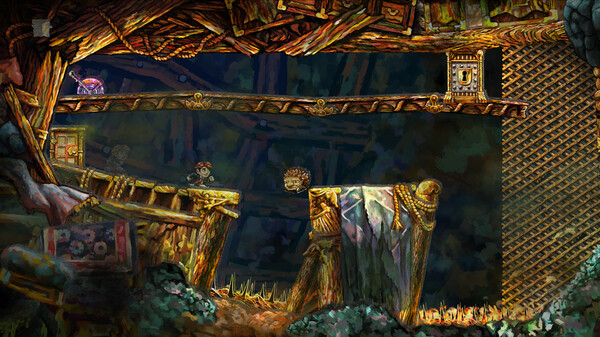 How do you restage a classic — the remaster's question — Steam store
Sources
This piece was written by reading the user reviews on the Steam store page as of 2026-06-20. No review text is quoted directly; typical claims are reconstructed.
- Steam: Braid, Anniversary Edition (Very Positive, 93% of 1,669; last 30 days Mostly Positive, 72% of 33)
- Read via WebFetch: the top Most Helpful (All Time) positives, representative negative complaints, and several recent reviews (developed and published by Thekla, Inc., reported release 2024-05-14)
- For background, general coverage of the edition's weak commercial performance (e.g. GameRant)
Closing
Steam reads 93% positive; my design-critique score is 8.5, and the two don't diverge much — but I'd split the parts. The original Braid's design — drawing a per-world grammar from the single verb of rewind, and carrying that verb all the way into story — is a classical achievement with little to dock. The marks come off the Anniversary container: the thinness of the new puzzles, and a heavy commentary layer that doesn't fit everyone's way of listening. The recent dip to 72% reads as a verdict on the container arriving late.
The pool's advice splits cleanly by stance. If you've never played the original, it's near-unanimous that 'this is the best way to experience Braid,' and I agree. If you've already solved it, 'on sale, for the commentary and re-recording' is the fair line. The classic's value doesn't waver; what wavers is where you find the meaning in buying it again, this time with the maker's voice attached. The split teaches us not about the game's quality but about the reach of remastering itself.
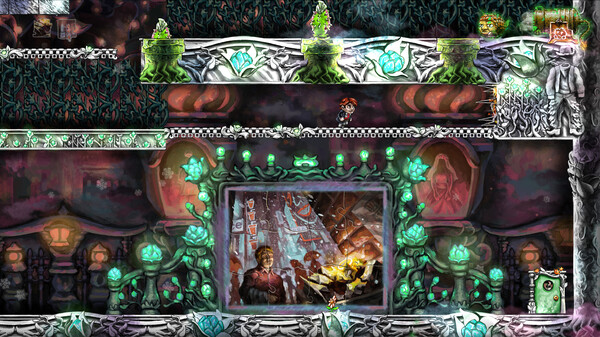 The rewind verb folds back, at last, into story — Steam store
Where are you with this game?
Press one and the game goes on your shelf. You can see it on your account page.
Reactions (no login)
Anonymous • one of each per visitor per day
Read next
Related reviews
Wilmot Works It Out
Un jeu de puzzle : on sort des pièces carrées d'un colis hebdomadaire, on assemble les images, puis on accroche les tableaux terminés aux murs de la maison. Chaque colis mélange des pièces de plusieurs images, il faut donc trier avant de construire. La suite de Wilmot's Warehouse, par Hollow Ponds et Richard Hogg.
Sokobond Express
A grid puzzle in which you draw one unbroken path for a single atom, bonding it to the atoms it passes until the target molecule is assembled — a minimalist crossbreed of Sokobond and Cosmic Express, published by Draknek & Friends.
LOK Digital
Un puzzle de mots-mêlés dans la langue inventée « LOK » : épelez ses mots sur une grille, noircissez les cases remplies et étendez le monde de petites créatures. Chaque mot a son propre effet et redessine les adjacences de la grille à mesure que vous le dépensez. Adapté d'un livre de puzzles physique par Letibus Design et Icedrop Games, édité par Draknek & Friends.


