REVIEW · 2023-03-24
Can of Wormholes
Ramper dans une grammaire cachee - un sokoban concu comme une machine a enseigner
Introduction
What I read here isn't a playthrough of mine but the Steam review pool for Can of Wormholes. Released in March 2023 by munted finger-reportedly their first commercial game-it's a grid-based sokoban about coaxing a worm into a target hole at the exact right shape and length. Push, grow, slice, ingest, flip: a short set of verbs draws out a bottomless well of interactions.
The verdict is startlingly one-way. Of 575 reviews, 569 are positive-99%, and 99% among the 548 Steam purchasers too-labelled 'Overwhelmingly Positive' (snapshot 2026-07-13). This isn't a game the crowd fights over. Yet inside that near-unanimous praise runs a fault line where acclaim and reservation land on one and the same design.
The most repeated proper noun in the pool isn't the developer or a genre: it's Stephen's Sausage Roll. 'The SSR shock, again'; 'the finest successor SSR ever got.' I want to test, in design terms, why an unknown maker's debut earns that shelf.
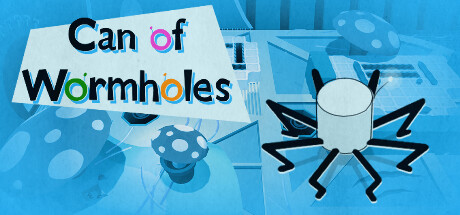 The tin-can protagonist and a worm crawling the board - Steam store
First Impressions
Line up the helpful positives and the vocabulary rhymes across languages: 'aha,' 'eureka,' the Chinese '啊哈'-words for the click of insight, repeated over and over, beside 'delightfully surprising' and 'the best puzzle game of the decade.' The shared claim: tiny elements yield staggering depth, and every level teaches exactly one new idea.
There are only six negatives in all, but they cut. One dismisses it as endless 'worm-bending'; another calls the tug-of-war shaping 'my least favourite puzzle type'; one admits giving up at 53%, too hard. And reservation isn't the negatives' monopoly-several glowing recommendations carry a caveat about the hint design I'll come to.
What's striking is how often praise and caveat point at the same feature. One reviewer's 'best ever' is another's 'robs you of the solve.' My job isn't to stage that as a fight but to translate where opinion forks into design terms.
 A level built from very few elements - Steam store
Putting the Mechanics into Words
What amazes the positives is how little there is. You move one worm-head forward a tile, tail pulled in a tile, Snake-style-plus eat-to-grow, reverse from the tail, and push other worms. The board holds walls, fences, floor, pits, a goal. Even the gravity of Snakebird is gone. In Puzzlebyrinth terms, the verbs are subtracted to a handful and the board is stripped bare.
But few verbs isn't simple rules. Reviewers describe 'a web of interactions hidden behind plain elements,' firing only when conditions fully align-so you never notice them until you do. Splicing their spoiler-free hints: the board looks 2D but elements hide '3D' properties, and the edge cases of ordinary moves carry effects of their own.
To me this doesn't add verbs; it gives each verb hidden inflections. The same 'push' yields wholly different results by position and facing. You learn not new actions but the hidden grammar of known ones-and the combinatorial blow-up is held down by compact grids and single-insight solutions.
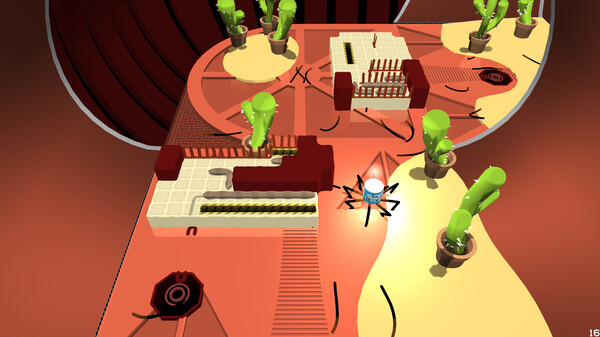 Stretching and shrinking the worm to fit a hole - Steam store
Teaching: Where the Curve Is Drawn
Almost every review names one feature: the 'Gain Insight' hint. Stuck, you're handed not a solution but a small separate level that isolates the puzzle's key mechanic to play. A Japanese review claims it 'shook' famous puzzle designers; English ones keep calling it 'the best hint system I've ever seen.' No words, learn by doing-'Show, don't tell' made real.
Yet the sharpest reservation gathers on that same feature. Because here 'the core mechanics ARE the puzzles,' one reviewer argues, a mini-level that shows the mechanic can spoil the whole thing. Some even quote the developer's stated intent-not wanting to dilute the solve for those who'd have seen it-and argue against it head-on. Best hint ever, or thief of the solve: opinion forks right here.
I read this as a question of where the learning curve is drawn, not of hint quality. The game's real object is discovering mechanics, so the mini-level is a construction line that eases the slope. A lifeline for those who can't grip it; a spoiler handed over just below the summit for those who could. The same line, poison or cure by your observation resolution.
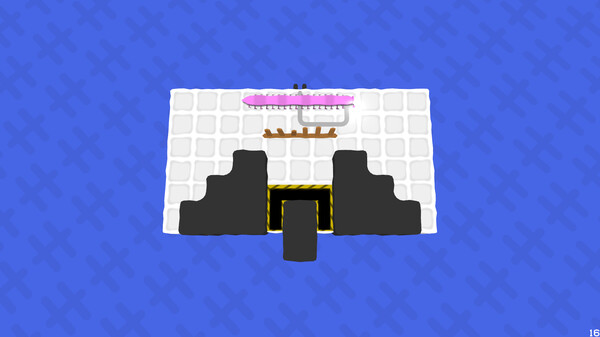 A small hint level isolating one key mechanic - Steam store
The Texture of Difficulty
Verdicts on difficulty split in two: 'fair, with a friendly curve' beside 'a single level took 30 minutes and I broke at 53%.' Read closely and they don't contradict-the kind of stuck differs. The individual levels are guarded by that construction line. One place isn't: the overworld that links levels, the meta-space for selecting them.
Several reviews stall exactly there. 'The puzzles are peak, but the meta-navigation to the next room is unexplained, awkward, and the wonderful hint doesn't reach it.' Firing rings from the can to send a worm into a level gets called 'a needlessly finicky gimmick.' Step-limited overworld puzzles feel less elegant than the main game-and that grumble recurs inside the positive long-reads.
So the difficulty is a matter of distribution, not amount: a main game where the teaching reaches everywhere, and an overworld where it's deliberately withheld. The maker likely meant the latter as a higher puzzle-hide the map, make you find it-but the pool reports that step reads as cut off from the main curve.
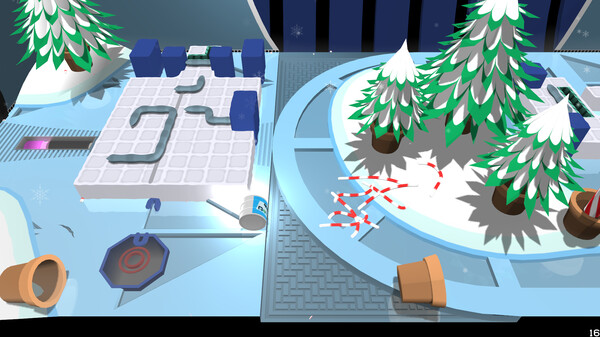 The overworld meta-space that links levels - Steam store
Sources
This piece was written by reading the Steam store's user reviews as of 2026-07-13. No review text is quoted directly; typical claims are reconstructed.
- Steam: Can of Wormholes (Overwhelmingly Positive; 569 of 575 positive = 99%, and 99% among 548 purchasers)
- Read via Steam's API: the top 20 helpful positives, all 6 existing negatives, and the top 10 recent-across English, Chinese, Japanese and Russian.
- Context: Thinky Games' overview (lists a 2024 Thinky Awards Game of the Year win) and LadiesGamers' review.
Closing
Steam reads 99% positive; my design-critique score is 9.0, and the two barely diverge. Hidden grammar under a few verbs, one discovery per level, and a learning curve propped up by a 'learn-by-doing' construction line-remarkable for a debut. A reviewer called it 'Baba Is You without the mess,' and the restraint of elements plus the care of teaching earns that.
The 1.0 I hold back points almost entirely at the overworld, where the finished teaching of the main game is switched off and the one patch of unfairness lives. Reviews put completion around 18-20 hours, ~18 even for 100%. Whether $20 feels steep depends on how you weigh that density. For anyone happy to sit and think, and to lean on the construction line when stuck, it's among the finest thinky puzzlers of the decade.
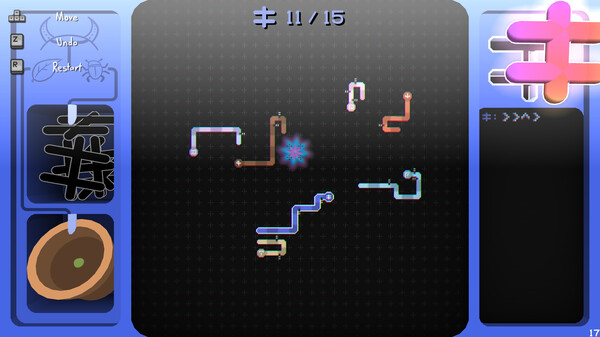 The colourful overworld and the tin-can protagonist - Steam store
Where are you with this game?
Press one and the game goes on your shelf. You can see it on your account page.
Reactions (no login)
Anonymous • one of each per visitor per day
Read next
Related reviews
Paquerette Down the Bunburrows
Un jeu de réflexion en 2D où l'on descend dans un terrier pour acculer des lapins en fuite. Les lapins fuient selon des règles fixes : on bouche donc leurs issues à l'avance avec des pièges, une pioche et des carottes. Cinq niveaux souterrains thématiques, plus de cent lapins et des secrets enfouis plus bas, signés Bunstack.
Void Stranger
Ramasser une dalle avec un bâton, la poser ailleurs — ce seul geste permet d'éviter pièges et ennemis pour descendre dans un labyrinthe souterrain oublié. Un Sokoban 2D de System Erasure où un verbe minuscule déploie des mécanismes insondables et une histoire cachée.
Bilkins' Folly
A pixel-art puzzle adventure in which you and your dog roam islands, match treasure maps to the landscape, solve riddles and dig up the loot. Developed by Webbysoft, published by Armor Games Studios.


