REVIEW · 2019-04-05
Supraland
Un bac à sable sans carte, et comment 95 % d'avis positifs le lisent
Introduction
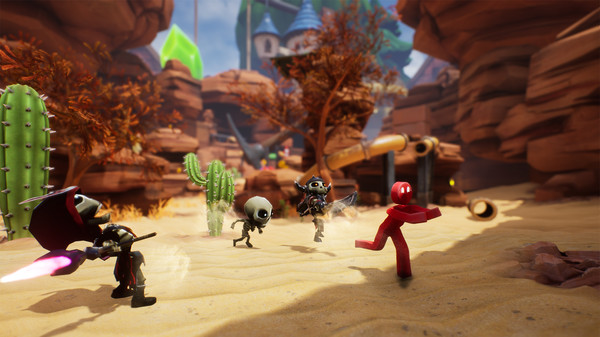
You walk a sandbox — a literal one, the size of a child's sandpit — in first person, past broken pencils and erasers that loom like cliffs. You pick up abilities one at a time to open paths that were closed, then walk back to everything you had to leave behind. Made by David Münnich of Germany under the Supra Games name and self-published on April 5, 2019. The store blurb calls itself a mix of Portal, Zelda and Metroid.
I write this from the Steam review pool rather than a play diary. Across all review types: 15,207 reviews, 14,482 positive and 725 negative — 95%, labelled Overwhelmingly Positive. English alone accounts for 4,886, and the last 30 days hold at 95% of 142 (snapshot 2026-08-05). Metacritic sits at 85. On paper there is nothing to argue about.
Then you read the text. The developer's own short blurb includes the words "terrible combat," and the helpful positives and the negatives repeatedly point at the very same design decisions to reach opposite verdicts. That 95% does not mean the pool agrees; it means the disagreement has been sorted neatly into two camps. What follows is an attempt to translate that sorting into design terms.
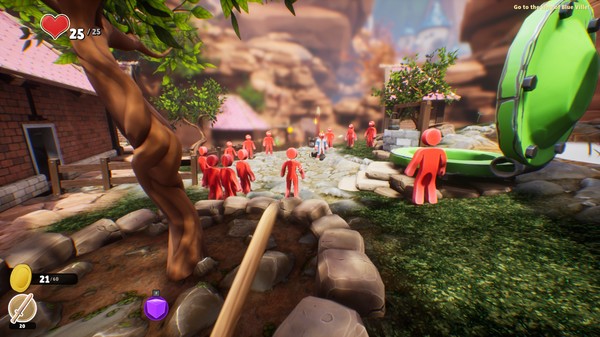 Supraland — Steam store key art
First Impressions
Line up the helpful positives and the vocabulary rhymes: clever, "level design is spot on," "every ability has a purpose," "it just flows," "hidden gem." One more phrase recurs — secret-ception: secrets inside secrets inside secrets. What they praise is neither story nor looks; almost without exception, it is placement.
The negative vocabulary is just as consistent: too sandbox-y, "walking around aimlessly," no map, vague, tedious, moon logic, and "combat feels tacked on." The developer's own "terrible combat" line gets picked up dutifully by the critical side as a deduction.
What interests me is the overlap. The scarcity of signposting is read by one camp as "the game assumes you're intelligent" and by the other as "unfair." My job is not to grow that into a fight, but to work out what this game deliberately removed — especially next to a work like Portal, where guidance is engineered room by room.
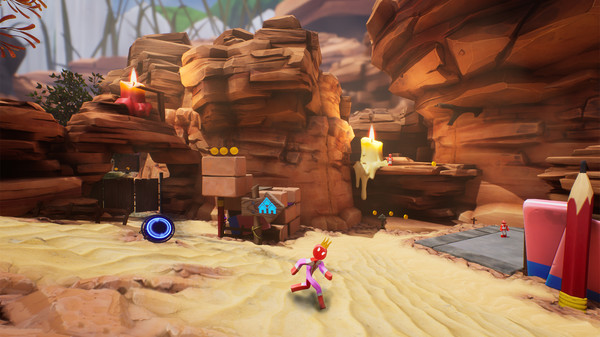 Supraland — Steam store key art
Putting the Mechanics into Words
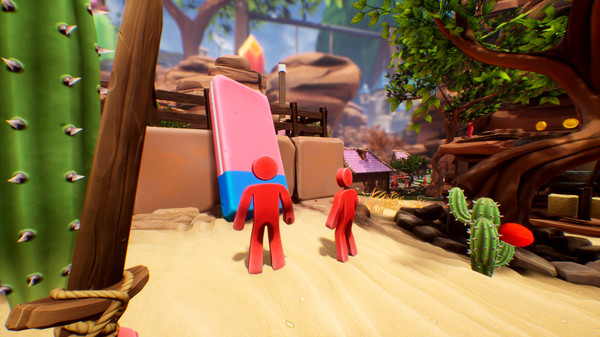
The praise the positives repeat most is that no ability is wasted. The developer says as much in the store text: the abilities were built to be so versatile they keep surprising you. In Puzzlebyrinth terms this is not subtraction of verbs but multiplication of their meanings — instead of shrinking the verb list, it grows the number of contexts a verb can be placed in, and lets the combinatorics explode from there.
The evidence that it works shows up as an odd boast in the reviews: "if you're stubborn enough you can solve things in ways the developer never intended," "I'm fairly sure I bypassed a few puzzles through determination and questionable engineering." Because the verbs stay open to terrain and physics, the designer's line is not the only correct one. What a single-answer puzzle would treat as a fault is reported here as an achievement.
The same openness runs backwards on the critical side: "things look solvable, and hours later you realise they needed a tool you don't have yet," "a key part of a lot of puzzles was running around the area until you notice the one bit you were missing." Nothing on the board tells you whether a puzzle is solvable with your current hand, so exploration often comes up empty. Multivalent verbs widen the space of solutions and, in the same motion, hand the player the cost of judging solvability. That transfer is exactly where the pool divides.
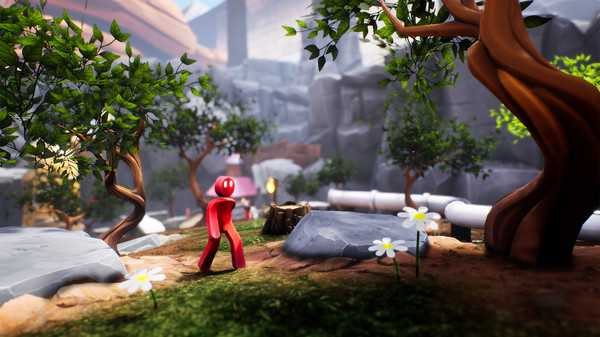 Supraland — official Steam store page image
Design Craft
What this game removed is easy to name. No map. No compass. No objective marker, no progress screen. The store text says the game "assumes that you are intelligent and lets you play independently" and that, despite child-friendly visuals, it targets experienced players. A December 2019 developer post goes further, listing the intent as: very subtle hints; not making it 100% clear which elements are part of the puzzle; very little guidance, with the game not telling you what to solve. What has been subtracted is not the verb set but the layer of guidance itself.
What that buys is the same currency TUNIC trades in: observation resolution. Because nothing points, every oddity at the edge of the frame becomes the player's asset. What it costs is equally plain. With no guidance UI, progress lives in the player's head rather than on screen. The recurring complaint — "the game is not friendly if you take breaks, there are no refreshers," "no map and no status screen, so there's no way to know what is missing in a given section" — is the direct invoice for refusing to externalise memory.
There is one more unusual authorial move here. The developer wrote "terrible combat" into his own blurb, published his puzzle-design philosophy as a post, and replied under his own name to critical reviews. Because of that, the argument around this game is about values rather than defects. One negative reviewer added an edit: having read the philosophy, he understood it, and still never reached the lightbulb moment — leaving only "look it up" or "give up." I read that not as a rebuttal but as a clean record of a design's reach being made visible.
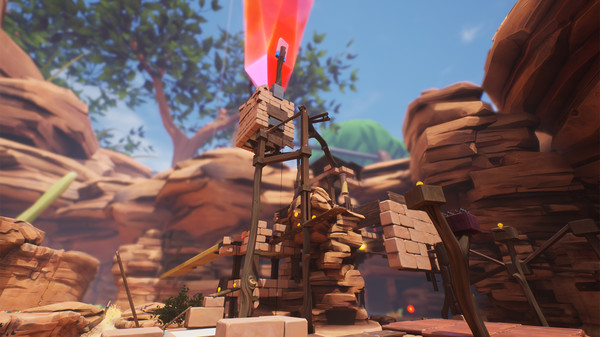 Supraland — official Steam store page image
The Texture of Difficulty
Difficulty is where the pool scatters most. "Not overly challenging, but not boring either — a fantastic casual game to relax with" sits inside the same 95% as "difficult puzzles act like brick walls every few minutes and halt your progress entirely." Collect the places where reviewers say they stalled and the difficulty separates into three different textures.
The first is insight difficulty: repurposing an ability you already hold for a use you never considered. Nearly everyone praises this one. The positives even have a stock formula for it — "1. I'm too stupid to do this. 2. Go to sleep. 3. It was that simple, how did I not think of it earlier." The second is observation-resolution difficulty: whether you can notice the one element you never registered as part of the puzzle. The third is friction: crossing the same terrain again and again, or pouring time into something that cannot be solved yet.
The verdict is decided almost entirely by that third texture, and the positives are not untouched by it. "Most puzzles are clever and well designed, but a handful completely defeated me; I eventually looked up the solution, only to discover there was no chance I was ever going to figure it out" — that sentence sits inside a recommendation. Most reviewers, in other words, rate the insight highly and then decide, last, how much friction they are willing to absorb. I label the difficulty hard, with the note that the felt texture differs wildly from player to player.
 Supraland — official Steam store page image
Sources
This piece was written by reading the user reviews on the Steam store and community pages as of 2026-08-05. No review text is quoted directly; typical claims are reconstructed.
- Steam: Supraland (14,482 of 15,207 reviews positive = 95%, labelled Overwhelmingly Positive; English 4,886 at 95%; last 30 days 142 at 95%)
- Read via WebFetch: the top ~10 helpful positive reviews, roughly 20 negative reviews across the helpful and recent sorts, and several recent recommendations
- Developer statement: Supraland, "Which puzzles were unfair?" (2019-12-11, the developer's post on puzzle-design intent)
- Reference data: SteamDB: Supraland (Metacritic 85, supported platforms, price history)
Closing
Steam reads 95% positive; my design-critique score is 8.2. Here is the gap. The way abilities are made multivalent, and the tolerance that lets players stray outside the intended line, are remarkably mature for a project this size. That I rate highly. The deduction is that having removed the entire guidance layer, the game absorbs almost none of the resulting friction itself. One map, or one signal saying "your current hand cannot open this area yet," would have shaved the friction without dulling the insight.
Who it is for, the pool has already answered. Anyone who wants to find the handhold themselves, who enjoys suspecting the space outside the puzzle, who liked the secret density of ANIMAL WELL — strongly recommended. Anyone who needs a destination marked, or who plays in short scattered sessions — less so. Reviewers report roughly 10-25 hours; the store claims 12-25; one reviewer finished with 12:20 on the in-game clock. That a demo exists is less a kindness than an honest piece of design: you can check from outside whether you fall inside its reach.
 Supraland — official Steam store page image
Where are you with this game?
Press one and the game goes on your shelf. You can see it on your account page.
Reactions (no login)
Anonymous • one of each per visitor per day
Read next

Related reviews
The 7th Guest: 25th Anniversary Edition
Une aventure-puzzle à la première personne où six invités arrivent dans un manoir désert et doivent résoudre vingt-et-un dispositifs, un par pièce. C'est la réédition MojoTouch de 2019 du jeu fondateur de Trilobyte sorti en 1993, qui montrait à l'époque tout ce qu'un CD-ROM pouvait contenir, avec ses acteurs filmés et ses décors pré-rendus.
La-Mulana 2
Un jeu d'action-puzzle d'exploration en 2D où l'on descend dans les ruines antiques d'Eg-Lana armé d'un seul fouet et de tablettes de pierre. On copie les inscriptions gravées sur les murs pour les relier à des mécanismes situés dans des salles lointaines. La suite de La-Mulana par NIGORO.
MOLEK-SYNTEZ
Dans un appartement exigu de la Roumanie de 2092, on programme un synthétiseur artisanal pour assembler, à partir de benzène et d'acétone, de petites molécules pharmacologiques. Un puzzle d'optimisation signé Zachtronics, où l'on ne peut agir que depuis le pourtour d'un plateau fini.


